
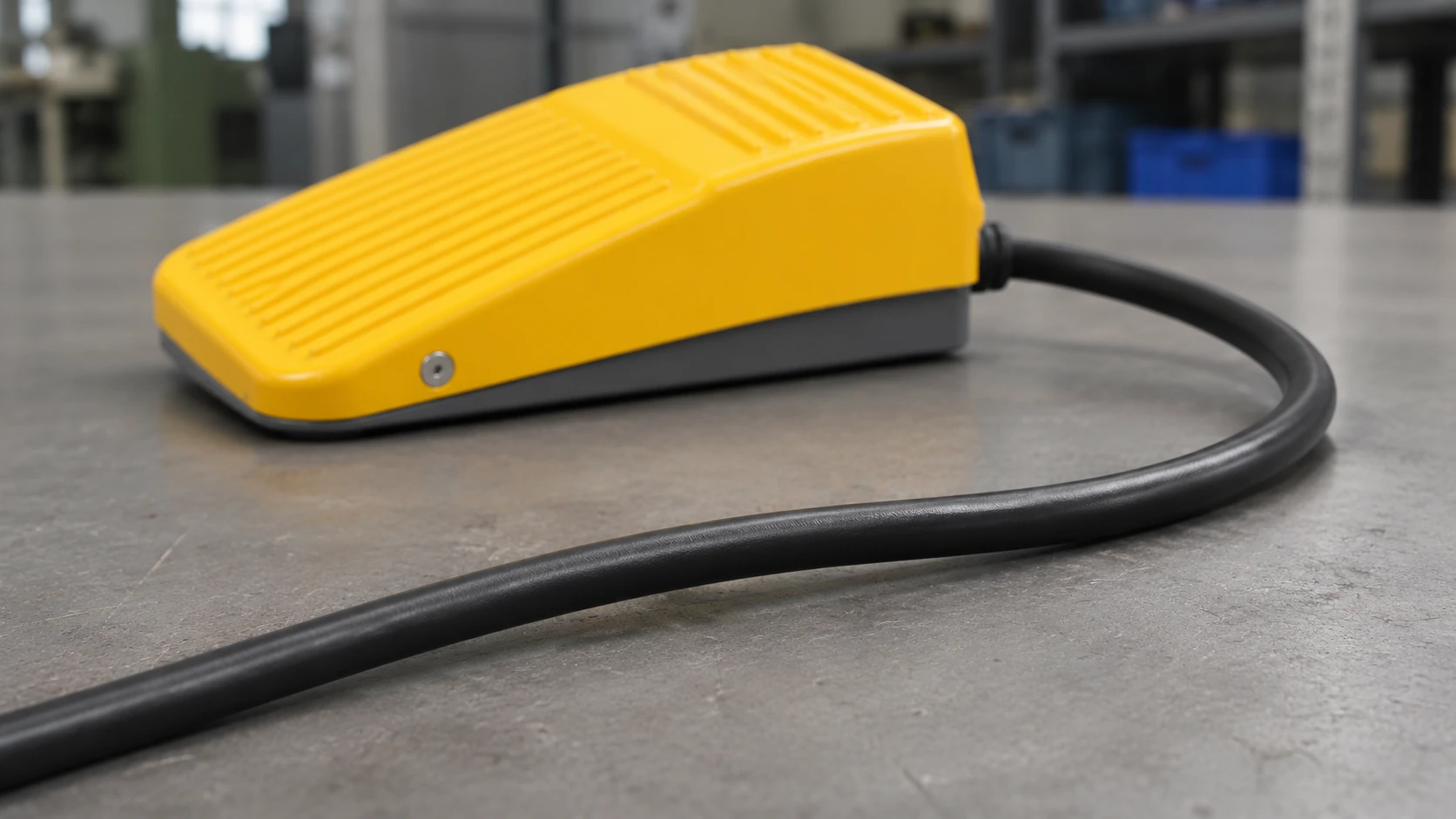
Foot switch cable jacket ovality measurement compares outside dimensions in different directions at a defined cable section. Begin by confirming whether the ordered cable is intended to be round, flat or another specified shape. Use a method that does not appreciably compress the jacket, preserve the measurement orientation, and compare results with the approved cable specification. A visibly oval section is an observation, not an automatic rejection. This guide uses the Lemaele LF foot switch as the product reference and explains how OEM buyers can request useful dimensional evidence without inventing a cable diameter, polymer identity or universal ovality limit.
Confirm the cable configuration on the order
El interruptor de pedal de la serie LF page shows the relevant product family and cable-equipped configurations. The actual supplied cable must still be identified from the order and drawing. Do not assume that every LF version has the same cable construction or that a visible black jacket identifies a particular polymer.
Ask for the cable designation, intended cross-sectional shape and outside-dimension requirements. Include any relevant assembly drawing that identifies the cable entry or restraint. An outside shape that is normal for one construction may be unexpected for another. Begin the inspection only after the parties agree which characteristic is being evaluated and which document controls acceptance.
Distinguish ovality from other cable characteristics
Outside ovality concerns directional variation in the external envelope of a cable section. Jacket wall thickness concerns the material between the inner and outer boundaries. Conductor size, strand count and conductor position answer different questions. Do not infer these internal characteristics from an outside-diameter reading, even when the outer shape appears regular.
The existing jacket thickness evidence guide addresses the separate wall-thickness question. For ovality, retain the larger and smaller measured outside dimensions and their directions instead of recording only one average. An average alone can hide a directional difference that matters to a mating interface.
| Evidence item | Qué verificar | Decision supported |
|---|---|---|
| Cable identity | Ordered designation and intended shape | Avoids comparing unlike constructions |
| Location | Section identifier and distance description | Connects both readings to one section |
| Condición | Packaging, restraint and conditioning history | Explains possible handling influence |
| Método | Instrument, force control and orientation | Supports a comparable result |
| Requisitos | Outside-size limit and any ovality definition | Provides a valid acceptance basis |
Agree the method before comparing results
El alcance público de IEC 60811-203:2012 identifies methods for measuring overall cable dimensions, including circular and flat cables. It does not establish the acceptance limit for an unspecified LF cable. Confirm the applicable cable standard, edition and approved method with the supplier or laboratory before treating a result as a conformity decision.
For an initial purchasing discussion, ask how the laboratory controls support, orientation and measuring force. A contact tool can deform a compliant jacket; an optical method requires a clear profile and suitable alignment. Neither approach should be chosen solely because it is available on the receiving bench. The method needs to resolve the actual requirement with an appropriate level of confidence.
Preserve the as-received cable condition
Inspect an isolated, disconnected sample. Record whether the cable arrived coiled, tied, pinched in packaging or already fitted through a restraint. Photograph the overall assembly and the section being measured. Temporary deformation from handling can complicate interpretation, so report the condition rather than assuming that every visible shape came directly from extrusion.
Do not heat, stretch or massage the cable to make it look round. If the approved procedure specifies conditioning or relaxation, record the required conditions and when measurements were taken. Retain the original observation as well. A comparison between a freshly unpacked cable and a conditioned laboratory sample is difficult to interpret unless both states are documented.
Define location and direction clearly
Identify measurement locations without damaging the jacket. Use a written location description or a photograph with a separate identifier. Avoid placing adhesive, clamps or a tight tie on the actual measurement section. If several positions are examined, keep each pair of readings linked to its own location rather than mixing the maximum from one section with the minimum from another.
For a round-cable investigation, describe the measurement directions and the procedure used to find the relevant outside dimensions. Do not assume that two convenient readings capture the most oval orientation. The laboratory should follow the selected method, including its sampling and directional rules, rather than adapting a formula from an unrelated cable family.
Control contact influence and repeatability
The NPL callipers and micrometers measurement guide provides general practice for dimensional instruments. It is useful background for handling and measurement influence, but it supplies no LF cable specification. Ask the laboratory to document the instrument and setup used for the jacket under evaluation.
Keep a contact instrument square to the section according to the selected procedure, and avoid pulling the cable taut merely to hold it in place. If successive readings change with operator handling, investigate the setup before reporting a precise ovality result. Preserve repeat readings with the reason for each repeat; selecting only the closest pair can conceal a method problem.
Report the dimensions before a calculated percentage
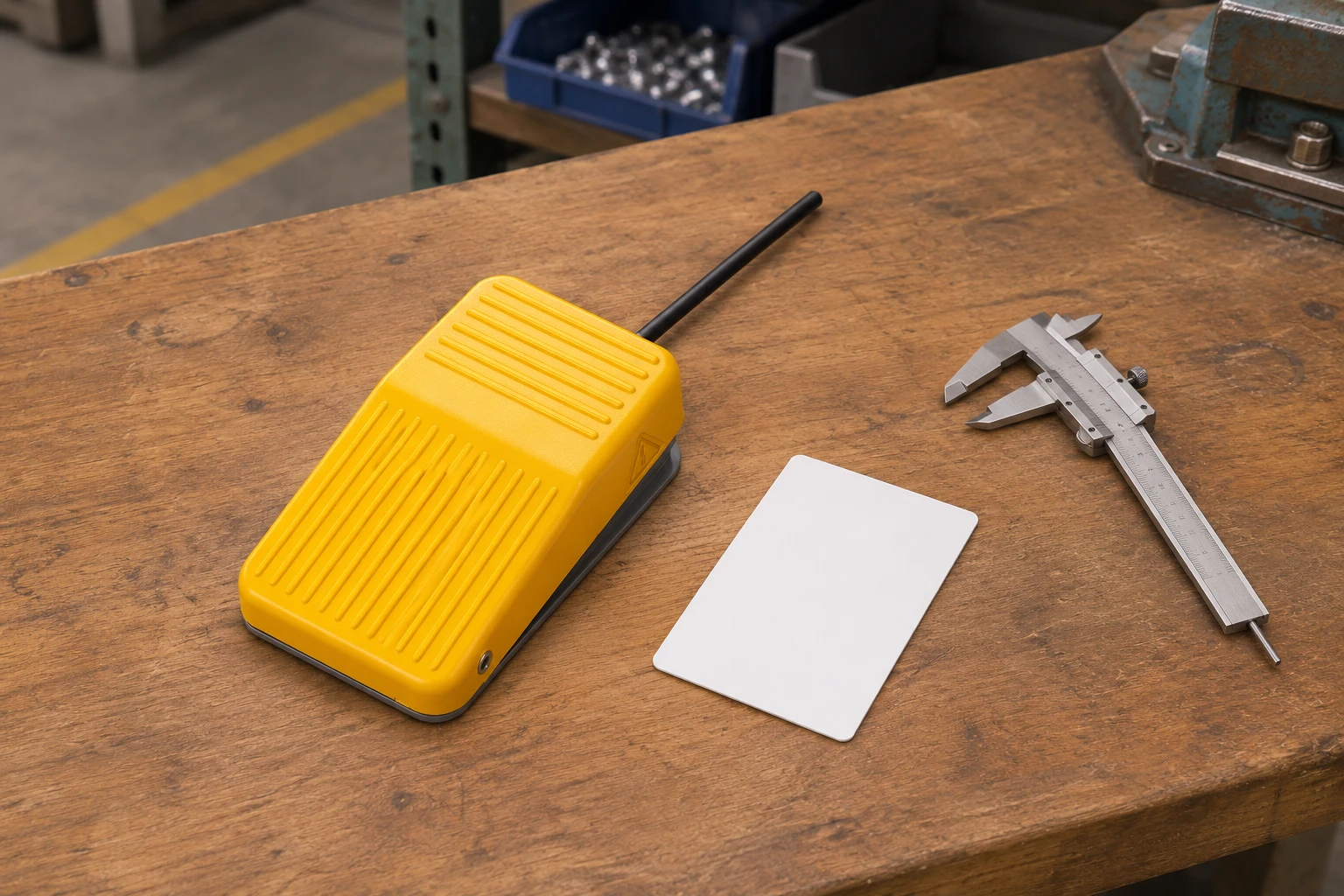
A useful report first shows the measured outside dimensions, their units, section identity and orientation. It then identifies any calculation explicitly required by the specification. Different purchasing documents may define out-of-roundness using different denominators or reporting conventions. A percentage with no stated definition cannot be reliably compared with another supplier report.
This guide deliberately assigns no universal formula or maximum percentage to the LF cable. Request the definition used by the controlling specification, and have the laboratory state its inputs and rounding convention. If the purchase document contains only an outside-size range, ask whether a separate ovality requirement is actually necessary for the intended assembly.
Connect cable shape to the intended interface
An OEM may investigate ovality because of an entry seal, restraint, routing feature or enclosure opening. Document that interface separately. Outside dimensions alone do not establish sealing, cable retention or electrical safety. A cable that fits through a hole may still require further checks under the equipment design and approved assembly procedure.
El cable strain-relief guide covers the different restraint function. The industrial cord-routing guide addresses how the cable is arranged around the equipment. Use dimensional evidence alongside those records without treating one successful check as proof of the entire installation.
Handle a discrepancy with comparable evidence
When two reports disagree, first compare the cable identity, section location, sample condition and method. A sample measured close to a compressed entry region is different from one measured on a free section. A flat-cable major dimension should not be presented as the diameter of an intended round cable. Resolve those distinctions before arguing about the last reported digit.
Provide the supplier with the raw readings, photographs and relevant drawing requirement. Ask whether the observed condition is representative of the shipment and what investigation is appropriate. Do not trim, strip or replace the cable as an incoming-inspection correction without authorization. Preserve suspect assemblies and keep their lot identity intact while disposition is agreed.
Write a cable evidence request that can be answered
For sample approval, request the exact cable configuration, outside-dimension requirement, method and report format. State the equipment interface that makes the characteristic important. Ask the supplier to identify any restrictions on measuring the assembled cable, including sections affected by the entry or packaging. The request should describe the engineering question rather than demand an unsupported numerical limit.
For routine receiving, use the agreed sampling plan and current revision. Record acceptance, hold or clarification against the specified requirement. If no controlling ovality requirement exists, an unusual appearance can justify an engineering review, but it should not be converted into a fabricated nonconformance. Keep that distinction clear in the final inspection record. Include the person responsible for reviewing an unresolved result and identify the additional evidence needed to close it. A hold should have a clear reason and a traceable sample rather than becoming an indefinite label attached to an entire product family. When the supplier supplies a replacement report, check that its specimen identifiers match the original inquiry. Retain superseded records with their status clearly marked so that later buyers do not accidentally apply a discarded measurement method or an obsolete cable configuration to a new order. This documentation also makes recurring receiving checks easier to compare.
Formación continua
The IIT KANPUR-NPTEL instrument demonstration provides general background on dimensional measurement. It does not establish a cable ovality method, an LF cable material or a product acceptance limit.

Preguntas frecuentes
¿Una chaqueta negra prueba que el cable es de PVC?
No. El color y la apariencia no establecen la identidad del polímero. Obtenga la especificación del material del cable para la configuración realmente ordenada.
Can I use jacket ovality to calculate wall thickness?
No. Outside shape alone does not reveal the inner boundary. Wall thickness requires separate evidence and an appropriate method.
What ovality percentage is acceptable for LF cables?
This guide establishes no universal limit. Use the controlling cable specification and agreed measurement definition for the selected assembly.
Does a cable fitting the entry prove that it is acceptable?
Fit is only one observation. Retention, sealing, routing and electrical requirements need their own applicable checks and approvals.