
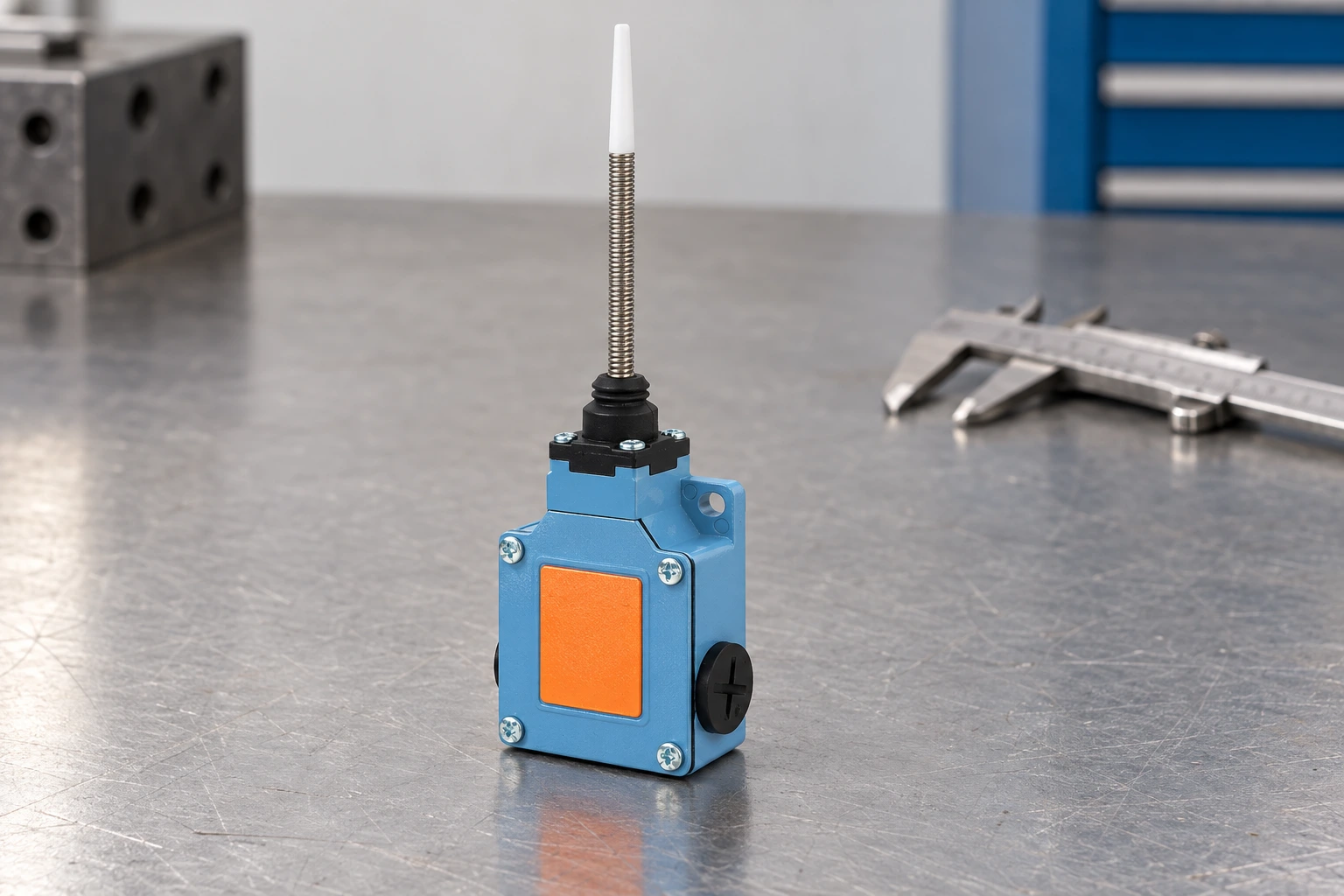
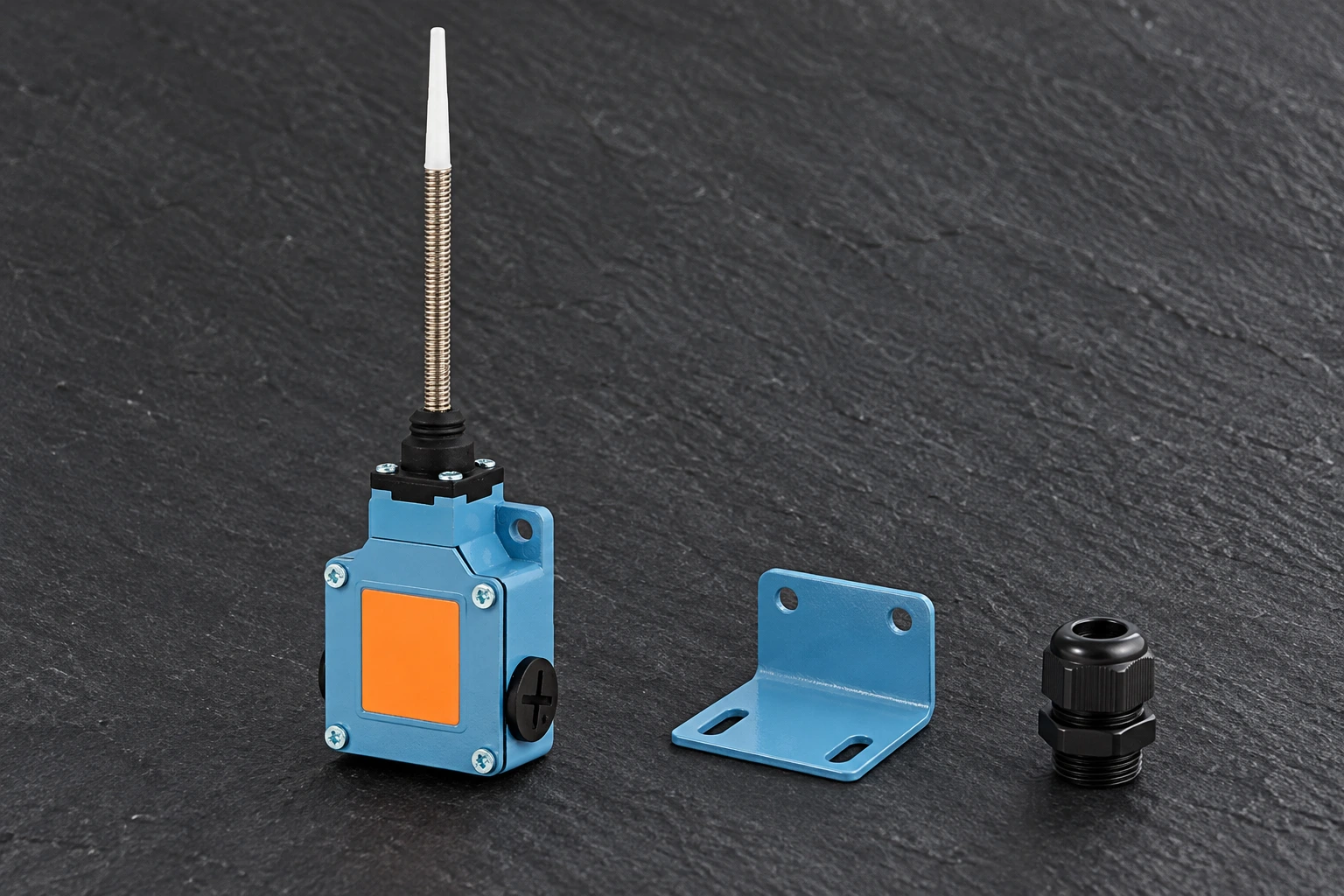
Choosing a metal vs plastic limit switch requires comparing the complete switch against its installation, not declaring one material universally superior. Housing material affects the engineering questions you ask about mechanical loading, conductivity, chemical exposure and assembly. It does not by itself prove an ingress rating, a temperature limit, a safety function or a longer service life. Start with the exact material and model, then request evidence for the conditions your machine creates. This guide compares enclosure-selection decisions for mechanical position switches. The illustrations show a real LEMA metal-body product reference; they do not depict or claim a verified plastic-body equivalent.
Compare complete products with the same job
A housing is only one part of a limit switch. The actuator transfers target movement, the contact assembly supplies the required electrical state, and the entries and cover form part of the installed enclosure. Two products with different housings may also differ in contact duty, mounting dimensions or actuator travel. A comparison that attributes every difference to metal or plastic can lead to an incompatible substitution.
Define the position-detection job first: target approach, movement, repeatability requirement, electrical interface and installation environment. Then compare candidate models against those requirements. Keep the same acceptance criteria for both candidates. If one product has documented evidence and the other has only a general description, record the evidence gap rather than estimating its performance from appearance or price.
RealPars’ limit switch anatomy and operation lesson helps separate the actuator, enclosure and contact mechanism. The LEMA limit switch application guide provides the broader position-detection context. Use those principles to set up a comparison, then rely on order-code-specific drawings and test information for actual product approval.
Name the metal or polymer rather than its colour
Metal is not a single material specification. An aluminium-alloy enclosure, a steel enclosure and a stainless-steel enclosure require different evidence for corrosion, surface condition and fabrication. A blue painted body cannot identify its alloy, coating system or chemical resistance by itself. Request the manufacturer’s declared material and surface treatment for the actual order code, and verify any application claim independently.
Plastic is similarly a broad category. The polymer grade, reinforcement, additives, moulded geometry and manufacturing process can matter to its behavior. Do not describe an unidentified housing as immune to chemicals or suitable for sunlight merely because it is nonmetallic. A product-specific declaration is needed for the exposures you plan to use. Keep unavailable information marked as unknown; substituting a generic polymer datasheet may misrepresent the finished component.
A generic material description is not a conductivity or protective-bond rating for a painted limit-switch assembly. The relevant engineering question is how the exact enclosure participates in the equipment’s electrical protection and installation, rather than whether a generic material conducts in a classroom example.
Evaluate mechanical loads and mounting as an assembly
Review impacts, vibration, mounting support and forces introduced by the target or cable. The body material, wall geometry, mounting ears, cover and fasteners work together. Do not infer impact resistance from a metal shell’s appearance or reject a polymer product without its test data. A switch should not act as the mechanical travel stop unless its specific approved design permits that function; select a separate stopping arrangement where the machine requires one.
For the mounting comparison, inspect the drawing, hole pattern, supported surfaces and specified fastener conditions. A replacement body with different ears can require a new bracket, altering actuator position and approach. Excessive tightening can damage an enclosure or distort a cover. Use the manufacturer’s installation method and verify the final geometry rather than applying the same torque to unrelated products.
El LEMA LZ1 product page identifies the metal-body reference in these illustrations. Its family description does not establish the performance of every installation or justify a plastic counterpart with assumed equivalent specifications. Review the mounting and repeatability process before changing enclosure size or bracket geometry.
Material comparison evidence checklist
Use this qualitative table to decide which documents and checks a candidate needs. It intentionally avoids blanket scores such as metal is always stronger or plastic is always corrosion-proof. The acceptance decision belongs to the complete model and its documented operating conditions. A missing record is an open engineering question, not evidence of either success or failure.
| Decision area | Evidence for either material | Assumption to avoid |
|---|---|---|
| Material identity | Exact alloy/coating or polymer-grade declaration | Colour identifies the material |
| Mounting and loading | Drawing, assembly instructions and relevant tests | A metal shell proves all impact performance |
| Medio ambiente | Model-specific exposure and ingress information | Plastic means universal chemical resistance |
| Electrical protection | Approved complete equipment protection design | Nonmetallic body automatically means double insulation |
| Service life | Application validation and inspection records | Body material supplies a universal life estimate |
This is a qualitative engineering review checklist, not a product rating or certification table.
Separate chemical resistance from ingress protection
Water or dust entry and material deterioration are different failure paths. An enclosure may resist one exposure while its seal, entry or coating does not. Ask which chemical, concentration, temperature and contact duration the supporting evidence covers. Cleaning chemistry can differ substantially from the process fluid normally nearby. Neither a metal-body label nor a polymer-body label establishes compatibility with all those conditions.
Similarly, an ingress rating must apply to the actual assembled configuration and verified conditions. Cover seating, entry hardware and mounting orientation can affect the installation. Do not transfer a rating from one family variant to another or convert a water-protection description into a washdown claim. Where the equipment is cleaned under pressure or exposed to immersion, obtain the specific evidence required for that condition rather than extrapolating from a catalog image.
As a United States workplace reference, OSHA 1910.303 addresses equipment condition and suitability for environmental exposure. The practical selection task is to identify the actual agents and temperatures at the installation, then confirm that the chosen equipment is suitable. It is not enough to pick a material that sounds durable while leaving the seals or entries unreviewed.
Review electrical protection and cable entries
Where an exposed conductive enclosure requires bonding under the approved equipment design, verify the complete protective arrangement. Do not assume that paint-covered mounting hardware supplies a required bond. Equally, a nonmetallic enclosure does not automatically establish double insulation or remove every electrical protection requirement. The internal circuit, accessible parts and complete equipment design must be considered together by the responsible designer.
Compare entry hardware and terminal access with the installation process. A suitable enclosure can be compromised by an incompatible gland, damaged seal or unsupported cable. Verify permitted cable diameter, retention, assembly method and service access for the exact model. Changing the body while retaining old entry hardware can introduce a mismatch even when the electrical contact function remains unchanged.
Inspect the finished assembly against its approved documentation. The material comparison should not hide a change in contact duty or terminal system. For those separate questions, use the AC and DC contact-rating guide. A conductive body does not determine the contact’s switching rating, and a polymer body does not establish suitability for a higher voltage or a particular safety circuit.
Consider temperature, outdoor exposure and maintenance
Use the product’s declared operating range and any relevant exposure evidence; do not calculate a finished switch temperature rating from the material’s melting point. The contact system, spring, insulation, seals and lubricant may have their own limits. Heat sources, enclosure location and process cycles should be included in the application description sent to the supplier. A comparison based on room-temperature appearance cannot settle those questions.
For outdoor installations, obtain the model’s documented suitability for sunlight, moisture and the relevant environmental conditions. Polymer formulation and a metal coating’s condition are among the questions to resolve, but neither alone predicts the assembled product’s service life. Avoid assigning a universal number of years. Record the verification evidence and plan inspections based on site conditions, equipment requirements and observed deterioration.
Service access also matters. Compare whether the approved procedure allows contact access, entry replacement or complete assembly substitution. A low purchase price can be offset by a difficult maintenance process, while an apparently more robust body may still be poorly matched to the available space. Evaluate those practical differences using the machine’s real downtime, access and spare-parts requirements rather than invented cost savings.
Make the purchase decision traceable
Create a candidate comparison containing exact order codes, declared enclosure materials, contact function, actuator data, mounting, entries and required exposure evidence. Separate verified facts from requests still awaiting a response. Ask the supplier to identify deviations explicitly, including any different material grade or mounting configuration. Do not use a generic family claim to approve a variant whose drawing or test information remains unavailable.
At sample approval, check physical fit and complete the relevant functional and environmental verification defined by the equipment project. Record the accepted configuration and prohibit undocumented substitutions. The best choice is the candidate that satisfies the complete evidence-based requirements with a maintainable installation. If both satisfy them, procurement and service considerations can decide between them; if neither does, hold the selection instead of treating metal or plastic as a shortcut to approval.
Further learning
RealPars explains switch anatomy and the relationship between the actuator and contact system. This supports comparing complete assemblies; the video is not evidence that either enclosure material meets a specific installation rating.
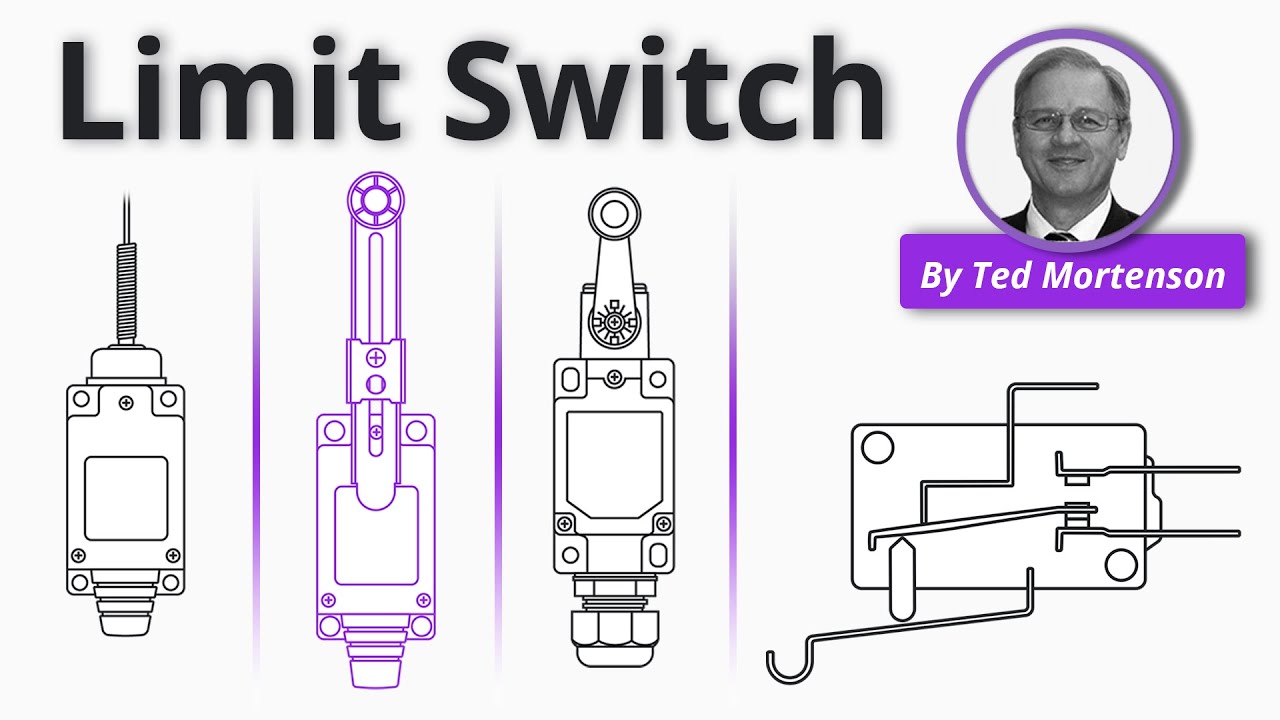
Watch Limit Switch Explained | Working Principles
Preguntas frecuentes
Is a metal limit switch always better than a plastic one?
No. Compare the complete models against the same target motion, mounting, electrical interface and environmental requirements. Housing material alone does not establish overall performance.
Does a plastic housing mean the switch is waterproof?
No. Ingress protection depends on the verified assembled configuration, including covers, seals and entries. Obtain the rating and conditions for the exact model.
Can I replace a metal enclosure with a similarly sized plastic model?
Only after the responsible designer verifies function, actuator data, mounting, electrical protection, entries and the required exposure evidence. Similar dimensions alone are insufficient.
Do these pictures show a metal and plastic LEMA product pair?
No. They show the verified LEMA LZ1 metal-body reference and separate illustrative inspection items. No plastic-body counterpart or equivalent rating is claimed.