
Foot switch cable jacket pressure mark inspection starts by recording the cable as received, identifying where the mark sits, and comparing it with the approved cable specification. A dent alone cannot establish either electrical safety or hidden damage. Keep suspect equipment disconnected until the responsible engineer decides what examination is needed. Preserve the packaging and restraint that contacted the cable. For an incoming inspection, the useful output is a traceable disposition: accept against an agreed requirement, request additional evidence, or hold the affected assembly. Do not heat, stretch, or tape over a mark before its original condition has been documented.
Define the pressure-mark question before measuring
A local impression and an overall oval cable section are different inspection questions. This article concerns an isolated mark that may correspond to packaging, a clamp, a stacked item, or another contact point. It does not provide a compression-set qualification method, a flex-life rating, or a permissible indentation depth. Those require their own specifications and evidence. A useful report describes the observation without naming an unproven cause: for example, a transverse depression near the pedal outlet, visible in two lighting directions.
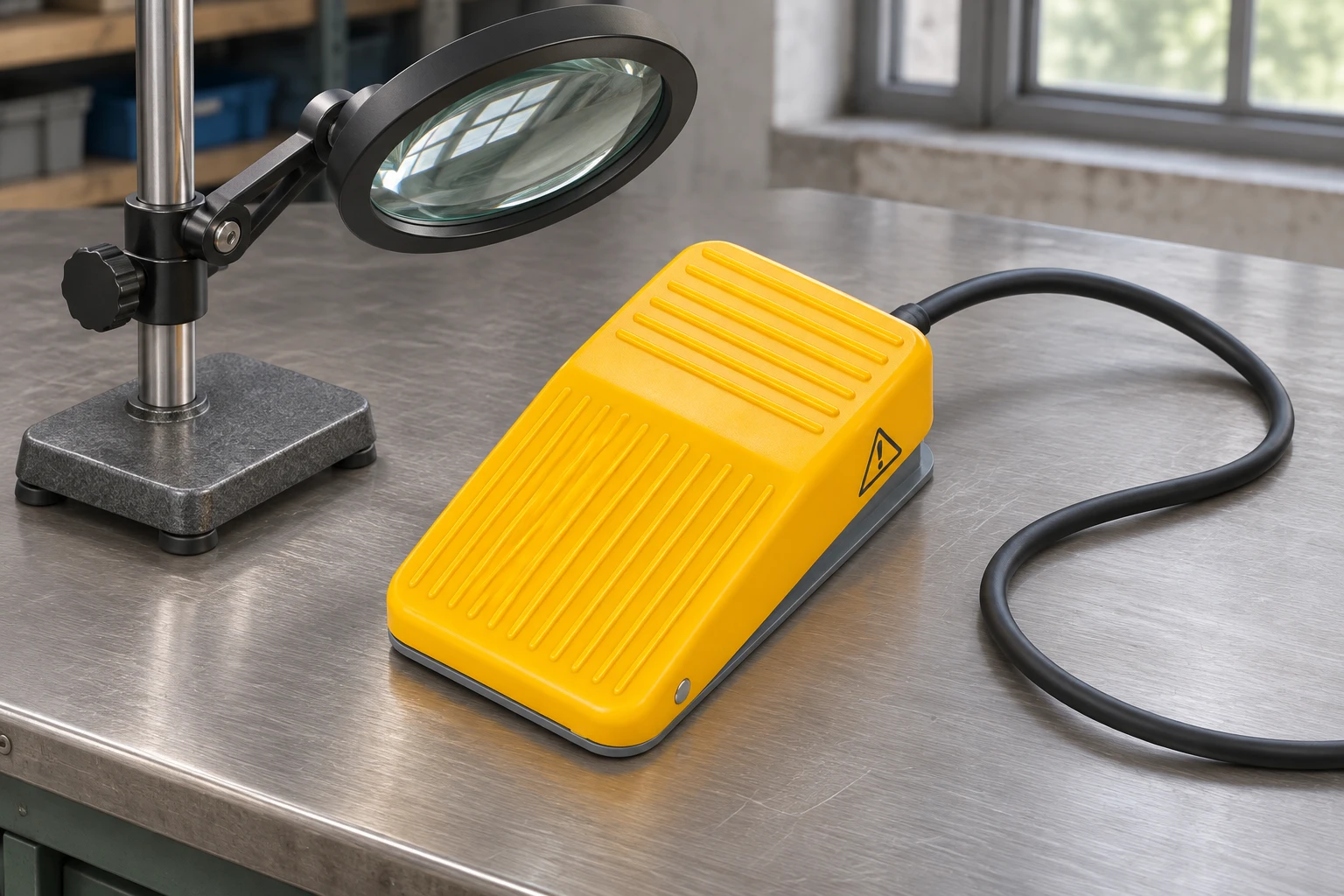
Lemaele lists the LF-Serie Fußschalter with several construction and cable arrangements. That series listing does not establish the jacket polymer, cable maker, allowable local deformation, or repair method for every supplied variant. Identify the ordered assembly and its cable first. The photograph in a catalogue establishes appearance, not the internal condition of a delivered cable.
Preserve a useful as-received record
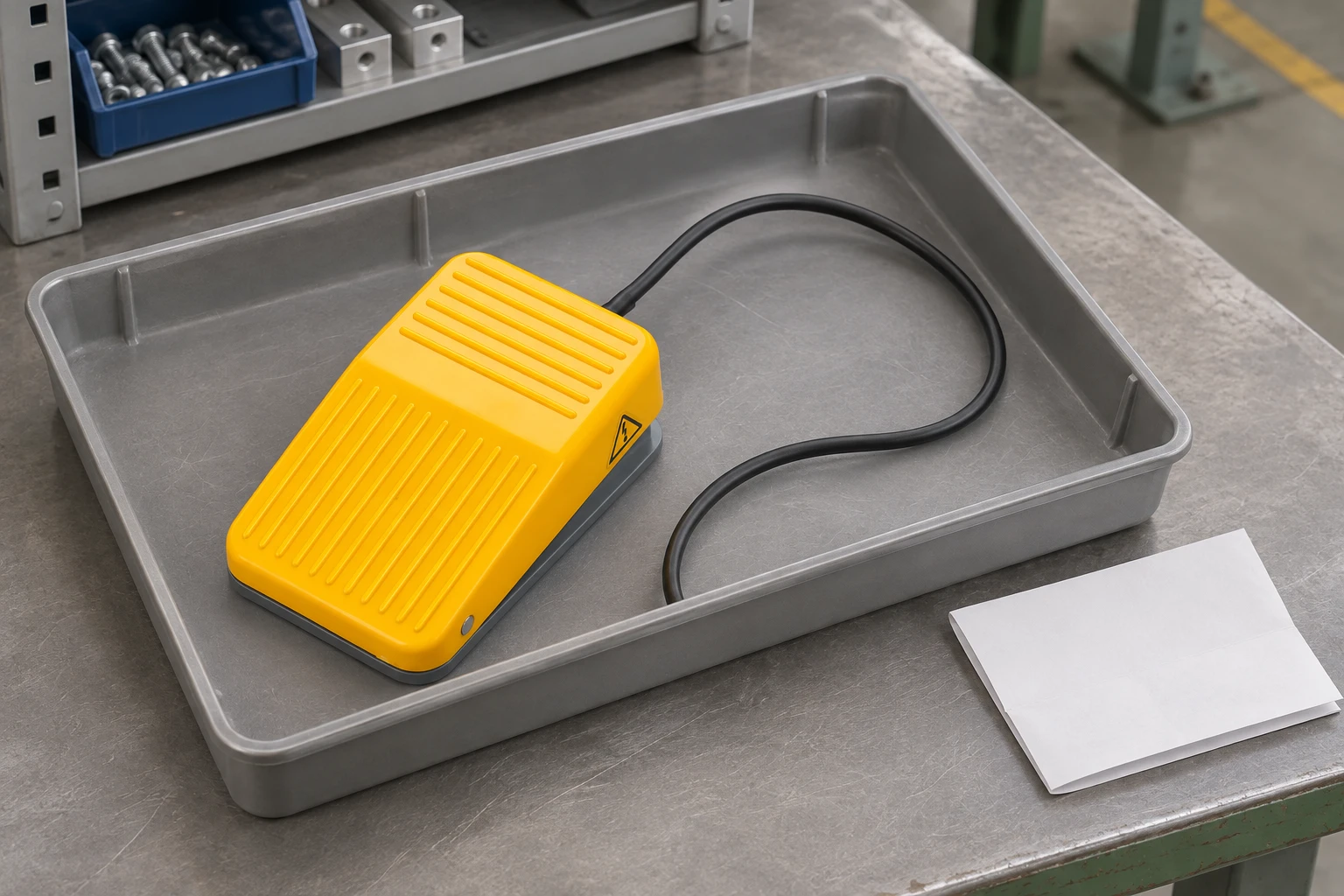
Assign an inspection number to the pedal, its packaging, and the cable restraint. Photograph the entire assembly before moving the cable, then the suspect section and an adjacent unaffected section. Include a scale in the same plane where practical, without pressing it into the jacket. Record the location from an identifiable feature such as the cable outlet, rather than from an end that may later be trimmed. Note whether the mark is on the inside or outside of a stored loop.
Record delivery date, batch identity, observed storage arrangement, and any known transport incident. Separate verified facts from operator recollection. If several assemblies share one carton, keep their locations identifiable. A mark concentrated where a divider bears on the cable suggests a question to investigate; it does not prove transport caused the condition. Preserve enough examples for the supplier to compare affected and unaffected packaging positions.
| Evidence item | Was zu überprüfen ist | Decision supported |
|---|---|---|
| As-received condition | Whole assembly, local mark, packaging contact and batch identity | Preserve evidence before handling changes the surface |
| Surface examination | Cuts, splits, exposed layers and local shape under consistent lighting | Choose the next engineering review, not an assumed damage depth |
| Dimensional observation | Defined location, direction, method and instrument contact | Compare like measurements with an agreed requirement |
| Disposition authority | Applicable document, reviewer and written release or hold | Prevent an unapproved return to stock |
Use handling guidance within its proper scope
Das SAB instructions for secure cable application identify damaging pressure as something to avoid. This supports investigating contact loads and handling conditions. Its cable-specific mechanical and temperature values must not be transferred to an unidentified LF cable. Ask for guidance covering the actual cable construction before setting a limit or conditioning procedure.
Similarly, UL Solutions explains cable-tie assessment, including manufacturer-recommended bundle diameter. A tie assessment is not approval of every cable and tie combination. For this investigation, request the actual restraint identity, installation method, and approved cable compatibility. Do not use a tie’s loop tensile strength as an acceptable squeezing force on the jacket.
Choose observations that do not change the evidence
Start with controlled visual examination. Use diffuse light for the overall surface and a second oblique light to reveal a depression or raised edge. Keep the camera position consistent between suspect and reference sections. A bright reflection can exaggerate an impression; a dark jacket can hide it. Save the original images alongside any annotated copies so reviewers can distinguish the physical observation from an inspector’s interpretation.
If the agreed method includes dimensional measurements, identify the instrument, calibration status, contact arrangement, orientation, and measurement locations. Contact force can change a soft cable’s apparent size. Prefer a validated noncontact method when it answers the question more reliably, but confirm that shadows and edge selection are controlled. Record the measured feature as a local profile or diameter at a named position; do not label it jacket thickness unless the method actually measures jacket thickness.
Separate a surface impression from a release decision
Describe cuts, splits, exposed layers, sharp kinks, discoloration, and deformation separately. A shallow-looking mark is not a universal acceptance category. Conversely, an appearance difference does not establish a specific internal conductor fault. The inspection owner should connect each observation to a documented requirement and the application. Where visible damage or uncertain cable integrity exists, retain the assembly on hold rather than using the machine to see whether it still runs.
Electrical checks, if required, belong to a qualified person using an approved procedure suitable for the complete assembly. A continuity result cannot by itself clear every insulation or mechanical concern. Do not improvise high-voltage tests or assume a catalogue test value is an incoming-inspection setting. If destructive examination is agreed, retain photographs and section identity, identify who authorized it, and avoid treating the cut sample as reusable equipment.
Compare patterns across a batch without inventing statistics
Create a simple location map for each inspected assembly. Distinguish inspected units from total units received. Report an observation as a count within the examined sample, with its selection method, instead of claiming the same rate across the entire lot. If all affected samples came from the top layer of one carton, expand the investigation deliberately before assigning a manufacturing cause.
For a repeated mark, compare the spacing and shape with carton dividers, ties, trays, and storage supports. Photograph suspected contact objects without recreating damaging pressure on a usable cable. Keep different cable variants separate in the comparison. A softer-looking jacket may reflect lighting or material differences; it is not evidence that one variant has lower quality. Request material and construction confirmation when comparisons depend on those details.
Agree a disposition and corrective action
The decision record should name the drawing or agreed acceptance document, its revision, the observed condition, the evidence reviewed, and the person approving the outcome. Where no limit exists, ask engineering and the supplier to establish a suitable decision rule before release. A temporary hold is a status, not a diagnosis. Track held assemblies so they cannot return to stock merely because the paperwork has moved to another department.
If the supplier recommends replacement, preserve the affected unit and batch trail through the agreed return process. If rework is proposed, obtain written scope, responsible personnel, verification steps, and limits on use. Applying tape or warming a jacket can conceal evidence without establishing restored performance. For prevention, review packaging support and restraint application using representative assemblies and the confirmed cable specification, then verify that the changed process removes the observed problem.
Prepare a focused supplier enquiry
Send the exact LF ordering reference, cable identification, quantity examined, observation locations, packaging photographs, and intended equipment use. Ask whether the condition matches a documented acceptance criterion and what further evidence is required. Request cable construction and handling instructions where those are missing. Keep purchasing questions separate from a demand for a specific technical conclusion; a faster answer is useful only when it addresses the delivered configuration.
For wider selection context, use the industrial foot switch selection guide. Follow the cable strain-relief guide for installation questions and the cable ovality measurement article when the question concerns the whole cross-section. These complementary checks help the buyer keep local pressure marks, routing, and dimensional variation in separate evidence records.
Close the inspection record after the decision
After disposition, record where each held, returned, replaced, or released unit went. Link the supplier response to the original inspection number and retain the untouched photographs. If packaging is changed, give the revised packing instruction its own revision and identify the first lot shipped under it. Review that lot with the same observation method used to identify the problem. This makes a prevention claim testable and stops a one-time appearance improvement from being mistaken for a permanent correction. Purchasing can then compare deliveries without reopening the entire technical discussion.
Weiterbildung
IIT Kanpur NPTEL demonstrates common dimensional instruments. The lesson supports understanding instrument contact and reading methods; it does not establish an acceptance limit for a flexible LF cable.

Häufig gestellte Fragen
Kann ein Kabel mit einem Druckmarke verwendet werden, wenn der Schalter funktioniert?
Der Betrieb allein stellt nicht die Kabelintegrität sicher. Die Freigabe erfordert die geltenden Anforderungen und eine verantwortliche technische Überprüfung des beobachteten Zustands.
Kann ich die Eindringtiefe von einem Foto mit dem Handy messen?
Ein gewöhnliches Foto dokumentiert das Erscheinungsbild. Quantitative Tiefe erfordert eine validierte Messmethode mit geeigneter Geometrie, Skala und Unsicherheit.
Soll ich die Jacke wärmen, bis die Beule verschwindet?
Ändern Sie nicht den ursprünglichen Zustand während der Inspektion. Jede Behandlung benötigt ein vom Lieferanten genehmigtes Verfahren und eine Überprüfung; allein die Wiederherstellung des Aussehens ist unzureichend.
What should an LF cable enquiry include?
Include the exact ordered variant, cable identification, batch, mark location, packaging photographs, sample count and the intended installation conditions.