
Micro switch tin whiskers are a materials and reliability question, not something that can be diagnosed from a shiny terminal photograph. First establish the exact terminal finish, lot identity and electrical environment. Then ask whether an applicable whisker-control assessment exists. A general contact rating, RoHS declaration or satisfactory continuity check does not answer that question. If a returned switch is suspected of containing metallic debris, preserve it for qualified examination rather than brushing or spraying it. This guide explains how buyers and engineers can build a useful evidence request without assuming that a particular LEMA switch contains tin plating or has a whisker problem.
What the concern actually means
Tin whiskers are conductive metallic growths associated with susceptible tin finishes. Their relevance depends on the actual materials, geometry and service requirements of the assembly. An electrically conductive growth can create an unintended connection if it reaches a different potential. Detached material can also complicate an investigation. Those possibilities justify a documented review; they do not establish that every tin-finished component will fail, or that any observed intermittent signal was caused by a whisker.
Start with NASA’s basic information on tin whiskers for the underlying phenomenon. Its examples concern identified materials and examined hardware. They should not be transferred into an unsupported statement about an unrelated switch. In a purchasing document, write the concern as a question about the supplied construction and its evidence. Avoid statements such as “this terminal is whisker free” unless the responsible supplier has defined what that statement means and provided applicable support.
Identify which metal surface is being reviewed
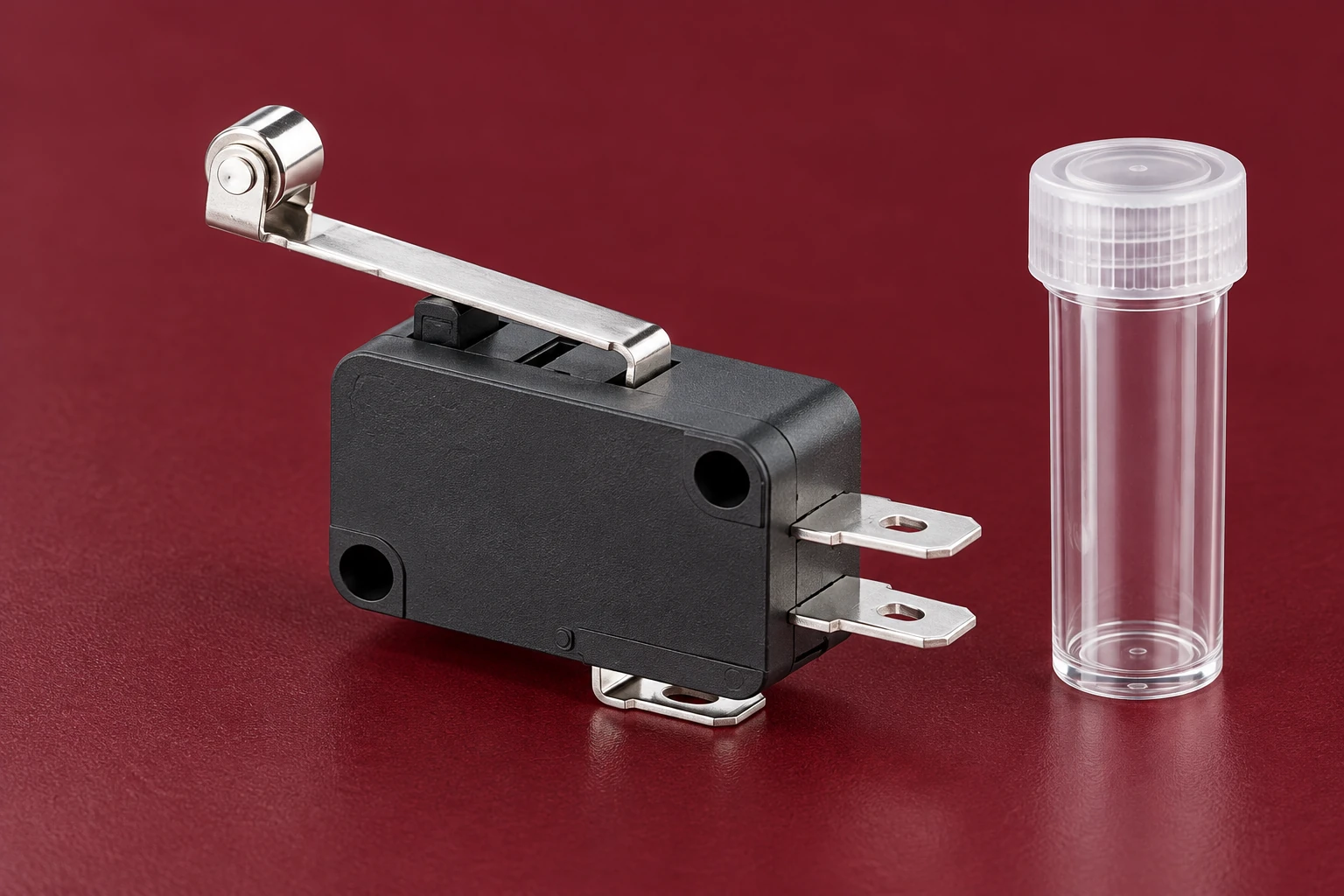
A switch contains several functionally different metal parts. External quick-connect tabs, an actuator lever, mounting hardware and internal contacts need not share a material or finish. A statement about contact alloy does not identify the external terminal coating. A general description of silver contacts therefore cannot settle a question about a terminal surface. Likewise, the apparent color of a lever cannot identify a plating system beneath it.
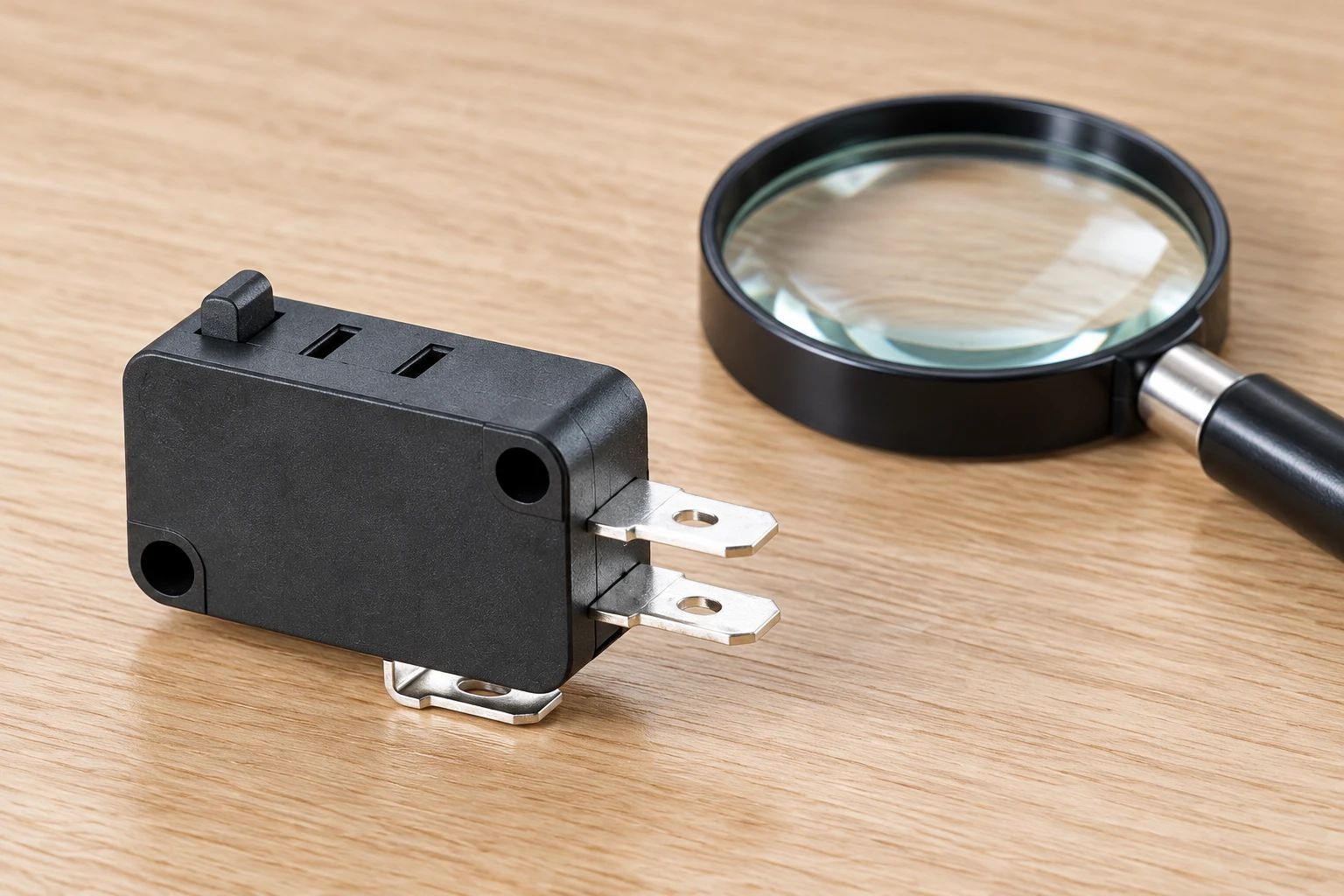
Benutzen Sie Mikroschalter der Serie KW7 as an actual component reference when preparing an inquiry. Specify the exact variant, actuator and terminal arrangement rather than relying only on the family name. The current product page helps establish the product relationship; this article does not establish its terminal plating composition or a whisker qualification. If your project requires that evidence, ask for an exact-variant declaration and its document revision. Keep unknown information visibly marked as unknown.
Build a material evidence request that can be answered
Send a photograph showing the part identification and a drawing reference showing the surfaces of interest. Ask which base metal and finish specification apply to those surfaces, whether that construction is common across your ordered variants, and what change notification applies. The supplier may need to distinguish current production from a historical lot. An answer for today’s part should not silently replace the material record for hardware already installed years ago.
Also separate the finish declaration from the qualification report. A declaration identifies what was supplied; a report describes what was assessed, under which conditions and against which criteria. Both may be necessary, but neither substitutes for the other. The switch material declaration guide explains a neighboring documentation task. A material reporting declaration alone is not an assurance that a specific failure mechanism cannot occur in service.
| Review field | Ask for this record | Keep this distinction clear |
|---|---|---|
| Surface identity | Part, terminal and finish specification | Contact alloy is not terminal coating |
| Supply history | Lot, revision and change notification | Current construction may differ from old hardware |
| Risk context | Circuit potentials and relevant conductors | A photograph does not establish a bridge risk |
| Investigation | Sample identity and examination method | A filament image does not establish composition |
| Approval | Applicable evidence and unresolved requirements | A generic declaration is not lifetime proof |
Map the circuit before judging the consequence
The same physical finding can have different consequences in different circuits. Record which terminals are connected, the potential differences during each machine state, and the required response to a false transition or loss of signal. Include nearby conductors and the mating termination. Do not limit the review to the switch body if exposed tabs, wiring accessories or adjacent hardware could participate in an unintended conductive path.
This is an engineering assessment, not an invitation to reduce electrical clearances or perform improvised live testing. The responsible equipment designer should decide how the concern fits the circuit and its applicable requirements. Mechanical spacing visible in a product image does not establish an acceptable whisker bridge length or an approved mitigation. If the switch is part of a protective function, follow the equipment’s approved validation and maintenance process; a component-level observation does not validate the complete function.
Preserve a suspect sample before routine maintenance
If intermittent behavior is already present, capture the symptom, machine state, operating history and sample identity before disturbing the assembly. Photograph the installed position and surrounding conductors where authorized. Record any recent cleaning, rework, terminal replacement or storage change. Handle and isolate returned hardware under the agreed investigation procedure so that loose particles and their original locations are not casually lost.
Do not open a sealed switch, apply contact cleaner or scrape a surface merely to make the fault disappear. Those actions can remove useful evidence and introduce another cause. A restored continuity reading after disturbance does not identify the original mechanism. Keep the component investigation separate from the controlled decision about returning equipment to service. The relevant maintenance personnel must establish a safe equipment state before any access to potentially energized parts.
Understand the limits of optical inspection
A bright filament in a photograph could be a fiber, scratch, burr or metallic growth. Appearance alone does not establish its composition or origin. Lighting angle, specimen orientation and imaging method affect what can be observed. Ask the examining laboratory to document the area inspected, method, findings and limitations, rather than requesting a simple tick box that says “no whiskers.” An absence observation applies to what was actually examined under the reported conditions.
NASA’s optical inspection video guidance illustrates why illumination and viewing angle matter and explicitly treats the guidance as preliminary. That page is useful for understanding the detection problem, not for inventing a universal inspection acceptance rule for microswitches. Decide with the laboratory whether additional analysis is required to identify a deposit. Preserve representative images and specimen references so the conclusions can be reviewed later.
The following NPTEL lecture explains optical and scanning microscopy as analytical tools. It supports the discussion of observation methods; it is not a test of a LEMA switch and does not provide a switch acceptance limit.
NPTEL-NOC IITM: #34 Optical & Scanning Microscopy | Features & Functions | Part 1
Watch #34 Optical & Scanning Microscopy | Features & Functions | Part 1.
Keep whiskers separate from other contact problems
Corrosion, transferred lubricant, low signal energy, mechanical misalignment and terminal damage are different investigation paths. Several can produce an intermittent observation, but similar symptoms do not prove a common cause. Use the failure evidence to select the path. A contact resistance measurement can describe an electrical symptom while leaving the underlying material mechanism unresolved. A switch that passes a bench test after removal may still require investigation of the installed arrangement.
For the broader component background, start with the micro switch guide. For measurement scope, use the Anleitung zum Kontaktwiderstand von Mikroschaltern. Check the final measurement method against the actual circuit and component guidance. Do not reinterpret a continuity buzzer result as an optical inspection, a materials analysis or a lifetime prediction. Keep the different evidence types in separate fields of the investigation record.
Evaluate proposed controls at the assembly level
A change in finish, coating, barrier, spacing or component construction can affect more than the original concern. It may change terminal mating, solderability, dimensional fit, inspection access or the approved bill of materials. Have the responsible engineering team assess the exact proposal and its tradeoffs. Do not apply a field coating to a switch because a research example used a coating on different hardware; process coverage and component compatibility still require evidence.
Ask whether the proposed control prevents a source, limits a pathway, reduces a consequence or improves detection. Those are different objectives and need different verification. Record the chosen objective, sample identity and acceptance criteria. Avoid converting a limited comparison into a promise of indefinite protection. If the available information cannot support your required assurance, retain the open issue and evaluate an approved alternative construction rather than rewriting the uncertainty as a pass.
Link the approval to lots and changes
A useful approval record connects the purchased part number, drawing revision, declared finish, assessed configuration and lot information. Store the supplier’s response with the purchasing requirement so later buyers do not have to reconstruct the reasoning. If a distributor substitutes a visually similar switch, the prior evidence may no longer apply. The same caution applies when a manufacturer changes a terminal finish while retaining the general product family name.
Before a repeat order, check whether the requirement and the supplied variant are still aligned. Ask for a notification route when relevant materials or processes change. This does not mean every purchase needs a new laboratory campaign. It means the organization should know which changes trigger review, who makes that decision and which evidence remains applicable. A clear change rule can prevent both unnecessary retesting and unnoticed substitution.
What to include in the purchasing inquiry
Provide the exact switch variant, annual quantity, assembly drawing, termination method and relevant service environment. Explain whether the request concerns new design approval, a customer material restriction or investigation of a returned lot. Attach the specific requirement rather than asking for an undefined “anti-whisker certificate.” Request a written response identifying what is known, what is not declared and which supporting documents can be supplied.
A productive outcome may be an applicable material declaration, a scoped assessment or a clear statement that additional qualification is needed. Each is more useful than a generic assurance without a construction reference. Keep commercial availability separate from technical acceptance: a part can be readily available while its evidence is still incomplete for your project. Release purchasing approval only through the process your equipment and customer requirements actually call for.
Häufig gestellte Fragen
Does a silver-colored terminal prove tin plating?
No. Obtain the finish specification for the exact terminal construction; appearance does not identify the coating.
Does a RoHS declaration establish whisker immunity?
No. A substance declaration does not by itself establish the absence of whisker growth or its service consequences.
Should a suspect switch be cleaned before examination?
Preserve the sample under the agreed investigation procedure. Unapproved cleaning or scraping can remove useful evidence.
Is the KW7 described as having a tin whisker defect here?
No. It is a real product reference for a materials inquiry. No terminal finish, defect or whisker qualification is established here.