
A toggle switch sealing washer closes a specific path at the panel interface when its material, geometry and compression match the approved switch assembly. It is different from a lock washer, an anti-rotation washer and a lever boot. Select the seal using the switch bushing drawing, finished panel, exposure conditions and maker’s assembly instructions. Adding an arbitrary O-ring or tightening the nut harder does not establish waterproof performance.
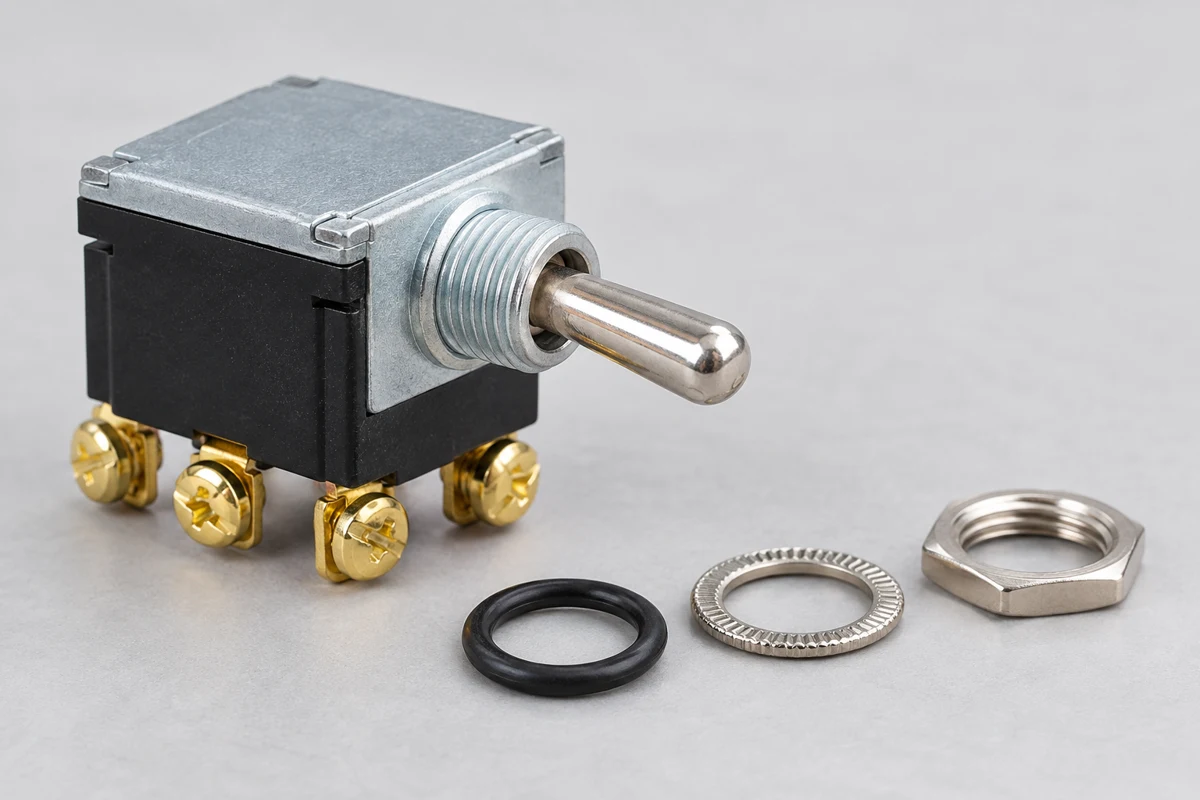
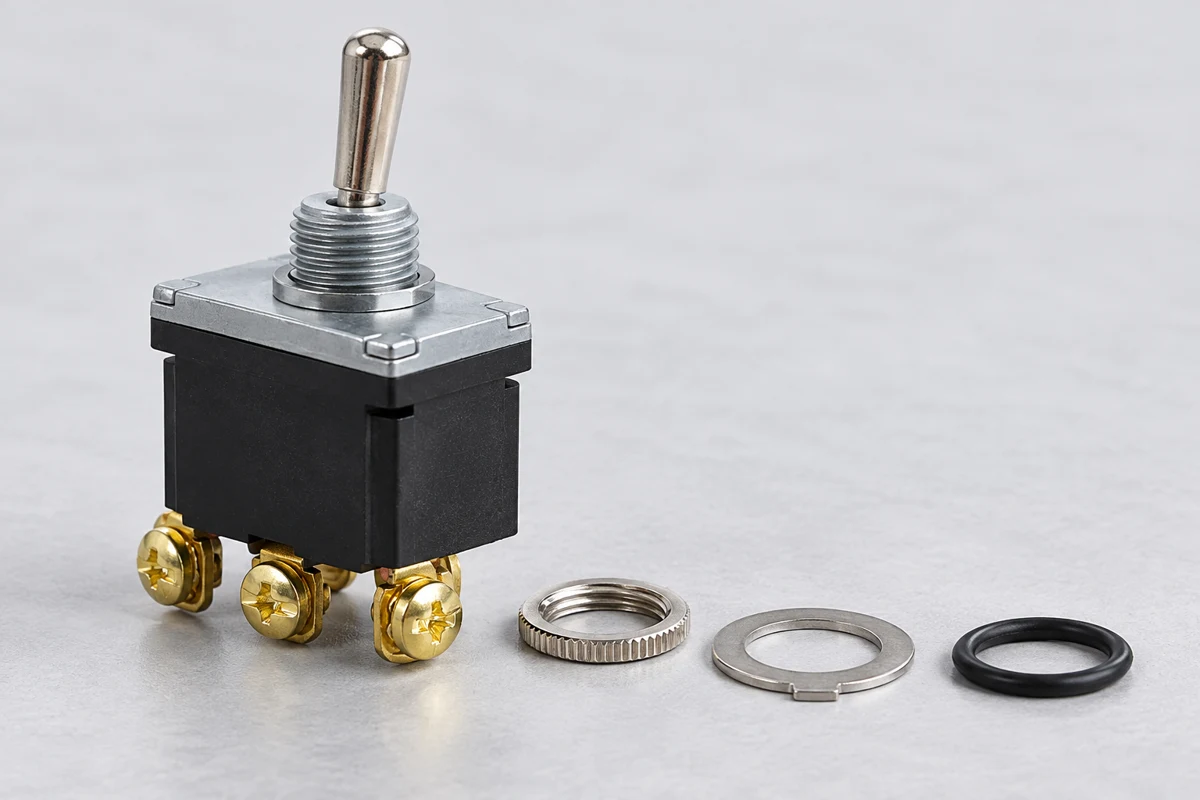
This guide focuses on the seal around a panel-mounted toggle bushing. It complements whole-switch environmental selection and boot selection. The LEMA LT3232B waterproof-toggle family is the product reference; its photograph does not establish that any aftermarket washer produces a particular IP rating.
Map every relevant entry path
Identify where moisture or dust could move into the enclosure: around the bushing, through the lever mechanism, along a threaded accessory or through rear connections. A panel washer addresses only the interface it is designed to seal. Even a correctly installed washer cannot make an unrelated opening watertight or protect exposed rear wiring.
Review the complete assembly instead of the accessory in isolation. Record the switch model, panel, nut, seal and any boot together. Ask which combination was evaluated for the claimed environment and how it was mounted during that evaluation. This prevents a component-level claim from being applied automatically to the finished equipment.
Distinguish sealing from locking and anti-rotation
A lock washer is intended to help the fastener arrangement resist loosening. An anti-rotation washer or keyed feature limits body rotation. A sealing washer creates the specified barrier at the panel interface. These functions can be combined in an approved assembly, but one should not be assumed to replace another.
Use the stack order in the supplier instructions. Putting a toothed or keyed washer on the wrong side of a seal can create an uneven bearing surface or damage it. Do not improvise a stack based on how many accessories were supplied in a bag. If documentation is incomplete, request an assembly diagram before sample approval.
Match geometry to the bushing and sealing land
Obtain the bushing diameter, thread, usable length and specified sealing surface. Compare the seal’s inside and outside dimensions and cross section with that interface. The nominal thread size alone does not define the seal. A washer that stretches over the bushing can still sit poorly on the flange or interfere with a keying feature.
Check the surface over which the seal will bear. It must provide the contact condition required by the approved design. If an O-ring requires a groove or controlled gland, do not install it as though any flat panel can provide the same result. Avoid publishing a universal groove or compression dimension without a verified material and seal design.
Include the finished panel in the specification
Paint, powder coating, burrs, local embossing and panel curvature change the surface seen by the seal. A surface that looks flat from a distance can have a ridge or cut-edge defect at the opening. Inspect the finished interface and confirm the permitted thickness and surface condition.
Do not sand away a coating casually to make the seal sit differently. That can affect corrosion protection or the enclosure construction. If a defect or roughness prevents the approved seal from seating, correct the panel process or request a validated alternative. Record whether the mounting requirement applies before or after finishing so production and inspection use the same condition.
| Artículo | Primary purpose | Required check |
|---|---|---|
| Sealing washer | Barrier at specified panel interface | Geometry, material and approved compression |
| O-ring | Seal in its designed contact arrangement | Supported gland or mounting design |
| Lock washer | Fastener retention function | Correct location and compatible stack |
| Anti-rotation feature | Limit body rotation | Engagement without seal damage |
| Lever boot | Protect specified lever region | Compatibility and tested assembly boundary |
Control compression using the approved assembly method
A seal needs the compression defined by its design. Too little may leave an entry path; too much can damage the seal, distort surrounding features or interfere with thread engagement. The external nut torque is not a direct universal measure of seal compression because friction, geometry and material behavior affect the relationship.
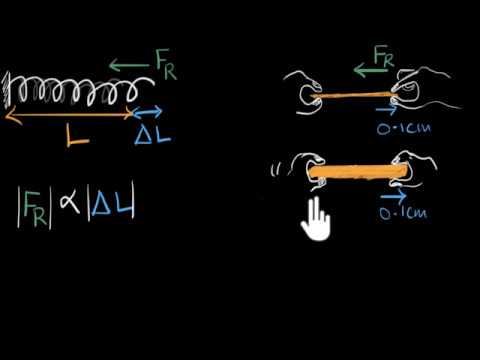
Use the switch or accessory maker’s fastening instructions and inspection criteria. The Khan Academy stress-and-strain lesson introduces deformation under load, helping explain why compression must be controlled. It does not provide an O-ring design value or a switch tightening torque. If no relevant assembly specification exists, ask for one instead of choosing a force by feel.
Choose material for the actual exposure
Identify water exposure, cleaning agents, oil, temperature range, sunlight and other conditions relevant to the panel. Material suitability is specific to those exposures and the seal construction. A black elastomer appearance does not identify its composition or prove compatibility. Obtain the material information and evidence required by the equipment design.
Consider how long the seal remains compressed and whether it will be disturbed during servicing. Do not assume that a removed seal can always be reused. Ask the maker for inspection or replacement guidance. If the environment changes, review the seal rather than relying on an accessory selected for an earlier enclosure or cleaning process.
Interpret IP information at the correct assembly boundary
The IEC 60529 framework classifies enclosure protection. For a purchased switch, establish what was tested and which mounting conditions apply. A stated rating may depend on the front interface, a specified seal, a particular panel and installation method. Confirm the boundary rather than extending it to the whole machine.
The seal also does not establish corrosion resistance, chemical compatibility or suitability for every cleaning method. List those requirements separately. If the equipment is exposed to unusual substances or repeated washdown, request relevant evidence and validate the installation under the approved test plan. Avoid treating the word waterproof as a complete engineering specification.
Prevent rotation without loading the seal unpredictably
A toggle lever applies forces to the mounted switch during operation. If the body rotates, the harness can twist and the seal interface can be disturbed. Use the approved anti-rotation feature or mounting arrangement rather than depending on excessive nut tightening to solve both rotation and sealing.
Check that the keyed feature engages without cutting or buckling the seal. Inspect the switch through its operating positions after the harness is attached. Cable forces can rotate or tilt the body even when the nut seemed firm before wiring. Provide independent wire support and confirm that service access does not require levering against the installed bushing.
Validate installation and service disturbance
Build a representative panel assembly with the actual finish and hardware stack. Inspect seating, thread engagement, actuator freedom and body stability. Perform environmental checks using the applicable approved method; an improvised splash test cannot establish a formal rating. Keep the test setup and acceptance record with the approved configuration.
When the switch is removed, inspect the seal and panel contact region before reassembly. Record deformation, cuts, contamination or lost hardware. Follow the maker’s reuse policy and repeat the checks affected by servicing. An accessory that once passed a sample check should not be assumed to remain suitable after being disturbed or installed on another panel.
Prepare an inquiry that identifies the seal system
Send LEMA the complete toggle model, bushing drawing, finished panel thickness, opening geometry, exposure conditions and intended service process. Identify whether the request concerns a panel seal, lever boot or anti-rotation arrangement. Ask for the supported hardware stack and any relevant tested configuration.
For procurement, retain the accessory order code, material information, assembly instructions and acceptance record. Do not purchase an unnamed O-ring by nominal diameter and substitute it without review. Where dimensions or compression details are unconfirmed, mark them as open items and resolve them before production. The aim is a repeatable sealed interface, not simply a washer that fits over the threads.
Further learning
This neutral lesson explains material deformation. It supports the need to control seal compression; the actual washer geometry and installation limits must come from the approved component design.
Recursos relacionados de LEMA
- Toggle Switch Sealing Washer and O-Ring Selection product reference
- Sealed toggle switch selection
- Toggle boot selection
- Panel mounting and clearance
Technical references
- IEC enclosure protection classification: Defines the IP classification framework; the relevant rating and tested assembly must be confirmed for the exact model.
- OpenStax torque and lever arms: Explains force and lever-arm relationships; switch operating force still comes from its model drawing.
Preguntas frecuentes
Can a sealing washer replace a waterproof boot?
Only if the exact design allows it, which should not be assumed. A panel washer and a boot usually address different interfaces. Map entry paths and obtain the supported combination from the maker.
Does tightening the nut harder improve sealing?
Not automatically. Excess compression can damage the seal or housing. Follow the specified assembly method, inspect seating and validate the interface rather than choosing torque by feel.
Is an IP rating proof of chemical resistance?
No. Ingress classification and material compatibility answer different questions. Specify the cleaning agents, oils, temperature and other exposures separately and request evidence relevant to those conditions.
Can an O-ring be reused after switch replacement?
Follow the seal or switch maker’s reuse guidance. Inspect for damage and permanent deformation, and replace it where the approved procedure requires. Recheck the installed interface after any service disturbance.