
A dustproof micro switch must be selected from documented ingress protection and the actual installation boundary, not a sealed-looking housing or a general waterproof label. Identify the dust exposure, actuator movement, cable or terminal entry paths and surrounding enclosure. Then confirm the exact switch variant’s evidence and validate its function in the intended mechanism. A switch body can resist ingress while dust still obstructs the external roller, lever or target.
This guide focuses on industrial position and mechanism inputs. It excludes mouse-click sound comparisons and does not claim that every LEMA waterproof micro switch has a particular dust classification. The KW12F wired switch family is the real product reference; request the applicable construction and test information for the order code being considered.
Describe the dust before choosing the switch
Record what generates the dust and where it reaches the mechanism. Dry process powder, fibers, wood residue and abrasive particles create different practical problems. Include particle accumulation, airflow, cleaning methods and whether liquid or oil makes the dust adhere. A simple label such as dusty workshop does not give the supplier enough information to evaluate the application.
Identify the function and consequence of a missed or unstable input. A production-position indication and a safety-related interlock can need different system architecture and validation. Do not elevate a general micro switch to a safety device because it is sealed. The equipment design authority must establish the required function and approved control arrangement.
Read the ingress classification correctly
IEC 60529 provides the IP classification framework for enclosure protection. For a switch, ask for the full relevant classification and conditions tied to the exact construction. Do not infer dust performance solely from a water-related description. A statement about the product family may also depend on a cable exit or terminal configuration that differs from the candidate part.
Record which boundaries were covered: switch body, actuator interface, cable entry or a larger mounted assembly. Ask what installation conditions apply and what evidence is available. Do not assign a new rating to a modified switch or extend a component claim automatically to the complete enclosure. Where the documentation is incomplete, describe the protection as unconfirmed rather than guessing.
Map entry paths and external obstruction paths
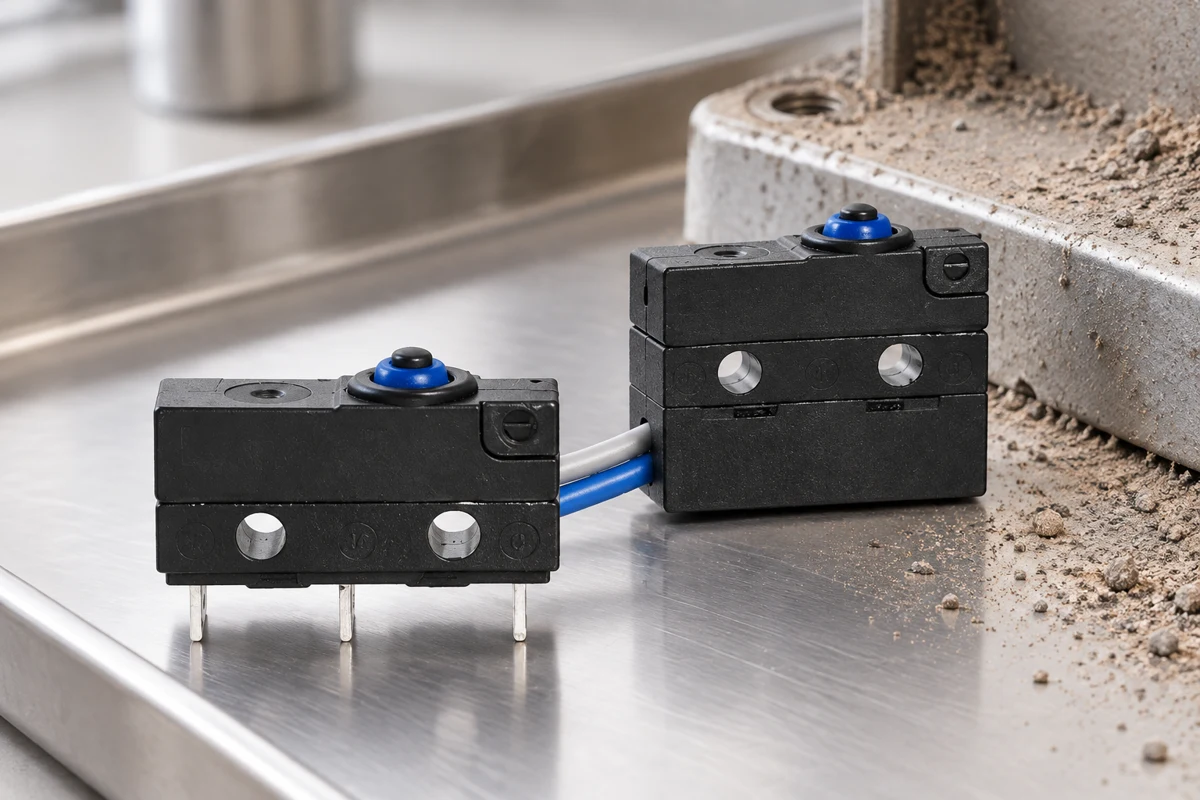
List possible entry paths around the actuator, housing joints, cable exit and exposed terminals. Then list external places where dust could accumulate without entering the body, such as the roller gap, lever path, target guide and bracket. These are different failure mechanisms and may require different corrections.
A sealed switch may retain clean internal contacts yet fail to operate because a target no longer reaches its lever. An open connection can become contaminated even when the body is protected. Check the entire sensing interface and harness region. Use the installation drawing to decide what the switch protects and what must be addressed by the equipment enclosure or cleaning plan.
Choose an actuator that remains free to move
Examine whether the target presses a plunger, follows a roller or sweeps a lever. Consider the spaces that can trap material and the directions in which motion could compact it. The best actuator depends on the mechanism and dust exposure, not a universal rule that one head type is dustproof.
Verify the permitted approach, force and travel for the exact option. Do not add a cover that restricts movement or creates a new pocket for residue without reviewing its effect. Check operation and release with the equipment assembled. A protective enclosure that keeps dust away can still cause interference if its clearance was evaluated only in the released position.
| Riesgo | Qué confirmar | Where to inspect |
|---|---|---|
| Ingress into housing | Exact documented protection boundary | Actuator interface, joints and cable entry |
| External obstruction | Free actuator and target movement | Roller, lever, guide and bracket |
| Contaminated connection | Protected terminals and harness | Rear terminals and end connectors |
| Cleaning disturbance | Permitted method and exposures | Seal, cable and actuator after cleaning |
| Special atmosphere | Applicable equipment requirements | Whole system, not only IP marking |
Treat cable and terminal construction as part of protection
A prewired sealed version moves the cable-entry construction to the supplier, but it still requires routing, support and compatible end connections. Specify cable length, conductor information, exit direction and exposure. Do not pull or bend the cable at the housing to create room. Support the harness so motion is absorbed where the design allows it.
For exposed terminal variants, assess whether the enclosure protects the connection region and whether service work introduces dust. NASA’s wiring workmanship standard is useful background for controlled interconnection and support; it does not provide an IP classification. Cutting a cable or changing a connector can alter the approved construction, so ask which modifications are permitted.
Keep electrical duty separate from ingress protection
The selected switch still needs to suit the circuit voltage, current, load character and expected operation. A sealed body does not increase the contact rating. For a controller input, establish the contact option and relevant minimum-load information. For a switched load, review the exact rating and protection against the intended duty.
A continuity check does not prove long-term electrical performance or environmental suitability. Preserve the distinction between contact state, loaded behavior and protection against ingress. The purchasing record should contain evidence for each requirement. If a candidate meets the size and sealing needs but lacks suitable contact information, it is not ready for release.
Plan cleaning without changing the assembly assumptions
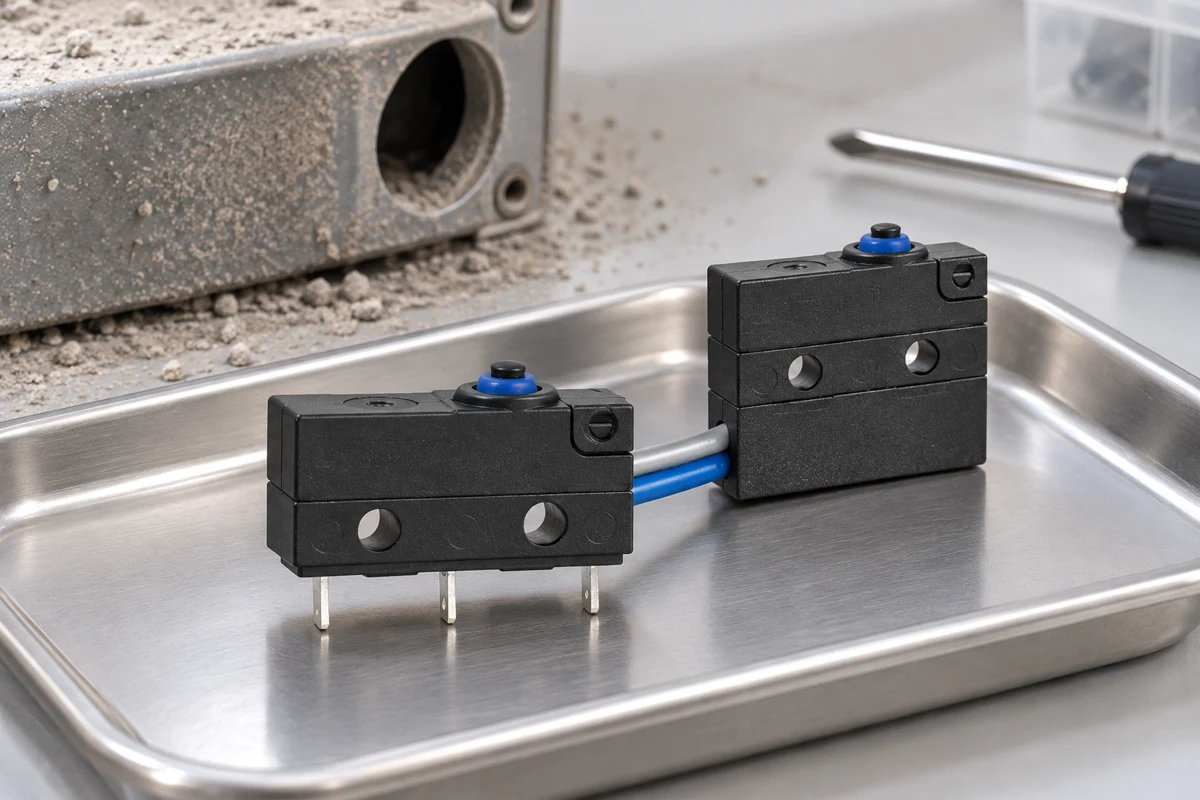
Ask how the equipment is cleaned and which materials or methods touch the switch region. Brushing, vacuuming, compressed air and liquid cleaning can affect the assembly differently. Follow the equipment’s approved maintenance method and the component instructions. Do not assume that a waterproof description permits every solvent, pressure or cleaning direction.
Cleaning can also disturb a lever, cable or bracket. Provide access that allows residue to be removed without forcing the actuator beyond its travel. Record inspection points after maintenance, especially where accumulated dust could mask a crack or damaged seal. If cleaning conditions change, review the selected switch and enclosure instead of keeping an old protection assumption.
Recognize when dust exposure needs a separate hazard review
Some process dusts create hazards beyond component contamination. If the equipment operates in a potentially explosive dust atmosphere, have the qualified team determine the applicable equipment and installation requirements. An IP classification alone does not establish suitability for that environment.
Keep the micro switch inquiry specific and avoid unsupported claims such as explosion-proof or universally industrial dustproof. State the actual application boundary and request evidence relevant to the design. If no appropriate candidate can be confirmed, revise the sensing architecture or protective enclosure under the design authority rather than interpreting an ordinary seal as a special-purpose approval.
Validate function before and after representative exposure
Define an approved validation sequence that reflects the specified equipment environment. Record operation, release, target position and contact behavior before the sequence and after it. Use suitable test methods selected by the responsible team; scattering powder over a sample is not a formal ingress qualification.
Inspect both the body and the external mechanism. Determine whether any problem came from material entering the switch, residue restricting movement, a changed target position or a contaminated connection. Do not replace the switch without preserving evidence. Separate causes allow the correction to target the actual path rather than repeatedly selecting more heavily sealed bodies.
Send a complete dust-exposure RFQ
Give LEMA the proposed switch order code, actuator drawing, target motion, dust description, environment, circuit duty and cable or terminal preference. Include photographs of the installed region and the enclosure boundary. Request the exact protection information and any conditions on mounting or cable construction.
Approve samples using the intended mechanism and connections, and record the checks required by the equipment plan. Keep the selected order code, protection evidence, harness drawing and maintenance instructions together. Reassess relevant requirements after changing the dust process, cleaning method, actuator or cable. The goal is a position input that remains functional in its specified environment, not merely a body advertised as sealed.
Further learning
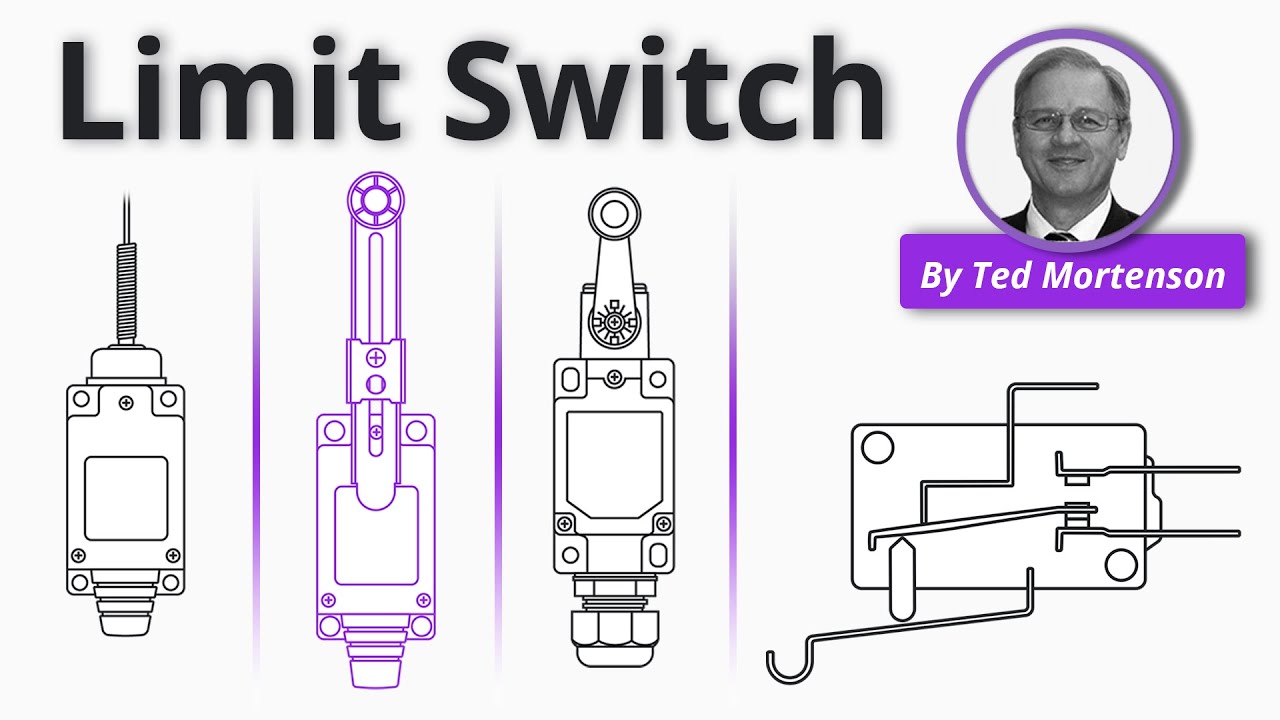
This lesson explains mechanical position switching. It supports the distinction between internal contact operation and a blocked external actuator; it does not demonstrate dust certification for the illustrated product.
Recursos relacionados de LEMA
- Dustproof Micro Switch Selection for Industrial Equipment product reference
- Industrial micro switch selection
- Micro switch mechanism travel
- Cable-equipped micro switch selection
Technical references
- IEC enclosure protection classification: Defines the IP classification framework; the relevant rating and tested assembly must be confirmed for the exact model.
- NASA wiring workmanship standard: A reference for controlled cable and harness workmanship; it does not certify the illustrated LEMA part.
Preguntas frecuentes
Is a waterproof micro switch automatically dustproof?
Do not assume it. Obtain the exact ingress classification and tested construction. A water-related description does not establish every dust requirement or protect an external mechanism from residue buildup.
Can dust cause missed operation without entering the switch?
Yes. Accumulated material can restrict the lever, roller or target guide and alter actuation. Inspect the complete mechanism separately from the internal housing protection.
Does an IP classification mean explosion-proof?
No. Ingress protection and suitability for a potentially explosive atmosphere are different requirements. Have the qualified design team determine the applicable equipment and installation requirements.
What should be checked after changing a sealed cable?
Review whether the modification is permitted and which protection assumptions it affects. Verify cable support, connection identity, actuator function and the required environmental checks before releasing the altered assembly.