
Power inlet recycled plastic content should be supported by a declaration for the exact part and a clearly stated calculation boundary. Ask whether the percentage concerns one housing, all plastic in the inlet, the complete component or its packaging. Confirm the material source, evidence period and applicable revision before transferring the statement into an OEM purchasing record. Black color, a recycling symbol and a restricted-substances declaration do not establish a recycled-content percentage.
Il Presa di alimentazione CA serie IPZ is the product reference for this inquiry. Its public product information does not establish a recycled-plastic percentage, a particular resin formulation or a recycled-content certification. This guide explains how to request usable evidence without assigning an unsupported environmental claim to the supplied inlet.
Define the object before asking for a percentage
Write down what is being assessed. A power inlet can contain several parts and materials; a statement about a molded housing may exclude metal contacts, other insulating parts or accessories. Packaging is another separate object. A supplier may provide a valid statement for a shipping bag that says nothing about the component inside it. Identify the intended boundary in the first line of the inquiry.
Avoid the question “Is this inlet recycled?” It can mean that the part contains recycled material, that it can be recycled after use, or that an old component has been reconditioned. Ask instead for the declared recycled-plastic content of a named part, with the basis and scope specified. If the answer concerns a narrower object, preserve that narrower wording rather than silently extending it.
Separate recycled content from recyclability
Recycled content concerns material incorporated into the product. Recyclability concerns a possible route after use. Neither establishes the other, and neither can be inferred from the color of a molding. Keep these questions in separate procurement fields so a useful end-of-life statement does not accidentally satisfy a material-content requirement.
Il US EPA Comprehensive Procurement Guideline program provides background on purchasing designated products containing recovered materials. Its recommendations have defined product categories and scope. Do not treat the program as an automatic requirement or approval for every electrical inlet. The practical lesson for this inquiry is to ask for evidence that matches the object and purchasing requirement actually under review.

Ask what the declared percentage measures
A percentage needs a numerator and a denominator. Ask the supplier to identify which material quantities enter the calculation and which are excluded. For a declaration about a housing, the denominator should be stated as that housing or its defined plastic content, rather than left ambiguous. Do not compare two percentages until their boundaries and methods are comparable.
A simple hypothetical example shows the problem. If a housing contains 2 grams of qualifying recycled material within 10 grams of housing material, its stated fraction would be 20 percent on that housing-mass basis. If the complete inlet weighs 25 grams, those same 2 grams are 8 percent of total component mass. These are illustrative arithmetic values, not IPZ measurements, composition data or a permissible product claim.
The general calculation is declared qualifying recycled mass divided by the declared reference mass, multiplied by 100 percent. Keep units consistent and retain the measurement or accounting basis. Real declarations may involve defined averaging periods or other documented approaches; do not replace those methods with an unsupported visual estimate. If quantities are unavailable, record the percentage as unverified rather than calculating one from photographs.
Clarify material origin and accounting scope
Ask how the declared recycled material is described and supported. Is the claim about material recovered before consumer use, after use, or a stated combination? Which evidence connects the material source to the manufactured part? A resin supplier’s general sustainability brochure is background information until the component supplier explains its applicability to the delivered configuration and period.
Il FTC recycled-content guidance in the 2025 edition of 16 CFR 260.13 distinguishes recycled-content claims from other environmental wording and calls for qualifying partial-content claims. Use the applicable guidance and the supplier’s substantiation when reviewing proposed wording. This article does not provide a legal determination that a particular claim is acceptable in every market. Avoid broad phrases that imply more than the available evidence demonstrates.
Use a declaration review worksheet
Send the same fields to each supplier. This makes missing information visible without rewarding the longest brochure. Ask for a document identifier, issue date, exact part scope, material boundary, percentage basis and supporting-record description. Include a clear place for “not declared” or “evidence pending” so the supplier is not pushed to provide an invented number.
| Declaration field | Request this detail | Evita questa supposizione |
|---|---|---|
| Part identity | Exact variant, revision and applicable supply period | A family brochure covers every delivered item |
| Object | Housing, all plastics, complete inlet or packaging | Packaging content applies to the inlet |
| Calculation | Qualifying mass, reference mass and units | Different denominators produce comparable percentages |
| Origin | Declared source categories and substantiation | A recycling symbol establishes content |
| Controllo | Document identifier, limitations and change triggers | An old statement covers a changed formulation |
The worksheet is a proposed document-review aid. It does not assign a minimum recycled-content target. That target, if required, should come from the buyer’s applicable specification and be assessed alongside the equipment’s other requirements. A declaration with a narrower scope may still be useful, provided its limitation remains explicit throughout the purchasing process.
Evaluate evidence strength without confusing document types
A controlled supplier declaration, an independently reviewed certificate and a purchase record have different roles. Ask what each document establishes rather than treating all of them as interchangeable proof. Check whether the cited certification actually covers the part, material stream or manufacturing operation in question. A logo alone is not an applicability statement.
For a sampled lot, retain the lot identifier and its relationship to the declaration’s period. If the supplier uses an average, ask which period, product group or facility it covers. Do not describe an average as an individually measured content value unless the method supports that description. Record unresolved scope questions as open items, with the supplier’s exact response and a responsible reviewer.
Keep substance declarations and safety evidence distinct
A declaration about restricted substances answers a different question from recycled content. Use the separate material declaration review when organizing substance information. A recycled-content statement should not be treated as proof of substance compliance, and the presence of a substance declaration does not establish the origin of the plastic used in a housing.
Likewise, environmental sourcing goals do not replace electrical or material-performance review. Consult the power inlet flammability evidence guide for the separate scope of a plastics flammability claim. If a new formulation or supply route is proposed, ask the responsible engineer which existing evidence remains applicable and what additional qualification is required. Do not presume that a recycled formulation is better, worse or equivalent without relevant evidence.
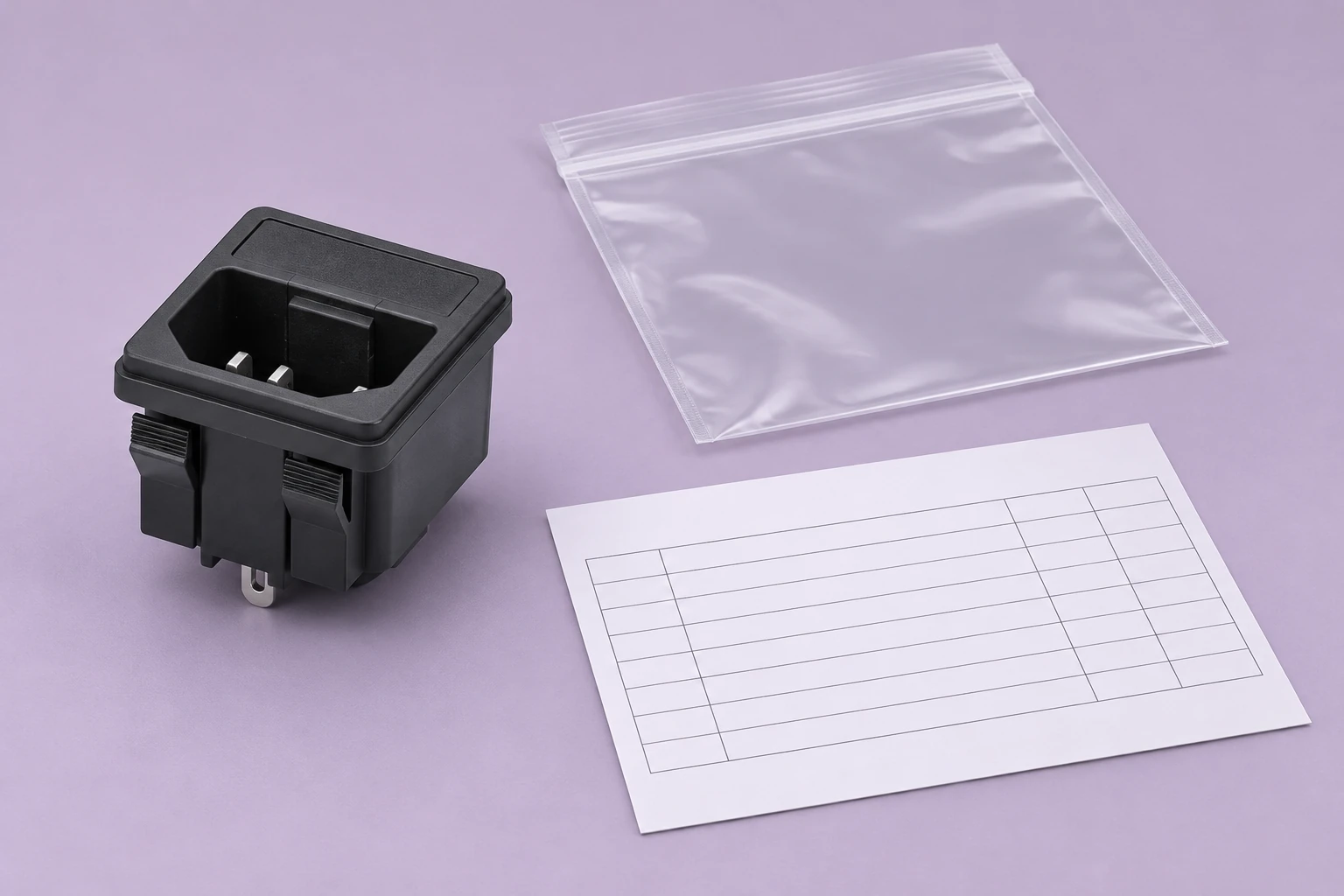
Review a material change as a controlled substitution
A proposed change should identify what remains the same and what changes: material reference, manufacturing location, process, appearance or supporting approvals. Ask for the effective date and affected part revisions. The component may still need a form, fit and function review using the equipment power inlet replacement guide. A content declaration does not remove that obligation.
Keep commercial approval separate from engineering release. The purchasing team can discuss price and availability while the technical team reviews the changed construction. Preserve an explicit hold when evidence is incomplete, instead of treating delivery urgency as evidence of equivalence. Once approved, link the released revision to the relevant declarations and qualification records so later orders use the same basis.
Compare offers using matched boundaries
Before ranking two offers, create a side-by-side record of their declared object, reference mass, source categories, accounting period and verification scope. A high housing-only percentage and a lower whole-component percentage cannot be compared directly. Ask for clarification or normalize only when reliable quantities and compatible definitions are available. Otherwise report the figures with their original boundaries.
Also identify whether the environmental requirement is mandatory, preferred or informational. An offer with no declared percentage should remain “not declared,” not zero. An offer with a declaration may still have open technical questions. This approach allows the buyer to see both sourcing progress and remaining qualification work without turning an incomplete document into a product-level conclusion.
Prepare the RFQ and approved wording together
Include the exact IPZ variant, expected order quantities, application description and the requested declaration boundary. Ask the supplier to state explicitly when no content claim is available. Request supporting-document identifiers and a change-notification arrangement. If the buyer plans to use a statement in a customer report, provide the proposed wording for review against the evidence before it is circulated.
Retain the final approved wording with the source document. For example, a declaration limited to one housing should remain limited to that housing in procurement summaries, rather than becoming “the inlet is recycled.” Keep packaging claims separate. The useful outcome is a traceable answer that procurement, engineering and the downstream customer interpret consistently, including any limits or unanswered questions.
Further learning: plastic recycling practices
The NPTEL IIT Kharagpur lecture below explains recycling and waste-plastic management as broader background. It helps readers understand the distinction between recycling processes and a finished-part declaration. It does not verify an IPZ material stream, establish a recycled-content percentage or prove electrical suitability. Use the written evidence request for the actual purchasing decision.
NPTEL IIT Kharagpur: Lecture 26 : Plastic Waste Management Practices : Recycling and Waste Plastics
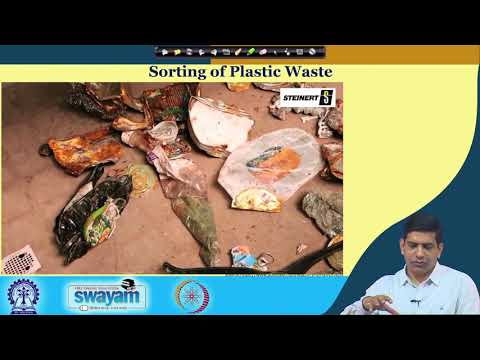
Watch Lecture 26 : Plastic Waste Management Practices : Recycling and Waste Plastics.
Domande frequenti
Does black housing color prove recycled plastic content?
No. Obtain a part-specific declaration with its scope and supporting basis.
Is recyclable the same as containing recycled material?
No. These statements concern different questions and need separate evidence.
Should an undeclared percentage be recorded as zero?
No. Record it as not declared or unverified until appropriate evidence is available.
Is a recycled-plastic percentage established for IPZ here?
No. The illustrative arithmetic is not an IPZ measurement, and no recycled-content certification or percentage is claimed.