
Illuminated push button cap luminance uniformity evidence should describe how light is distributed across a defined cap area under controlled conditions. Ask for the exact illuminated variant, documented electrical drive, viewing geometry, measurement regions and the agreed acceptance calculation. A phone photograph or one center reading cannot establish the distribution over the whole cap. This guide helps equipment buyers request a useful optical report while separating measured uniformity from subjective appearance, daylight visibility and certification. It does not assign an LED voltage, luminance target or uniformity limit to a Lemaele product without an approved specification.
Confirm that the ordered button includes illumination
Start with the complete order code, cap color, cap construction and illuminated option. Keep a record of whether the review concerns an unmarked cap, a legend or another defined light-emitting region. Comparing different regions between samples can produce misleading conclusions even if the measurement equipment is unchanged. The report should tie every image and result to the actual variant supplied for evaluation.
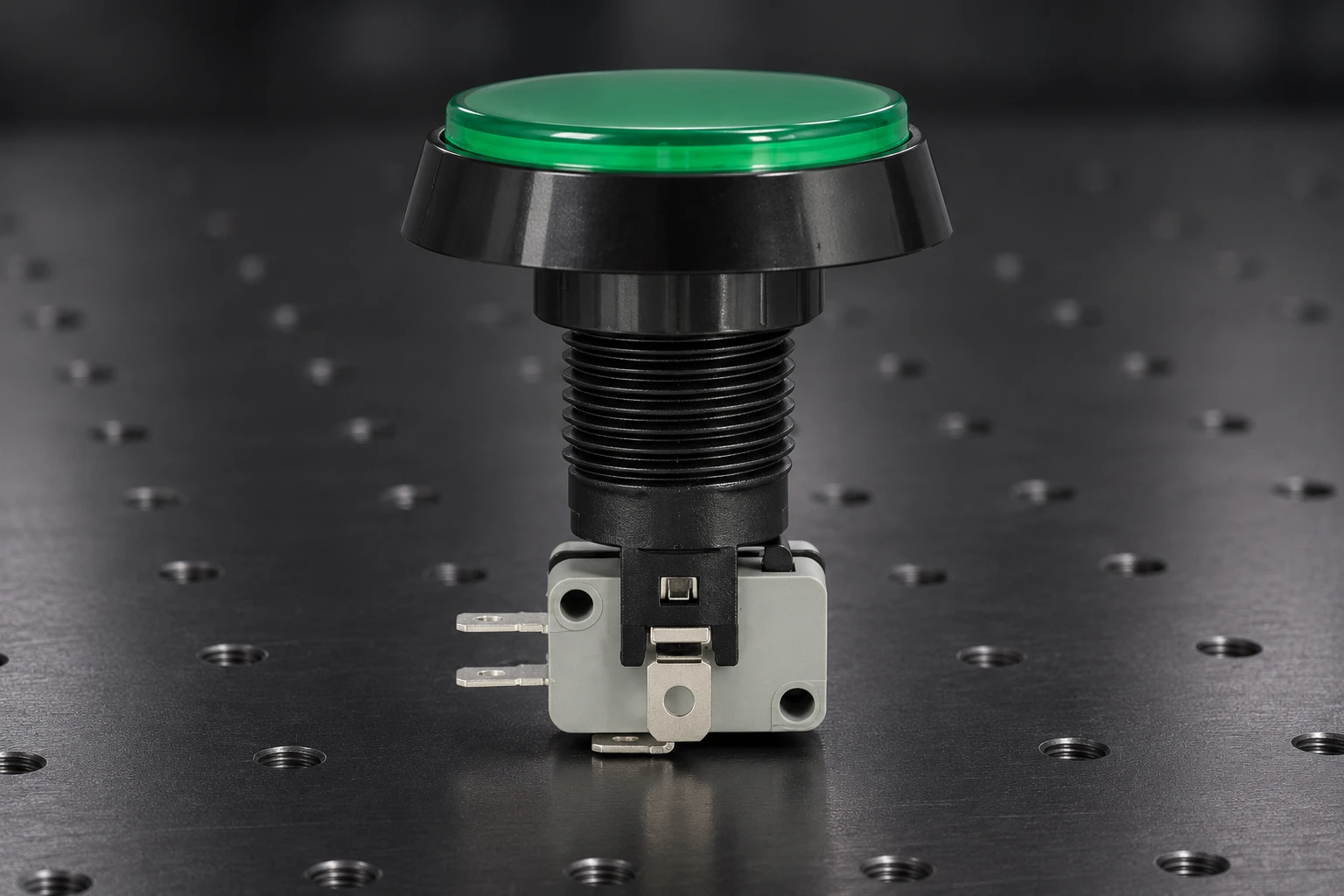
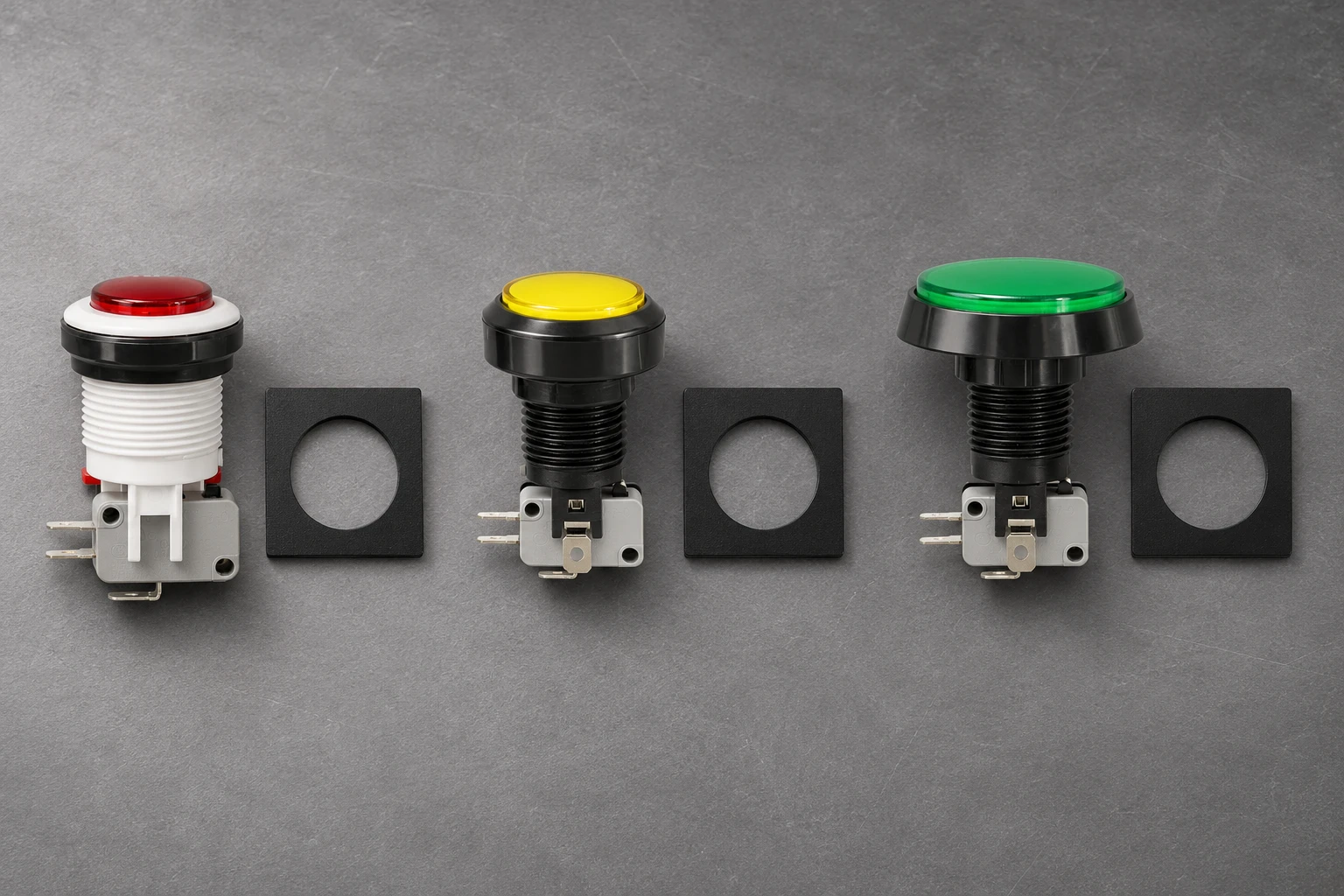
O Lemaele PBS series push button switch page lists versions with and without LED and provides a real product family reference. The public photograph does not prove that every pictured button is an illuminated variant. Ask Lemaele to confirm the ordered configuration and approved drive information before arranging an energized optical measurement. Do not derive LED terminals, polarity or voltage from the cap color or microswitch arrangement.
Define the optical question before collecting images
Uniformity asks how the observed luminance varies across selected parts of the emitting surface under a stated condition. Overall brightness, color consistency and readability in ambient light are related purchasing concerns, but they require their own definitions. An average over the whole cap can hide a localized dark region, while a sharp local highlight may not represent the cap’s intended emitting area.
A university study archived by UNT on LED push button lighting characteristics treats uniformity as one of several lighting-quality attributes. Its tested products and results are not PBS qualification evidence. For your own inspection plan, specify what information an operator must recognize and which cap region matters, then ask the optical specialist to define an appropriate measurable characteristic.
| Evidence item | O que verificar | Decision supported |
|---|---|---|
| Configuração | Confirmed LED option, cap and sample identity | Avoid comparing unlike variants |
| Conditions | Approved drive, stabilization and ambient conditions | Make observations reproducible |
| Geometria | Viewing angle, distance and cap orientation | Define what the result represents |
| Region map | Emitting area and exclusions documented | Prevent hidden changes in the calculation |
| Cálculo | Formula, region values, units and acceptance rule | Support a reviewable decision |
Fix drive, ambient light and viewing geometry
Use the supplier-approved electrical drive for the confirmed illuminated variant, applied by a qualified person using a suitable setup. Record the relevant actual drive conditions and the stabilization procedure in the report. Do not treat the switch contact rating as the LED supply specification. If a drive condition is missing, obtain it before testing rather than guessing from another button family.
Document the viewing direction, measurement distance, cap orientation and ambient-light control. A curved cap presents different surfaces to the detector as the viewing angle changes. Keep those conditions consistent between samples, and state which condition the result represents. If the equipment will be viewed from several directions, plan separate observations rather than claiming one front-facing image covers all possible installation angles.
Choose an instrument and region map that answer the question
Ask the laboratory whether it will use a suitable imaging luminance system or another validated approach. The report should explain how its spatial resolution and measurement area relate to the cap. A detector that averages a large region may miss a small dark zone; a tightly selected point may overemphasize texture. Select the method according to the characteristic being controlled, not the appearance of the instrument.
NIST’s photometric calibration publication identifies luminance among the quantities covered by its calibration services. This supports the importance of measuring the intended optical quantity with appropriate calibration. It does not validate a particular factory camera or establish PBS acceptance limits. Ask the laboratory for the calibration status and limitations relevant to its actual setup.
Record values and the exact uniformity calculation
Uniformity can be expressed using different ratios or statistical summaries, so the calculation must be named explicitly. Identify the measured regions, the values included and any excluded mask. If a specification uses a minimum-to-maximum ratio, do not substitute a minimum-to-average result under the same label. Two reports with similar numbers may answer different questions when their formulas differ.
This article deliberately supplies no universal passing percentage. The responsible equipment team should define an acceptance rule that matches the operator’s task and approved component requirement. Report raw region values as well as the chosen summary so reviewers can see whether a localized variation drove the result. Retain units, measurement conditions and uncertainty or method limitations with those values.
Use photographs as context rather than measurement proof
An ordinary image can locate a region of concern, document sample orientation and support discussion of visible appearance. Automatic exposure, reflections, image processing and clipping can also change the apparent distribution. Keep original image files where available and record the capture conditions. Avoid declaring a numerical luminance difference from ordinary pixel values unless the imaging process has been validated for that purpose.
Treat the daylight visibility review as a separate task because ambient readability differs from spatial distribution under a controlled optical setup. Surface condition can also affect observation, so retain the clear-cap abrasion and haze record when relevant. Neither record replaces a uniformity map, and neither should be used to imply an untested optical characteristic.
Compare samples without mixing configurations
Group results by confirmed illuminated variant and defined measurement condition. Cap color, legend arrangement or construction changes may require a new comparison basis. Do not rank differently configured buttons using a shared threshold simply because they fit the same panel opening. If the purchase specification covers several variants, define how each will be assessed and what evidence is shared legitimately.
Use repeated observations to investigate whether a suspicious region persists after the sample and measurement setup are checked. Record any repositioning or revised mask rather than choosing only the most favorable image. If a region changes because of a reflection or measurement alignment, keep that explanation with the data. If it remains attached to the sample, ask the supplier for a technical review without guessing its internal cause.
Request a report and quotation with clear boundaries
Send the desired PBS option, cap color, any approved legend, intended viewing conditions and the evidence your equipment program needs. Ask for confirmation of the drive specification and whether a suitable optical report can be provided for the requested configuration. Include the acceptance document if one exists; otherwise identify the need to define it with the responsible design team.
Utilize illuminated push button OEM guide for the broader ordering discussion. Keep mounting, switching and illumination requirements separately identifiable so one does not obscure another. A successful optical review cannot establish contact suitability or safe wiring, and a mechanically suitable button does not automatically meet a project’s illumination requirements.
Maintain the approved configuration and evidence
Close the review with the sample identity, measurement report, approved conditions and the resulting purchase disposition. List any missing information explicitly. When a supplier proposes a cap, LED or optical construction change, ask whether the earlier evidence still represents the new configuration. A family-level product name alone is not enough to settle that question.
Retain an approved reference sample where your quality procedure uses one, together with the objective report rather than as its substitute. Decide how future production will be checked and who reviews deviations. For a repeat purchase, compare the current order configuration with the version named in the report before carrying forward its disposition. Ask the supplier to identify any differences and have the responsible reviewer decide whether additional assessment is needed. The practical outcome is a well-defined evidence request: which button was evaluated, how the cap was observed, what calculation was used, and which agreed requirement supports acceptance. That is a stronger basis for purchasing than an attractive illuminated photograph.
Aprimoramento de conhecimentos
This nptelhrd lecture by IIT Kharagpur introduces photometry as background for understanding optical quantities. It does not demonstrate a PBS test or establish a product uniformity threshold.

Perguntas frequentes
Can a phone photo prove cap uniformity?
It can document appearance and location, but it cannot establish a quantitative luminance distribution without a validated measurement process.
Does every PBS button include an LED?
The product family includes options with and without LED. Confirm the complete ordered configuration rather than inferring illumination from a photograph.
What uniformity percentage should a PBS cap meet?
No universal PBS limit is established by the public product reference. Agree on the emitting region, calculation, conditions and acceptance requirement for your equipment.
Is uniformity the same as daylight visibility?
No. Uniformity describes distribution across defined regions under stated conditions. Ambient readability requires a separate evaluation appropriate to the equipment use.