
A 10A vs 15A IEC inlet comparison must start with the exact component approval, its voltage and its intended market. Two numbers on a catalogue page do not necessarily describe two physically different products, and a higher number does not automatically increase the permissible load of the complete equipment. Identify which rating applies to the purchased variant and the matching cord set. Then check the internal wiring, terminals, protective devices and equipment requirements. This guide explains that decision process without assigning a regional current rating or certification to an inlet based on its photograph.
It is intended for equipment designers, purchasing teams and competent service personnel. The illustrated LEMA inlet provides a product reference for discussing mounting and identity; it is not an approval certificate. Any live measurements or equipment modifications require qualified personnel following an approved procedure. This article concerns detachable equipment power interfaces rather than replacing domestic wall outlets.
Read the rating together with its approval context
A useful rating record includes more than amperes. Record the manufacturer, exact order code, voltage, applicable approval scheme, temperature conditions, terminal version and any installation conditions. When a supplier lists both 10A and 15A, ask whether the values come from different certification evaluations or refer to different variants. Do not combine a current from one line with a voltage from another to create a rating that was never declared.
O IEC 60320-1 catalogue entry identifies the standard family for appliance coupler general requirements. That entry establishes the subject of the standard, not the approval of a particular purchased inlet. The related standard sheets and the product’s certification documents provide the details needed for a specific comparison. Keep the edition used in the equipment assessment in the engineering record.
For example, if a vendor describes a component as 10A under one evaluation and 15A under another, request the supporting records for both before choosing a market configuration. That is an example of a documentation question, not a statement that every inlet carries those two approvals. A familiar front shape cannot resolve the question, and neither can a marketplace title copied from a different manufacturer’s product.
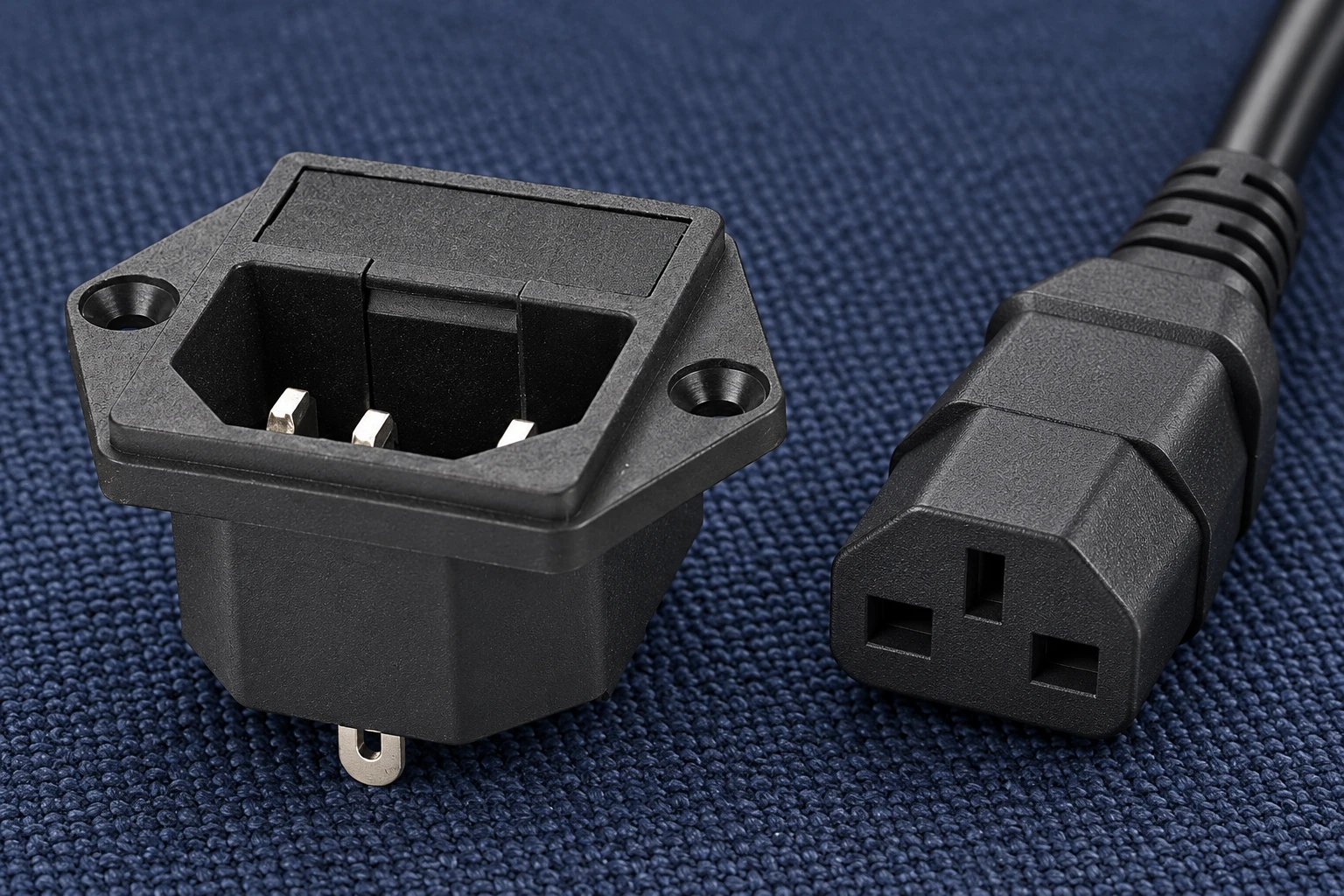
Distinguish the inlet from the cord connector
The equipment inlet is mounted on the appliance. The mating cord connector belongs to the cord assembly. Buying a higher-rated inlet does not upgrade an existing lower-rated cord, connector or upstream plug. Record the complete path from the supply plug to the internal load so that each component has an identity and an applicable rating. A detachable connection makes replacement convenient, but it also makes undocumented cord substitutions possible.
Check the mating interface designation against the approved drawing. Similar connectors can differ in keying, temperature class, protective conductor arrangements or intended equipment construction. Never remove a keying feature to make a connector fit. A connector that can be inserted is not, by itself, evidence that the assembled combination meets the equipment requirements.
Separate these checks from mechanical panel preparation. The power inlet panel cutout guide covers mounting fit and retention. Its dimensional checks complement the present rating review, but correct cutout dimensions cannot establish electrical approval. Both records are needed when a purchasing change alters the mounting style as well as the current designation.
Compare the complete assembly before selecting a number
| Comparison item | Provas a recolher | Reason to hold a substitution |
|---|---|---|
| Inlet current and voltage | Exact order code and applicable rating document | A catalogue mixes market ratings without identifying their conditions |
| Cord and mating connector | Approved cord assembly designation for the destination market | The proposed cord is not covered by the equipment configuration |
| Internal terminations | Terminal drawing, specified mating hardware and assembly method | A different terminal requires an unvalidated harness change |
| Equipment operating demand | Measured or documented input demand across permitted modes | The review considers normal running but omits startup or peak demand |
| Thermal conditions | Documented temperature limits and assembly assessment | Nearby heat or restricted ventilation falls outside the reviewed conditions |
| Protection and approval | Approved circuit and applicable equipment documentation | A larger fuse is proposed solely because the inlet number increased |
This qualitative checklist does not set a universal load limit. Its purpose is to reveal missing evidence before two catalogue numbers are treated as interchangeable. In US workplace applications, 29 CFR 1910.303 installation and labeling requirements (official 2025 edition) explains the requirement to follow the instructions associated with listed or labeled equipment. Other markets and equipment classes require their own applicable assessment.
Use power calculations only within their limits
For a simple resistive load, the familiar relationship P = V × I connects power in watts, voltage in volts and current in amperes. As an arithmetic example, 120V multiplied by 10A gives 1,200W. This calculation describes that simplified load relationship. It does not approve a 1,200W machine, establish a permissible continuous loading rule or address every electronic power supply’s input waveform.
For AC equipment with significant reactive or nonlinear behavior, real power divided by nominal voltage may not be enough to determine the RMS input current. Use the equipment manufacturer’s input specifications and a suitable measurement method. Record the operating mode, supply condition and measurement boundaries. A label showing output power is not necessarily the same as input demand.
Equally, a larger current number should not be used as permission to change protective devices. A fuse coordinates with the protected circuit and equipment requirements. The inlet fuse sizing guide explains the separate information needed for that decision. Keep component rating review and protective-device selection linked, with each conclusion supported by its own evidence.
Check termination changes as carefully as front dimensions
A replacement can fit the panel while changing the connection method behind it. Compare solder, quick-connect or other terminal versions against the actual harness design. Record the specified mating terminal and the manufacturer’s assembly instructions. A loose connection can produce local heating even when the catalogue current seems comfortably above the measured equipment demand.
Inspect the available space for conductor routing, insulation and service access. Do not force a terminal into a different orientation merely to clear a nearby cover. Verify that the selected mounting method retains the inlet under the expected cord handling. These are assembly-specific checks; a photograph cannot provide a universal torque, wire size or terminal force.
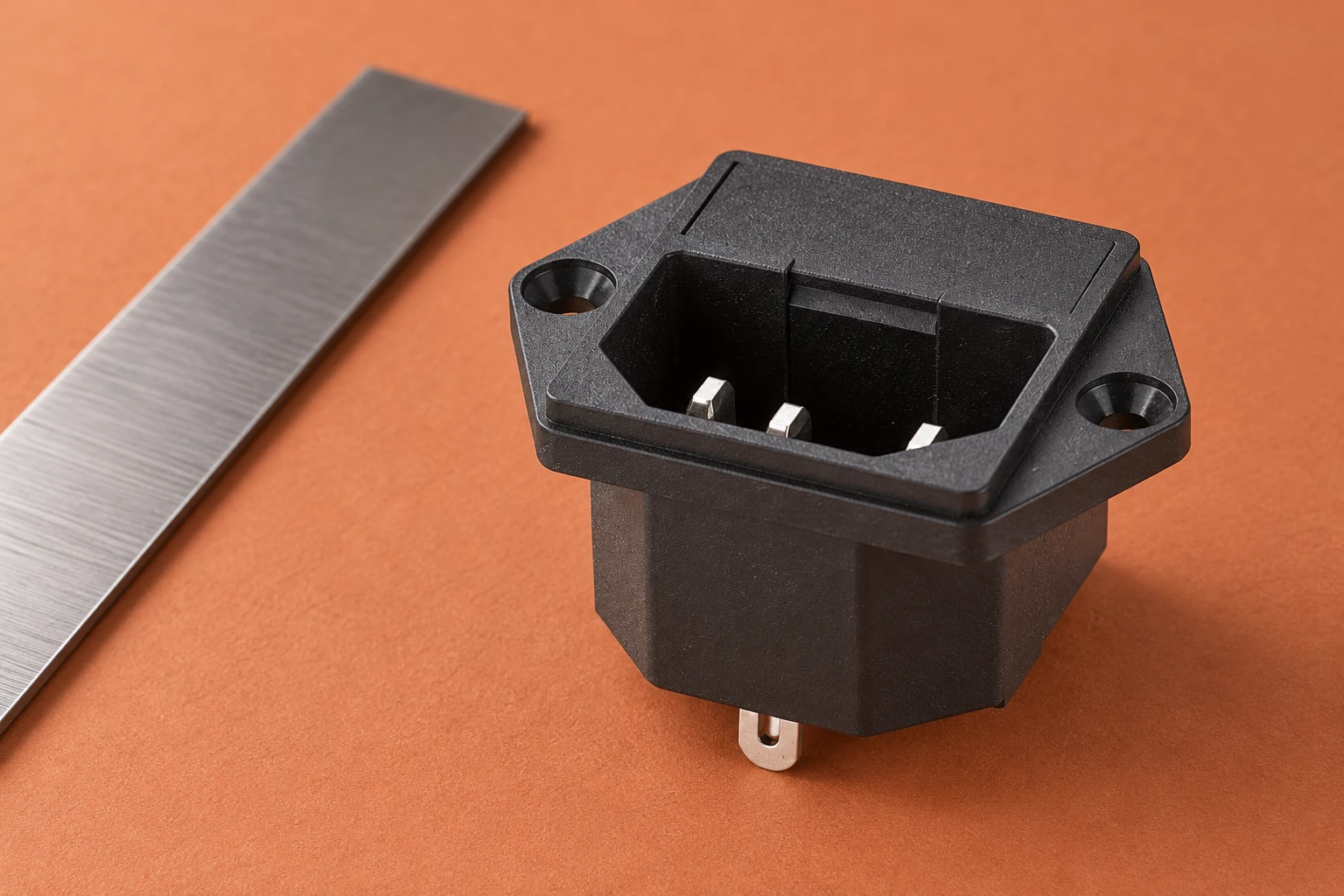
O LEMA IPZ inlet product reference shows mounting variants useful for early comparison. Ask for the drawing and rating documents for the exact proposed part. The pictures in this article illustrate visible housing and mating features only. They neither identify conductor functions nor certify a 10A or 15A installation.
Build separate destination-market configurations
A manufacturer supplying several countries may use one equipment platform with different approved cord assemblies. Maintain a configuration record that connects each destination market with its supply plug, cord connector, inlet variant and equipment assessment. This prevents warehouse teams from treating every physically compatible cord as an approved substitute.
When reviewing a supplier’s statement, ask whether an approval covers the finished component, a particular material and terminal version, or a limited use subject to conditions. Have the responsible compliance reviewer confirm the interpretation. The UL Product iQ information page describes a route to certification records; an online database search remains separate from evaluating the complete equipment.
Keep approved samples and photographs associated with their documents. If the delivered marking differs from the sample or the supplier changes the internal construction, treat that as a review trigger. An unchanged front panel appearance is insufficient to dismiss the change. Procurement should have a clear hold-and-query path rather than silently accepting a substitution.
Validate the operating configuration and close the record
Plan verification around the equipment’s permitted operating modes and environmental conditions. The responsible engineer should define what inspection, electrical and thermal checks are required, where measurements are taken and how results are judged. Do not create acceptance limits from a generic blog article or a one-time observation that a connector feels cool.
Record the actual cord set and inlet used during assessment. Keep supply voltage, load mode, enclosure configuration and relevant cooling conditions with the results. A test using an open cabinet or an unusually short duty cycle may not represent the intended equipment installation. If a component is changed, assess whether earlier evidence still applies to the modified assembly.
For heat-related symptoms, the separate contact resistance and heat guide discusses investigation boundaries. Here the final deliverable is an approval comparison: the exact part, its applicable rating, the permitted cord configuration, installation conditions and the reviewer’s decision. Select the inlet on that complete evidence, rather than choosing the largest ampere number in the search results.
Further learning
This independent educational video provides background for the checks discussed above. It does not identify the terminals of the illustrated LEMA product or replace the equipment manufacturer’s approved procedure.

Watch Electric power | Circuits | Physics | Khan Academy — Khan Academy Physics
Perguntas frequentes
Can the same inlet be described as both 10A and 15A?
A supplier may declare different ratings under different evaluations or for different variants. Verify the exact order code, market, voltage and supporting approval conditions; do not assume this applies to every inlet.
Does fitting a 15A inlet upgrade a 10A cord?
No. The cord, mating connector, internal wiring and equipment remain subject to their own applicable ratings and approval conditions.
Can I calculate equipment suitability from watts divided by volts?
That calculation has limits for AC loads. Use the documented input demand, suitable measurements and the complete equipment assessment rather than treating a simplified calculation as approval.
Should the fuse increase when the inlet rating increases?
Not automatically. Protective devices must remain coordinated with the approved circuit and equipment requirements, independently of a larger catalogue current number.