
Micro switch magnetic field exposure should be reviewed using the exact switch construction, field conditions and required switching behavior. A mechanically operated snap-action switch is not automatically a reed switch or Hall sensor, but that distinction does not establish immunity to an external magnetic field. For equipment near magnets, obtain applicable supplier evidence and assess the complete assembly. Do not infer a safe field limit from the current rating, housing material or a photograph. This guide explains how an OEM buyer can turn a vague “magnet resistant” request into a traceable component review without assuming an unverified product qualification.
Identify the switching mechanism first
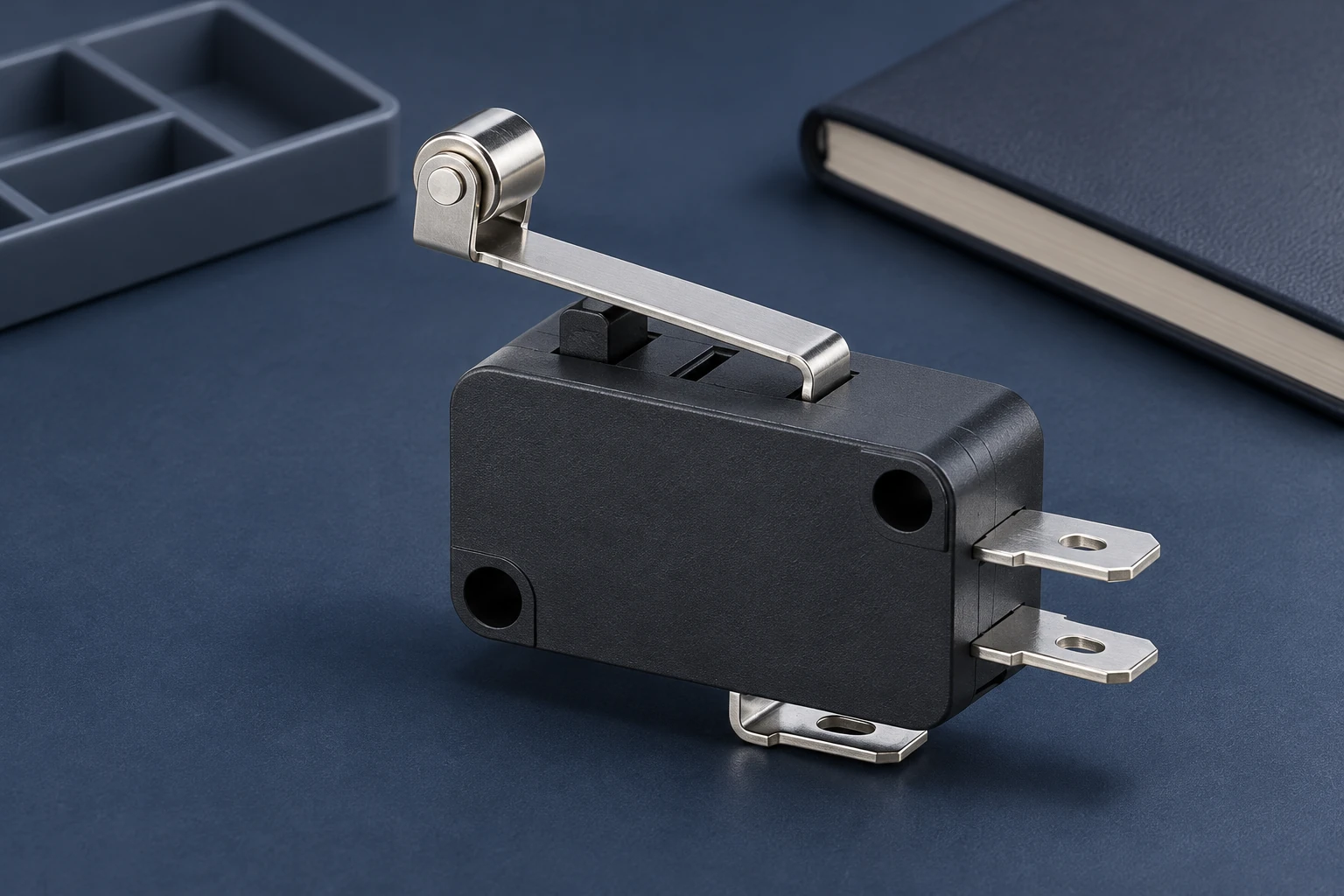
O Micro Interruptor da Série KW7 provides a real mechanical product reference: the website shows plunger and lever configurations with electrical terminals. Those visible features help identify the component family, but they do not disclose every internal material. Ask for the exact ordering code, actuator configuration, terminal arrangement and relevant construction information. Keep the purchased configuration attached to the inquiry rather than sending a generic picture of a similar switch.
A reed switch is intended to respond to a magnetic field. A Hall sensor uses a different sensing principle and associated circuitry. A mechanically actuated microswitch changes contact state through physical actuator movement. Confusing those categories can send a purchasing team toward an irrelevant sensitivity specification. Conversely, calling a component mechanical does not prove that all its parts are nonmagnetic or that every operating characteristic remains unchanged near a magnet.
Start the specification with the required machine function. Is the switch detecting a door position, confirming a mechanism endpoint or reporting a manual action? Record which contact state is required at each mechanical position. This makes the review about a defined function, rather than an undefined promise that the switch will “work around magnets.”
Describe the field at the actual installation
A useful inquiry identifies the field source and where the switch sits relative to it. Include an assembly sketch, the source operating states, switch orientation, permitted mounting variation and the operating sequence. Ask the responsible engineering team which field quantities must be measured or modeled. A supplier cannot reliably assess the installation from “near a motor” without information about the actual location and operating conditions.
Separate a steady field from changing fields and radiofrequency exposure. The FDA discussion of MRI benefits and risks distinguishes these environments in a specialized medical setting. Its value here is the distinction between phenomena, not a test prescription for industrial switches. An ordinary switch must not be described as suitable for an MRI environment on the strength of this article or an informal bench observation.
Distance alone is not a transferable acceptance criterion. Two assemblies can have different source geometry, magnetic paths and nearby materials even when the measured separation is identical. Record the switch location and orientation in an agreed coordinate system. Where field measurements are part of the assessment, preserve the instrument identification, measurement locations and source states so that another person can interpret the record.
Keep the mechanical review separate from signal noise
A reported false input can arise at different points in the system. The physical actuator might move unexpectedly, the contacts might not produce the intended state, or the downstream circuit might interpret a disturbance as a state change. Do not assign the cause to magnetic influence before isolating those possibilities. Preserve the event conditions, input traces and mechanical observations when an intermittent problem appears.
The existing guide to cable shielding and PLC noise addresses a neighboring signal-path question. Cable routing and input interpretation deserve their own assessment; they cannot be used to establish a microswitch field rating. Equally, a satisfactory continuity reading taken away from the installation cannot resolve a disturbance that only occurs when another part of the machine is operating.
Record what was actually observed. “Input indicated open during source start” is more useful than “magnet damaged switch” when no component investigation has yet established damage. Keep source operation, actuator movement, contact indication and controller indication on a common event timeline where feasible. That sequence helps the responsible team choose the next measurement without treating the initial explanation as a confirmed failure mechanism.
Build an evidence request that can be answered
The following table is a qualitative inquiry checklist. It contains no universal field threshold or product rating. Use it to agree what information is required before an assessment starts.
| Inquiry field | Information to retain | Unresolved question |
|---|---|---|
| Configuração | Part code, actuator and construction revision | Does available evidence cover this variant? |
| Field source | Type, operating states and location | Which phenomena require assessment? |
| Orientação | Assembly sketch and mounting variation | Are relevant installation positions represented? |
| Função | Required contact states and transitions | What behavior constitutes acceptance? |
| Evidência | Specimens, methods, observations and limits | Can this report support the proposed use? |
Ask whether existing evidence covers the same construction and operating requirement. A report about another actuator, internal revision or enclosure arrangement may be useful background while still leaving an unresolved applicability question. Request a clear statement of what was tested, how it was oriented and what acceptance criteria were used. Keep exceptions in the decision record instead of silently broadening the report scope.
Historical technical literature can help the team frame questions. For example, the NASA technical report held in NTRS is supporting research material, not a certificate for the KW7. Read the original report scope before using any observation. Evidence on a particular contact assembly cannot establish the response of an unidentified modern switch with a different mechanical construction.
Plan assessment around the required contact states
Define the relevant actuator positions and source operating states before testing. A useful matrix may include the unoperated switch, the intended operated position and the transition between them. The engineering team should decide which loads, mounting conditions and environmental factors belong in the assessment. Acceptance must address the actual required function rather than the convenience of a single instrument reading.
Where a test is authorized, distinguish observations made during exposure from checks made only afterward. A component that returns to its expected state after the source is removed may still have shown unacceptable behavior during the event. Conversely, a post-test change requires investigation before it can be assigned to a particular physical mechanism. Preserve the specimen identity, setup photographs and observation sequence for that investigation.
Do not improvise tests with strong magnets, live circuits or safety-related equipment. Use an appropriate facility and a plan approved by the responsible people. The assessment may require controls for movement, electrical energy and nearby equipment. This guide does not supply exposure limits, laboratory procedures or permission to bypass machine safeguards. Component evaluation and machine safety approval remain separate decisions.
Preserve the mounting and actuator configuration
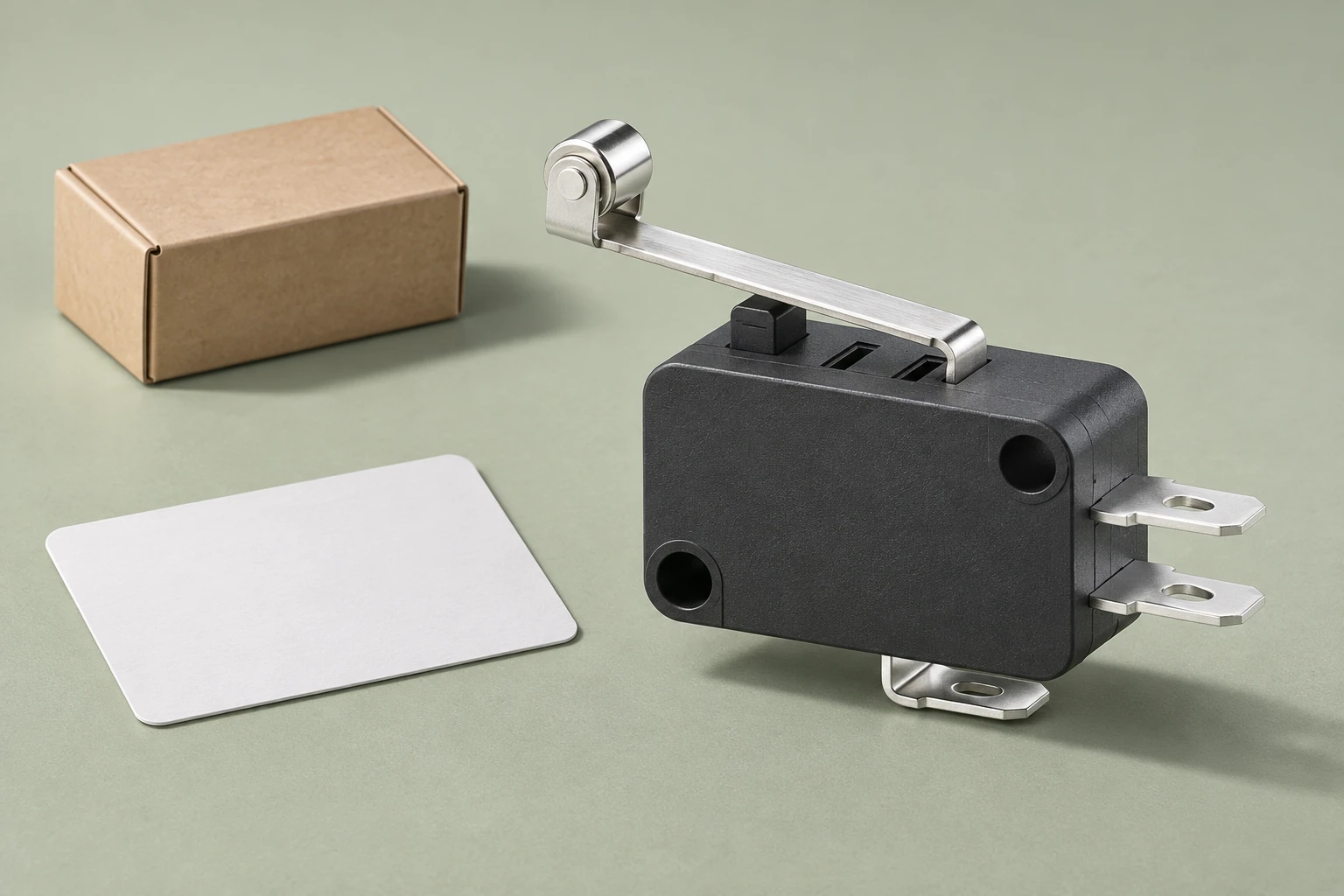
A magnetic-field inquiry still depends on ordinary mechanical details. A change from a plunger to a roller lever changes the identified configuration and its installation relationship. Do not substitute a different actuator because it fits the same mounting holes and then carry forward the earlier assessment without review. Preserve the agreed operating geometry and use the supplier drawing for the exact variant.
O industrial microswitch selection guide provides the broader starting point for matching application requirements. The microswitch replacement guide addresses form, fit and function during maintenance. Neither replaces exposure-specific evidence, but both help prevent an unrelated configuration change from making a previous assessment difficult to interpret.
Keep magnetic exposure requirements in the controlled purchasing record when they matter to the application. A free-text email that never reaches the replacement order can disappear during maintenance. Record the approved part reference, any construction restrictions, applicable report and unresolved limits. If the switch or surrounding assembly changes, ask whether the original decision still applies before accepting the replacement.
Use educational physics to clarify the review
The IIT Delhi physics lesson below explains force and torque in a magnetic field. It provides background for understanding why construction and orientation belong in a field-exposure inquiry. It does not show a KW7 test, establish field immunity or supply a procurement threshold. Use it to clarify the physical questions, then use applicable component and assembly evidence to make the selection decision.
CH 22: IIT Delhi: Physics [ IIT-PAL]: Force and torque due to magnetic field (CH_22)

Watch Force and torque due to magnetic field (CH_22).
Send a concise technical inquiry
A productive inquiry includes the exact part reference, application sketch, field-source information, required mechanical and electrical behavior, relevant operating states and the evidence requested. State explicitly whether the inquiry concerns a steady field, changing field, radiofrequency environment or more than one phenomenon. If the field description is incomplete, ask the application team to resolve it instead of requesting a meaningless universal approval.
For a supplier response, distinguish three outcomes: directly applicable evidence is available, further assessment is required, or the proposed use is outside the established information. All three can be useful purchasing answers when their boundaries are clear. A missing published field rating should remain an open requirement rather than being filled with an assumption about the housing or mechanism.
Release the part only through the equipment team’s normal review process. Retain the final configuration, evidence references, acceptance decision and change-control trigger together. The practical objective is a reproducible explanation of why the selected assembly meets its defined function, including what has not been established. No magnetic-field limit or specialized medical-environment approval for a Lemaele product is asserted here.
Perguntas frequentes
Is a mechanical micro switch the same as a reed switch?
No. A mechanically actuated switch and a magnetically operated reed switch use different actuation principles. Identify the exact component before requesting evidence.
Does a plastic housing establish magnetic immunity?
No. Housing appearance does not identify every internal material or establish behavior in an external field.
Can a general current rating establish a field limit?
No. Electrical ratings do not by themselves define magnetic-field exposure qualification.
Does this guide approve KW7 for MRI equipment?
No. No MRI approval or magnetic-field limit is established. The intended specialized environment requires its own applicable assessment.