
A maintained toggle switch stays in its selected state after the lever is released. A momentary toggle switch is active only while the lever is being held and then returns to its rest position. That release behavior—not the word “toggle”—is the first decision for an OEM panel or equipment control.
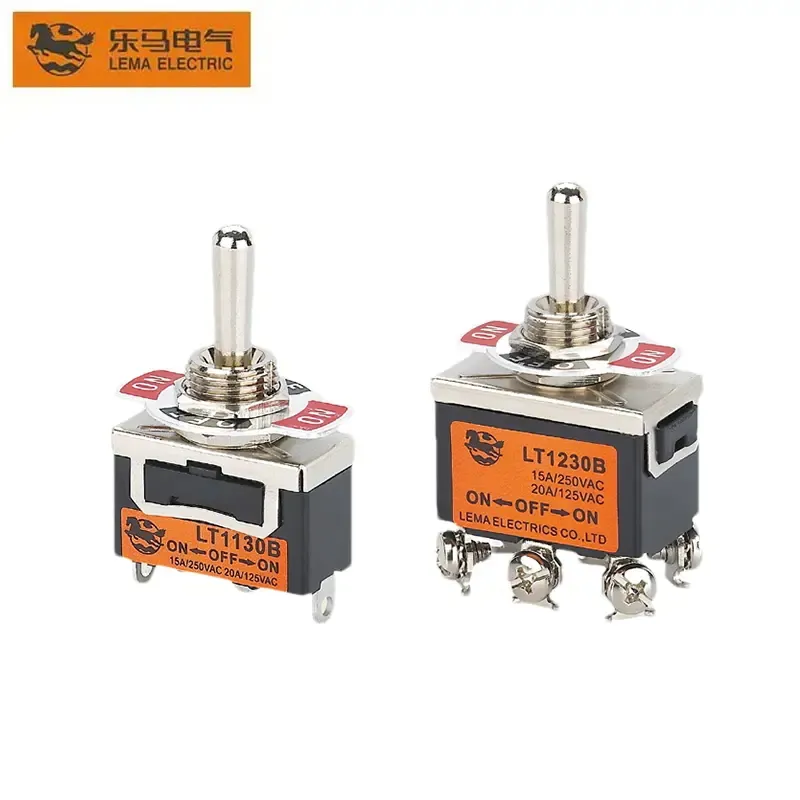
For a control that must remain ON, OFF, or in its selected route after the operator lets go, start with maintained action. For a control intended to act only during a hold, start with momentary action and verify the exact return positions in the selected part’s drawing. TE Connectivity’s toggle-switch overview makes the same core distinction: both maintained-contact and momentary toggle types exist.
The practical difference for a panel specification
| Question | Maintained action | Momentary action |
|---|---|---|
| What happens when the operator releases the lever? | The selected state remains until the switch is actuated again. | The active state ends when the lever is released and the mechanism returns to its stated rest position. |
| Best first-use question | “Should this circuit state persist without the operator holding the lever?” | “Should this command exist only while the operator holds the lever?” |
| What must be confirmed in the part documentation? | The available positions and the circuit state associated with each position. | Which position or positions spring back, and the complete return map. |
| Common purchasing risk | Buying a general “toggle” without confirming the state that remains after release. | Treating a generic ON/OFF label or a center position as proof of spring return. |
The terms vary across catalogues. Some use “latching” or “alternate” for a state that remains after actuation; Panasonic’s explanation of momentary and alternate operation illustrates the distinction. Treat those words as prompts to read the drawing, not as a substitute for it.
Toggle is the lever style, not the operating decision
“Toggle” describes a lever-actuated switch. It does not, by itself, say whether the selected lever position will remain or return. The same product family can also be offered with different pole/throw arrangements, numbers of positions, terminals, mounting options, guards, sealing provisions, and operating actions. Those are separate selection fields.
That is why an ON-OFF or ON-OFF-ON label is not enough for an engineering handoff. It describes a sequence of labeled positions, but the drawing or catalogue legend must still show which positions are maintained and which, if any, return on release.
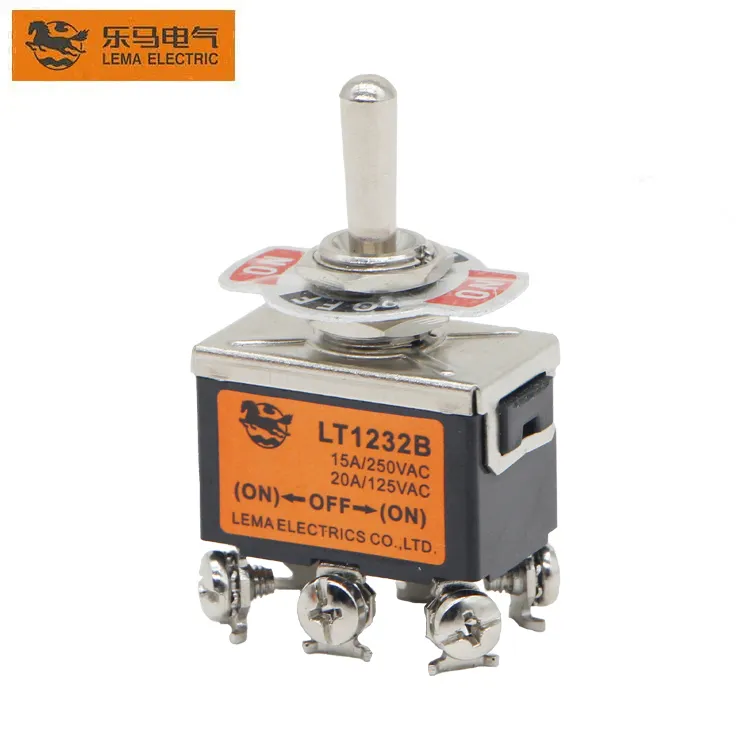
Read the release behavior before comparing configurations
Use this sequence before selecting an SPST, SPDT, DPDT, two-position, or three-position option:
- Write the required state after release. For each lever position, state whether the circuit must keep its selected condition or return to rest.
- Name the operating action. “Maintained” is suitable only when the selected state must persist; “momentary” is suitable only when the intended command ends when the lever is released.
- Then compare circuit and mechanical details. Choose poles, throws, positions, terminals, panel fit, clearance, environmental needs, and electrical requirements against the selected model documentation.
This order prevents a familiar configuration label from deciding the operating behavior by accident.
Turn the decision into an unambiguous BOM line
The useful output is a short state map—not merely the phrase “toggle switch.” A purchasing or supplier inquiry can carry these fields:
| Field to record | Why it matters |
|---|---|
| Position-by-position state map | Shows what must happen at each lever position and after release. |
| Operating action | Identifies maintained or momentary behavior before substitutions are considered. |
| Circuit configuration | Keeps poles/throws separate from the action decision. |
| Mechanical constraints | Captures mounting, actuator clearance, terminals, labels, and any guard requirement. |
| Electrical and application conditions | Must be checked against the selected part’s documentation and the real load. |
For example, some catalogues put a function in parentheses to indicate a momentary position. Spemco shows this convention, but it is not a universal legend. Keep the exact state map and the manufacturer’s drawing together in the approval record.
When the answer is maintained—and when it is not enough
Choose the maintained path when the intended equipment behavior is for the operator to select a state and release the lever while that state remains. The next review is not simply “find an ON-OFF switch.” Confirm the circuit arrangement, the number of available positions, and every mechanical and electrical constraint against a selected part.
Choose the momentary path when the command must exist only during actuation. If that is your conclusion, use this guide to selecting a momentary toggle switch for OEM duty for the next questions on return maps and hold-duty documentation. A maintained substitute should not be accepted just because it has a similar lever or mounting format.
A LEMA Toggle Path After the Action Is Defined
LEMA’s Toggle Switch category is a useful starting path once the action and state map are settled: the public category lists LT1, LT2, and LT3 series alongside individual product pages. The site also presents a self-resetting toggle switch with screw terminals, which is relevant as an example of a product that should be checked for return behavior rather than selected from a general “toggle” label.
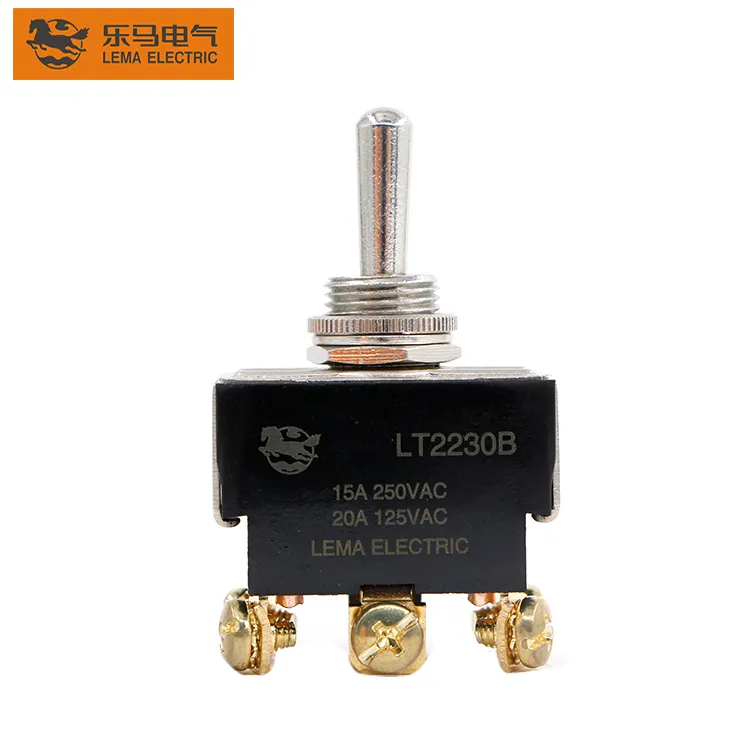
Do not treat the category, image, or product title as proof that a particular LEMA model fits your circuit. Before selecting a model, obtain and review the current model documentation for its state map, ratings, mechanical installation, approvals, and applicability to the actual equipment.