
When an OEM uses several toggle-switch descriptions across panels, harnesses or equipment variants, “wholesale” can sound like a simple volume-buying task. It is not. A lower number of purchase lines is useful only when the function, interface and approval record remain under control.
The practical goal is to make each request comparable before asking for a quote. That protects purchasing from comparing unlike options and gives engineering a clear point at which an alternative needs review rather than an informal “same as” decision.

Consolidation is an approval decision, not a SKU-count target
Start by separating two ideas that are often combined:
- Buying fewer lines may simplify purchasing and inventory.
- Approving fewer configurations changes the engineering and quality boundary.
Those actions can happen together, but they do not automatically mean the same thing. Two switches may look alike in a catalogue and still need different circuit functions, lever positions, terminals, panel interfaces or environmental provisions. Until the responsible team accepts that boundary, keep the parts as separate lines.
For product-family exploration, use the LEMA Toggle Switch category to locate its current LT1, LT2, LT3 and waterproof paths. Treat the category as a starting point for an exact-model review—not as proof that any two listed products are interchangeable.
Build a controlled line-item record before requesting a wholesale quote
An RFQ becomes comparable when the buyer supplies the information that must not drift during quotation or re-ordering. The following record is deliberately evidence-led: it asks for requirements and documents, rather than guessing from a photo or a broad product title.
| Field to lock | What the buyer records | What the supplier should return or confirm | Why it matters for consolidation |
|---|---|---|---|
| Function | Required circuit behaviour and lever positions from the approved design | Exact model code and the applicable product document | Similar lever shapes do not establish the same circuit behaviour. |
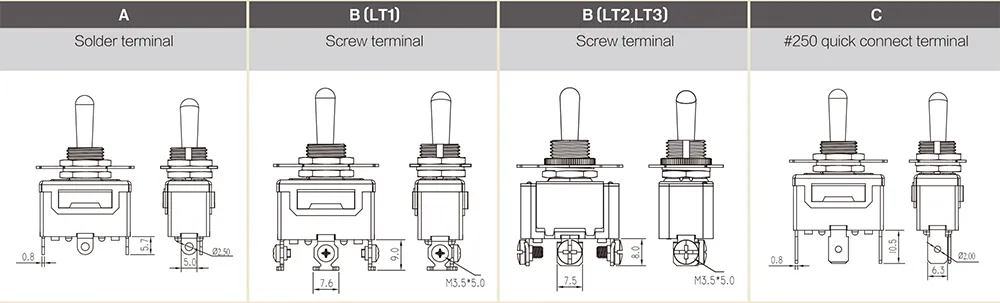
| Interface | Panel requirement, fixing method and mating / wiring interface | Dimensioned drawing and terminal identification for the quoted model | A purchase line cannot be shared when installation or termination changes. |
| Actuation | Maintained or momentary behaviour, where required by the design | Model-code explanation and any relevant drawing note | This prevents a functional change from being hidden inside a generic description. |
| Environment | The actual exposure, sealing need and assembly condition | The model-specific evidence and the condition under which it applies | Do not turn a general “waterproof” label into an unverified system claim. |
| Approval basis | Current internal part number, drawing revision and acceptance owner | The quoted model’s document revision and any stated change-notice process | This makes a later alternate visible to engineering and quality. |
| Commercial record | Required quantity pattern, packaging needs and delivery destination | Quote validity, packaging proposal and delivery terms | These are commercial facts to obtain in the quote, not assumptions to publish. |
The table does not prescribe a universal specification. It gives every participant the same fields to complete. If a field is unknown, flag it as an evidence gap instead of filling it with a nominal value from an unrelated series.
Use three buckets instead of forcing every request into one part number
After the record is complete, sort candidates by approval boundary rather than by appearance.
- Same approved basis. Keep lines together only when the responsible team can point to the same required function, interface, conditions and accepted model evidence.
- Candidate alternate. Keep a similar option separate while it is being reviewed. Ask what would have to be confirmed before it could become an approved alternate.
- Separate requirement. Retain a distinct line when the function, installation, exposure, documentation or ownership differs.
This approach is especially useful when purchasing sees many close descriptions. It gives the team a way to reduce duplicate requests without silently removing a necessary variation. It also improves the next RFQ: the supplier can identify whether it is quoting the approved item, proposing an alternate, or responding to a different requirement.
Ask for an evidence pack, not a promise
A clear supplier request reduces the chance that “OEM” or “custom” becomes a vague label. For each line or candidate alternate, request the evidence needed for the buyer’s own review:
- the exact quoted model code and its configuration explanation;
- the applicable drawing or datasheet revision;
- terminal and mounting information relevant to the assembly;
- the source and scope for any protection or approval statement being relied upon;
- the proposed sample / first-article route, if your internal process requires one; and
- the supplier’s stated notification path for a material, tooling, document or model change.
This is a request checklist, not a claim that every supplier can provide every item. Where a document is missing, preserve that gap in the review record. Purchasing can then decide, with engineering and quality, whether the missing evidence blocks the quote, needs a test, or requires a separate purchase line.
Run a short cross-functional release loop
Consolidation works best when it has a visible owner at each handoff.
- Purchasing collects the controlled record and keeps the quote attached to the proposed model code.
- Engineering checks the required function and physical interface against the approved design evidence.
- Quality or compliance owner checks the evidence needed by the organisation’s acceptance process, including the scope of any claimed approval.
- Supplier confirms what was quoted and identifies any variance from the request.
- The record owner releases the resulting line as approved, approved with conditions, or still separate.
The point is traceability, not bureaucracy. A visible decision protects a later re-order from becoming a new, undocumented part choice.
If the immediate question is how to evaluate the supplier rather than how to control the part record, see LEMA’s guide to evaluating a toggle-switch manufacturer in China. That supplier-assessment question is related, but it should not replace model-level approval evidence.
Start the model-level review with the LEMA toggle-switch range
The LEMA category can help a buyer identify a relevant product family for a model-level discussion. As one concrete example, the LEMA three-position mini waterproof toggle-switch page exposes terminal-type, panel-waterproof-nut and model-selection material. Those are useful prompts for the evidence pack above.
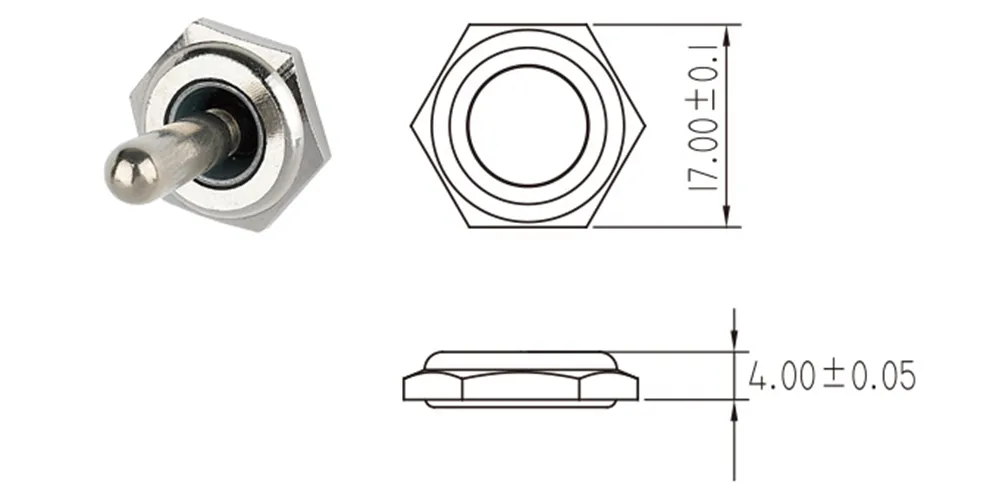
The linked category and product page do not establish fit for your panel, circuit, exposure, certification scope, availability or production approval. Use them to start a precise conversation, then validate the exact model and conditions against your own design and acceptance process.
References
- LEMA Toggle Switch category — current family navigation and product-card context for the model-level review.
- LEMA three-position mini waterproof toggle-switch page — example page showing terminal, panel-nut and model-selection material for an exact listed product.
- Switch Components toggle-switch catalogue — an external catalogue illustrating why circuit, terminal and position variants must be treated as controlled request fields.