
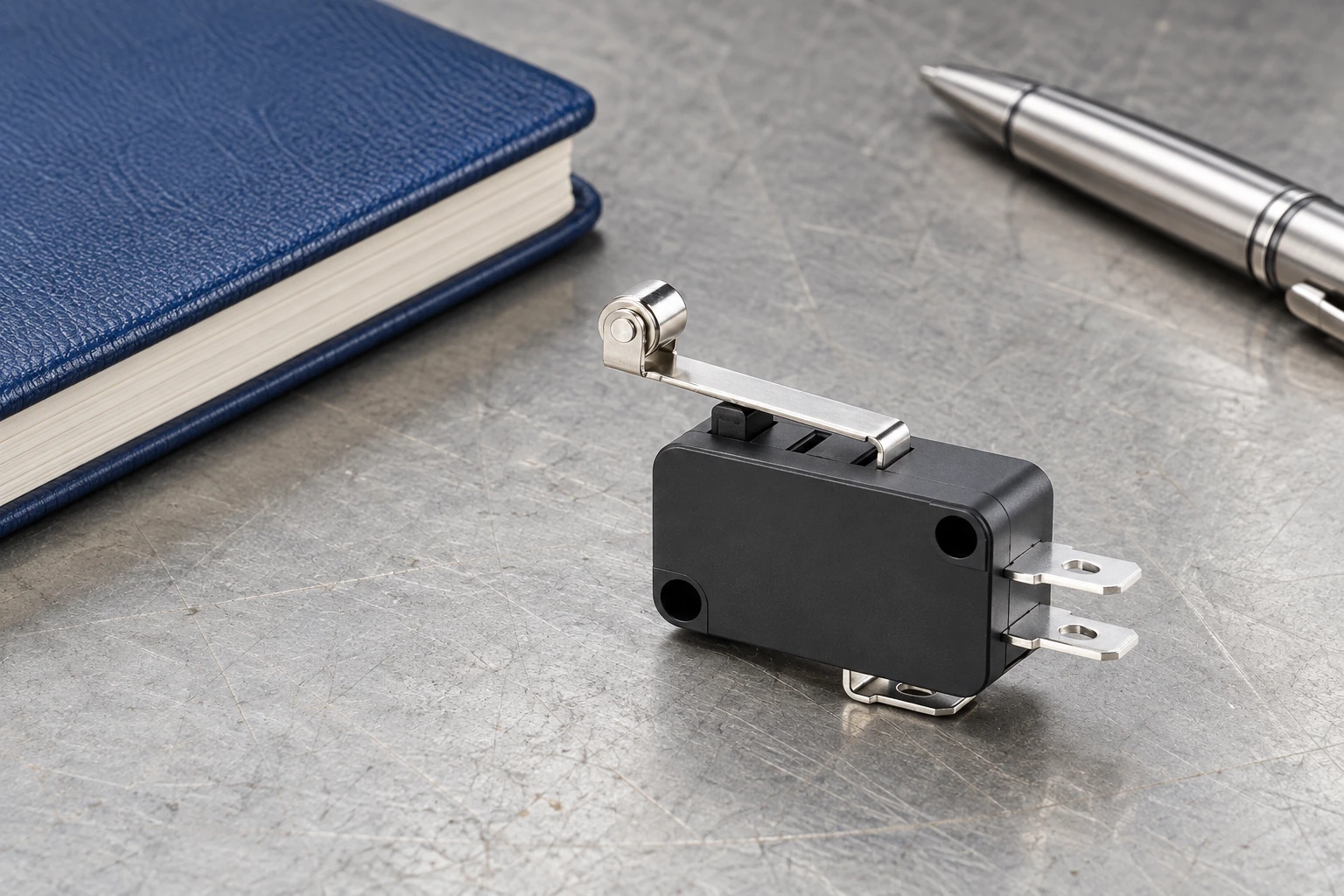
Micro switch accelerated life testing can shorten the time needed to investigate a failure mechanism, but it cannot turn an arbitrary harsh test into a credible service-life prediction. Define the intended use, identify the mechanism being accelerated and justify the relationship between test stress and service conditions before extrapolating. For the LEMA KW7 series, request evidence for the exact variant and duty. No acceleration factor, field reliability or guaranteed lifetime is assigned here. A switch that survives rapid unloaded cycling has answered a different question from a loaded switch tested under a justified acceleration model.
Decide what decision the test must support
Begin with the engineering decision. A team may want to compare design variants, discover weak construction, establish a qualification result or estimate life under a specified duty. These are different objectives. A test designed to expose weaknesses can be useful without supporting a numerical life prediction. Name the objective before ordering fixtures or selecting an elevated stress.
The NIST accelerated life test guidance describes planning around stress levels, samples, observation time and models. The NASA accelerated testing knowledge base discusses accelerated exposure as a way to reveal failures sooner. These are general reliability resources. Neither provides a validated model or a qualified test profile for a particular LEMA switch.
Write the proposed conclusion in advance. “Variant A showed fewer failures under this test” is narrower than “Variant A will last a specified number of years in every machine.” The second statement requires a chain of assumptions and evidence that the first does not. Making the intended conclusion explicit helps prevent a useful development experiment from being promoted into an unsupported sales claim.
Define the use condition before the accelerated condition
Specify the installed actuator, travel window, speed, electrical load, environment and expected sequence of use. Distinguish calendar exposure from contact operations. A machine that runs continuously and one that sits idle in a damp location can accumulate different kinds of damage despite recording the same number of switching events. The accepted model must correspond to the mechanism of interest.
The electrical and mechanical life guide explains why loaded and unloaded endurance are different. An acceleration study needs that distinction at the start. State whether contacts make and interrupt the actual load, operate an interface or only carry a load switched elsewhere. Keep the circuit and suppression arrangement controlled throughout the study.
Describe the mechanism motion with similar care. Increasing the cycling rate can change impact, dwell, heating or recovery time. It may also shift the test from intended operation into actuator abuse. A counter displaying many operations proves only that the counter recorded events; the study must show that the switch experienced the intended mechanical and electrical conditions.
Identify the failure mechanism you intend to accelerate
A single switch can fail in several ways. Contact degradation, a damaged terminal connection and an actuator return problem need different observations and potentially different models. Combining them indiscriminately into one life number can hide the reason the data changed with stress. Define failure criteria and retain enough evidence to classify what happened.
An elevated temperature test may reveal a mechanism that is irrelevant at the intended use conditions. A faster motion profile may produce abnormal impacts. More severe is not automatically more representative. Review failed samples and compare the observed damage with the expected field mechanism before fitting an acceleration relationship. If the mechanism changes, the inference must change as well.
Record competing failures rather than deleting inconvenient units. A fixture cable failure, a sensor problem or a jam can interrupt observation without being a component failure. The analysis should preserve how each sample left observation and why. Otherwise the apparent reliability improvement may simply reflect inconsistent handling of incomplete or unrelated results.
Build a test-planning record
| Planning field | Evidence to define | Limit to preserve |
|---|---|---|
| Decision | Comparison, exploration, qualification or prediction | These conclusions need different support |
| Use condition | Electrical duty, motion and environment | Operation counts are not calendar exposure |
| Acceleration | Stress selection and mechanism rationale | Harsher is not automatically representative |
| Observation | Failure criteria and fixture verification | Preserve incomplete and competing outcomes |
| Inference | Model checks and uncertainty | Report observations when extrapolation is unsupported |
This table sets evidence questions rather than sample sizes or stress values. The appropriate design depends on the intended conclusion and the available knowledge about the mechanism. If the study lacks enough failures or enough distinct conditions to support a proposed model, keep the conclusion limited. Choosing a model because it produces the desired forecast reverses the purpose of testing.
Use the planning review to decide which measurements must be collected continuously and which can be collected at defined inspections. Intermittent switching faults may be missed by a simple end-of-test continuity check. Conversely, an overly sensitive detector can count fixture noise as a switch failure. The observation method needs validation against the actual failure criterion.
Separate fixture performance from component performance
The actuator fixture must deliver the specified motion without drifting into a different travel range. Record alignment, mounting, measurement locations and the setup checks performed before and during the test. The switch fixture guide provides background for separating setup behavior from component behavior. Use the exact available fixture evidence rather than assuming repeatability from its appearance.
Verify the electrical observation path as well. Contact voltage, current and timing should represent the study’s defined duty. A replacement supply, changed filter or loose fixture connection can alter the apparent failure rate. Keep a configuration log so an analyst can connect a change in the data to an intentional intervention or an equipment problem.
Control the thermal and environmental exposure around the installed sample. A chamber indication may differ from the local temperature at a loaded terminal or a shielded sample position. Record what was measured and where. The purpose is to establish the actual test conditions with their limits, not to imply that every available sensor measures the same exposure.
Fit and challenge the model before extrapolating
Model selection should follow the physics and the data. Check whether the assumed relationship between stress and life is plausible for the mechanism being studied. Review the distribution, variation across stress levels and uncertainty in the fitted parameters. A smooth line on a graph does not demonstrate that the assumptions remain valid outside the observed range.
Include the data that do not end in a failure with an appropriate statistical treatment. Record observation time and why a sample was removed or remained functioning when the study ended. Do not silently count all survivors as permanent successes or discard them to simplify the calculation. The inference should reflect the information the experiment actually collected.
State the extrapolation distance and its uncertainty in the report. A result close to observed conditions and a distant service-life forecast do not have equal support. If the model has not been established, report the direct observations instead. Those observations can still guide development, supplier discussions or the design of a better follow-up experiment.
Keep exploratory screening separate from qualification
A development team may deliberately increase stress until a weakness appears. That can help prioritize design improvements, but the observed threshold is not automatically a service rating. Describe the exploratory purpose and preserve the test history. Avoid combining exploratory and qualification results as if every sample had followed one controlled acceptance procedure.
Qualification should use the agreed acceptance criteria, controlled configuration and required conditions. If an accelerated method is proposed as part of that evidence, the responsible equipment review must accept its basis and limitations. The supplier’s catalog life remains a separate statement unless the new study explicitly establishes how its conditions compare.
Link the final study to the sample approval record and the exact production identity. A later material, terminal or actuator change may affect the failure mechanism or test applicability. Preserve raw observations, setup history, failure analysis and the model version so a future reviewer can understand why the original decision was made.
Stress measurement background video
nptelhrd: Module 14 – Lecture 1 – Vibration Measurement
Watch Module 14 – Lecture 1 – Vibration Measurement.
The NPTEL lecture explains vibration measurement, which is relevant when vibration is one of the proposed test stresses. It supports measurement planning only. It does not supply an acceleration law for a KW7 switch or establish that a particular vibration exposure predicts field life. The life model must be justified separately.
Frequently asked questions
Can faster cycling alone predict field lifetime?
No. Faster cycling may change heating, impact and recovery behavior. The mechanism and the relationship to service conditions need evidence before a life prediction is made.
Is an exploratory overstress test a qualification test?
Not automatically. Exploratory testing can reveal weaknesses without establishing an accepted service limit. Keep its purpose and conclusion separate from a controlled qualification procedure.
What if the samples do not fail during the study?
Retain their observation times and test conditions. Survivors contain information, but they do not prove unlimited life. The analysis must treat the incomplete lifetime observations appropriately.
Does this article assign a reliability value to KW7?
No. It provides a planning framework and no measured lifetime, acceleration factor or reliability claim for a particular KW7 variant.