
Toggle switch UV weathering should be reviewed through evidence for the exact exposed parts, material formulation and installed assembly. A waterproof description or metal lever does not establish sunlight durability for the housing, seal, boot, markings or surrounding panel. Specify which surfaces receive light, what functional changes matter and how the evidence relates to the intended environment. Ask for documented exposure conditions and acceptance criteria rather than a generic “UV resistant” statement. Accelerated exposure can help compare defined constructions, but a chamber duration alone does not establish a guaranteed number of outdoor years for an assembled control.
Define what is actually exposed to sunlight
Start with the equipment drawing and normal operating position. A toggle on an open panel may expose its lever, nut and boot directly, while the body remains behind the panel. A transparent enclosure can change the light reaching the control, and a hinged cover changes exposure when it is open. Record the orientation and likely shading rather than assigning the same exposure to every component in the assembly.
Describe use as well as storage. Equipment can spend long periods parked outdoors even if operation is brief. A replacement switch stored inside its packaging has a different exposure history from the same part installed in a demonstration panel near a window. Capture the relevant lifecycle stages, cleaning practices and expected inspection access. These observations define the evidence needed; they do not by themselves quantify a weathering dose.
Identify the parts and avoid assumptions from appearance
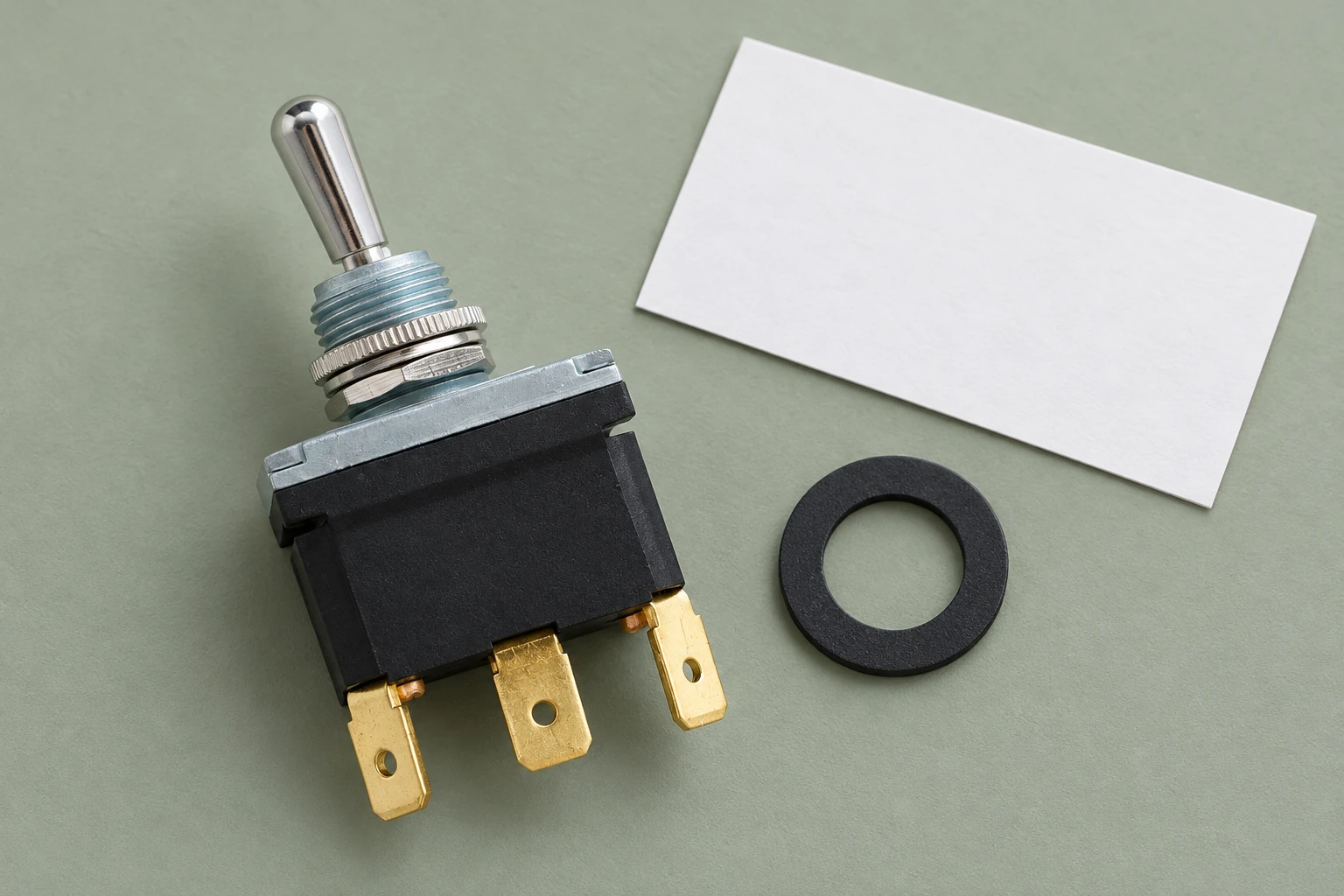
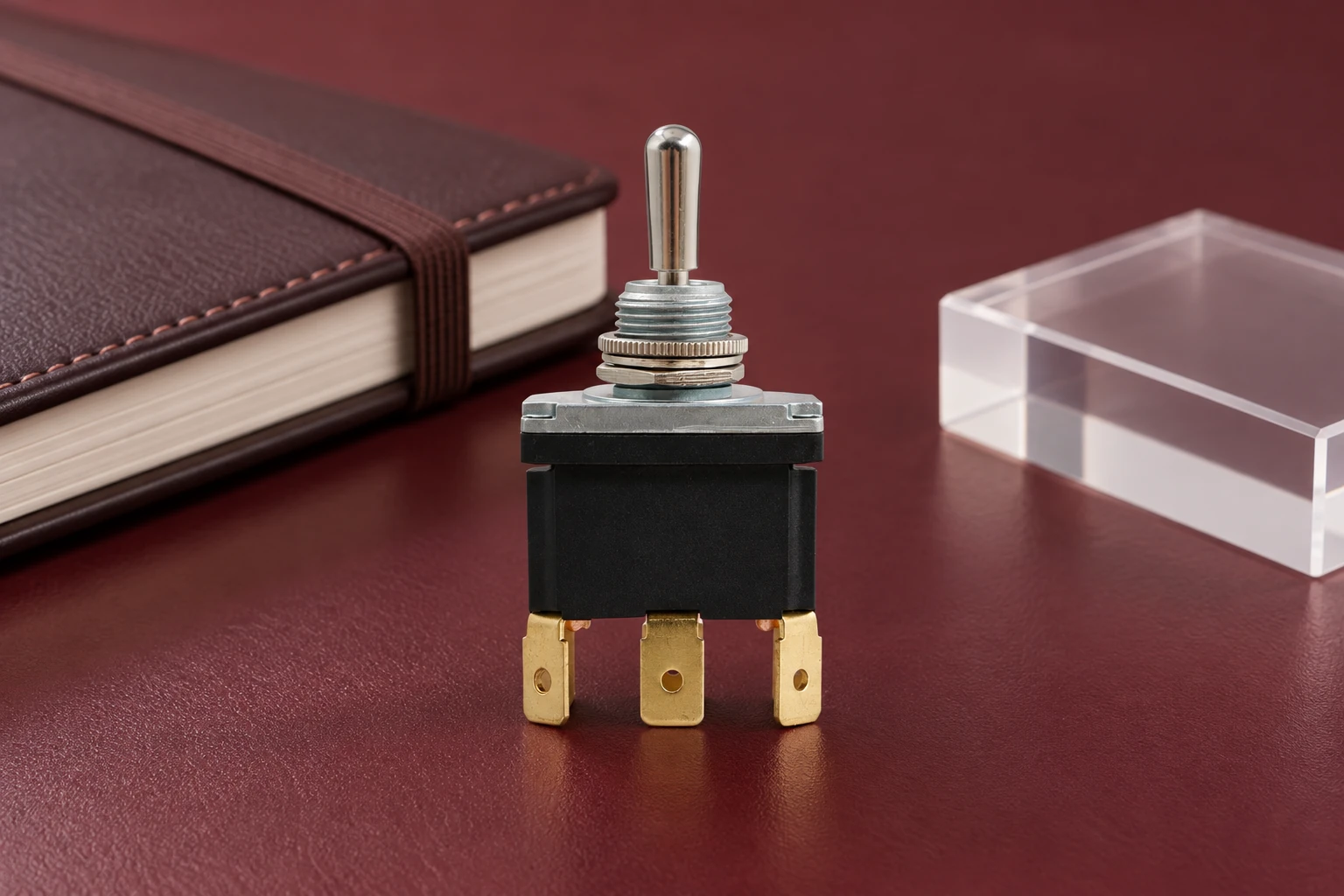
The LT3230C toggle switch provides a relevant starting point for an exposed-panel review. Its visible metal lever and mounting hardware differ from its black housing. The photograph identifies the reference product, but it cannot determine resin grade, stabilizer package, coating chemistry or the construction of an optional cover. Obtain those details for the actual order code if they are necessary to evaluate the application.
A metal operating lever does not make every assembly component immune to weathering. Review any polymeric seal, protective boot, printed identification and adjacent panel material separately. Conversely, a change in appearance does not automatically mean the electrical function has failed. Establish the required properties and the responsible evidence for each part, then compare the assembled control against those requirements.
Separate UV exposure from heat and moisture
Sunlight exposure can coincide with elevated surface temperature, rain, condensation and mechanical operation. A laboratory program needs to distinguish which variables it controls and which mechanisms it is intended to represent. Do not treat a high ambient-temperature rating as a UV-resistance rating. Likewise, an ingress-protection statement does not describe how a polymer changes after prolonged light exposure.
The NIST accelerated weathering metrology program emphasizes measurement of spectral UV irradiance, specimen temperature and moisture. Those variables explain why the name of a lamp and a total exposure time are not enough to compare reports. Request a clear account of the light source, exposure cycle, specimen conditions and measured response. Use the applicable test procedure to settle the details rather than borrowing settings from an unrelated product example.
Understand the spectrum before selecting evidence
Ultraviolet light occupies a different spectral region from visible light and infrared radiation. A test intended to represent outdoor weathering needs a justified exposure spectrum. A source used for another purpose, such as a disinfection process, should not be assumed equivalent to sunlight. The relevant question is whether the exposure addresses the material response and service conditions under review, not simply whether the source is called a UV lamp.
The FuseSchool video below introduces the electromagnetic spectrum, including ultraviolet radiation. It supports the distinction between spectral regions used in the exposure discussion. It is not a polymer-aging test, a lamp-selection procedure or evidence that a particular LEMA part survives weathering. The article’s procurement decision still depends on exact material and assembly evidence.
FuseSchool – Global Education: Electromagnetic Waves | Electricity | Physics | FuseSchool

Watch Electromagnetic Waves | Electricity | Physics | FuseSchool.
Read the report as a record of a defined specimen
Check whether the specimen was a raw material coupon, molded component, finished protective boot or complete mounted switch. A coupon can establish useful material behavior under a stated method, but it may omit thickness, color, molding history, assembly strain and interfaces present in the final part. Ask why the specimen is representative. A photograph of a different black plastic part is not a sufficient bridge to the supplied configuration.
Record sample identity, formulation or controlled grade where available, color, manufacturing route and drawing revision. If commercial confidentiality prevents full formulation disclosure, the supplier can still identify a controlled material designation and state the applicability of its evidence. The objective is traceability, not publication of proprietary chemistry. Evidence should remain tied to the delivered construction even when the full recipe stays with the material manufacturer.
Agree appearance and function criteria separately
UV-related assessment may examine color, surface condition, cracking, flexibility or a functional response of the assembled control. Select criteria that matter to the application. A decorative color requirement needs a different acceptance method from a seal-integrity requirement. Terms such as “slight fading” or “no damage” are difficult to apply consistently unless the evaluation method and acceptable condition are defined in advance.
| Part or property | Evidence to request | Assembly check |
|---|---|---|
| Housing or boot | Controlled material and exposure report | Cracking, surface condition and fit under agreed criteria |
| Identification | Exact marking construction and evaluation | Required legibility remains available |
| Seal interface | Exact material and installed configuration | Retention of specified condition after exposure |
| Operating action | Pre/post assessment using defined method | No unacceptable change to intended movement |
| Appearance | Agreed color or surface evaluation | Meets the actual contractual requirement |
This matrix is a qualitative planning tool. It does not assign a test limit, laboratory exposure period or outdoor rating to the switch. The responsible engineering team should connect each relevant property to an agreed evaluation method and acceptance criterion. Record any excluded property so the report cannot later be interpreted as covering it.
Do not equate chamber time with outdoor service years
The NIST weathering measurement project explains that differences between indoor and outdoor exposure conditions complicate service-life prediction. That limitation matters when a purchasing document tries to convert a test duration directly into field life. A conversion needs a validated relationship for the material, exposure and failure mechanism concerned. An arbitrary multiplier does not provide one.
Ask what the test establishes: comparison between two formulations, retention of an agreed property, or a supported service-life model. Keep those claims distinct. If a supplier has comparative data only, describe it as comparative data. If field history is offered, ask whether the installation, climate, orientation, maintenance and construction resemble the proposed use. Neither a chamber report nor a field anecdote should silently acquire a broader scope than its evidence supports.
Review a protective boot as part of the assembly
A boot can change exposure and access, but it introduces its own material and interface questions. Obtain the exact boot designation, compatibility with the bushing, installed condition and available weathering evidence. Do not assume a cover offered for a similar switch will fit or retain its intended function. A cover that restricts lever movement or obscures identification can introduce problems independent of sunlight exposure.
Use the separate toggle sealing washer and O-ring guide to organize the sealing interface. The weathering review should then examine the evidence for the specified materials and exposed condition. A seal-fit decision and a material-aging decision inform each other, but neither substitutes for the other. Any change to the boot or washer should be assessed against the released assembly rather than the switch body alone.
Inspect aged equipment without guessing the failure cause
Record where an observed change appears, how long the equipment has been exposed and whether the affected area was shaded. Compare representative photographs and maintenance records where available. Cracks, stickiness or discoloration may have several contributing causes, including chemical contact, stress and temperature. Do not assign UV as the sole cause because the equipment was outdoors.
If operation is inconsistent, follow the approved maintenance and isolation procedure. Review the toggle replacement checklist before selecting a substitute so pole arrangement, action and panel fit are preserved. Retain the suspect component and exposure history for analysis. A new switch may restore operation while leaving the environmental cause unresolved, so record both the repair and any continuing investigation.
Make the RFQ specific enough to avoid a vague answer
Provide the supplier with the order code, panel orientation, exposed-part list, enclosure or cover details and intended service environment. Request exact material or controlled construction identification for relevant polymeric parts, available weathering reports and their applicability. Identify whether appearance, mechanical action, sealing or identification retention drives acceptance. Ask the supplier to state any missing evidence directly.
For a broader product decision, refer to the toggle mechanism and selection guide, while keeping this request focused on exposure. Agree who owns assembly testing when component evidence is insufficient. Include change-notification requirements for material, color, process or protective-cover substitutions. The final approval should identify the released construction, supporting report and limits of the conclusion, allowing a later purchaser or maintenance team to understand exactly what was accepted.
Frequently asked questions
Does a metal lever make a toggle switch UV resistant?
No. The assembly may contain polymeric housings, seals, boots and markings. Review the exact exposed parts and applicable evidence.
Can UV chamber hours be converted directly into outdoor years?
No universal conversion is established. A service-life prediction needs a validated relationship for the material, exposure conditions and relevant failure mechanism.
Does a waterproof boot automatically provide sunlight durability?
No. Fit, ingress protection and weathering are separate evidence questions. Confirm the exact boot construction, installation and supported exposure.
Does this article assign a UV rating to LT3230C switches?
No. It provides an evidence-review framework. The quoted configuration needs its own applicable material or assembly documentation.