
Toggle switch mounting washer material certificate verification starts by connecting the document to the exact washer supplied with the ordered switch. Check the part identity, material requirement, manufacturing or supply lot, test scope, and issuing organization before accepting a material claim. A silver appearance, a magnetic response, or a generic certificate for the switch family cannot identify the washer alloy. This guide explains how buyers can request useful evidence for the mounting hardware associated with an LT3230C toggle switch without confusing material documentation with dimensional fit, electrical certification, or finished-panel performance.
Define which piece of mounting hardware needs evidence
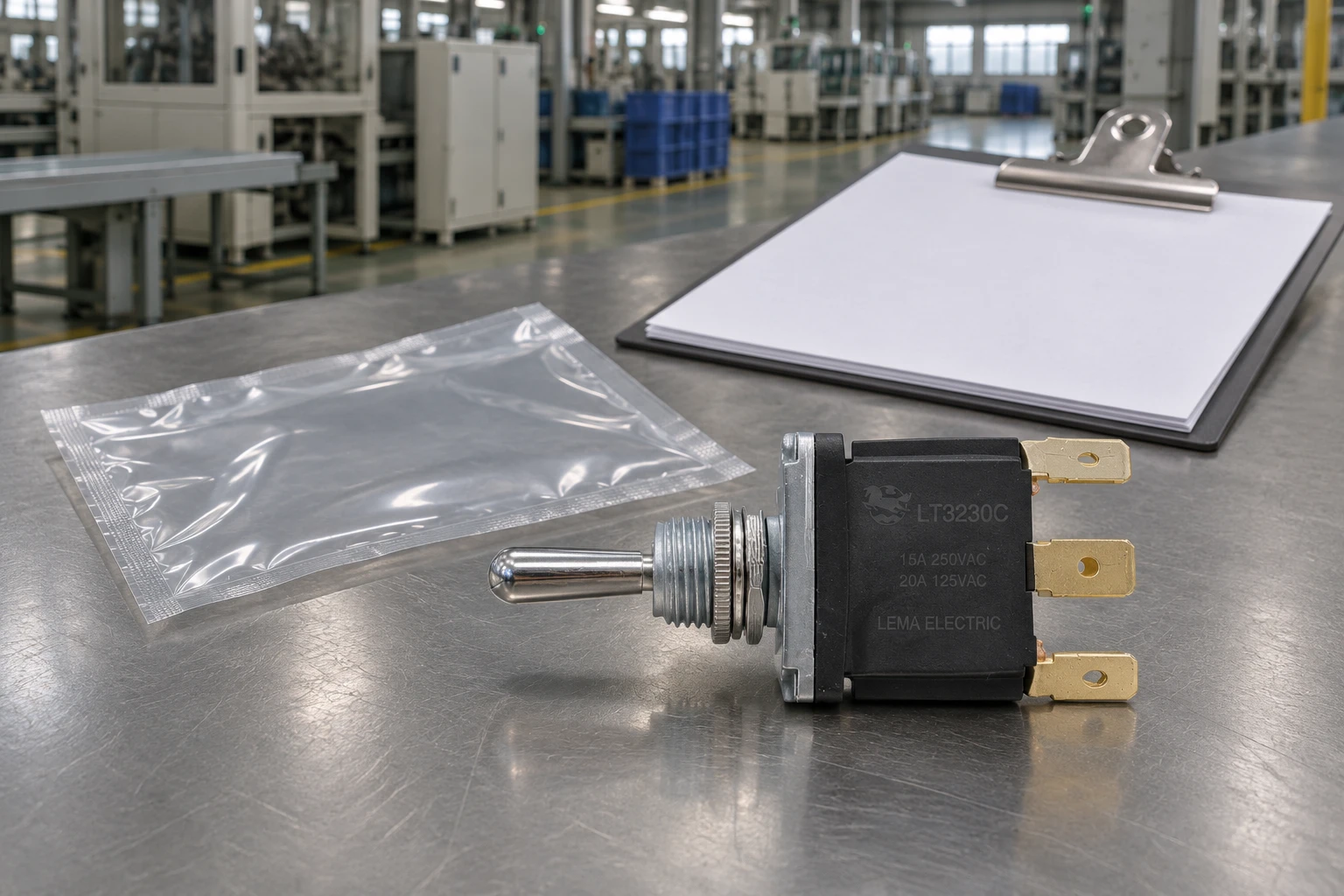
The LT3230C heavy duty toggle switch reference image shows a threaded bushing, nuts, and installed mounting hardware above the switch body. That image is useful for identifying the assembly. It does not prove the washer substrate, surface treatment, heat treatment, or the existence of a material certificate. Confirm the actual ordered accessory arrangement with the supplier rather than assuming every shipment includes identical hardware.
Use a marked photograph or assembly drawing to distinguish the washer from the locknut, support plate, or sealing accessory. Include the hardware part designation when available. A certificate for the mounting nut cannot automatically support the washer, even if both parts arrived together. The same caution applies to replacement hardware added by a distributor or panel assembler after the switch manufacturer supplied the original assembly.
Agree on the material requirement before requesting a certificate
Purchasing should first identify the property that matters and its contractual basis. The question might concern an alloy designation, a surface treatment, a restricted substance declaration, or a requirement stated on the approved drawing. These are different requests. Asking simply for a stainless certificate can produce a document that looks useful but answers none of the design team’s actual questions.
If the drawing specifies no material, ask the responsible engineer and supplier to clarify the requirement before interpreting a test report. Do not introduce a new grade by copying the description of a visually similar washer. Record whether a document is required for every shipment, for initial approval, or only when a material change occurs. This prevents an informal receiving preference from being mistaken for a pre-existing purchase obligation.

| Evidence item | What to verify | Decision supported |
|---|---|---|
| Hardware identity | Washer designation, assembly view, and supplier configuration | Ensure the document concerns the correct component |
| Requirement | Material or finish requirement and drawing revision | Identify the exact claim needing evidence |
| Lot linkage | Document identifier linked through packing or assembly records | Connect source evidence to delivered hardware |
| Test scope | Method, sample description, reported properties, and limitations | Avoid conclusions beyond the measurement |
| Disposition | Responsible reviewer, unresolved questions, and release decision | Create a usable receiving record |
Build the connection from document to delivered washer
A useful document trail identifies the washer or accessory part, the relevant lot or other traceable grouping, the order or delivery record, and the applicable requirement revision. The exact identifiers depend on the supplier’s system. The aim is to show why this particular document applies to these delivered parts, not to demand an identifier the supplier never uses.
Check that any repacking or assembly step preserves that connection. If washers are removed from bulk stock and installed onto switches, ask how the hardware batch is associated with the finished shipment. An original material document may remain valid evidence when supported by reliable conversion and allocation records. Without that connection, it describes material somewhere in the supply chain but does not establish the identity of the washer in your hand.
Read what the document actually claims
Distinguish a supplier declaration from a laboratory report and from a certificate for reference material used to check an analytical method. Read the reported property, test method where given, sample description, issue date, authorization, and any qualifications. A chemical composition result does not directly establish mechanical hardness, thickness, corrosion behavior, or suitability for a sealing function.
The NIST discussion of metrological traceability explains why traceability belongs to a measurement result supported by an appropriate documented chain. It does not automatically extend from a calibrated instrument or reference material to every later result. This principle helps assess measurement evidence; NIST is not certifying the LT3230C washer, its supplier, or the shipment covered by your purchase order.
Treat XRF as a method with conditions, not an automatic answer
If a supplier proposes X-ray fluorescence screening, ask what question it will answer for the actual washer. Natural Resources Canada’s XRF training booklet discusses practical influences on alloy analysis, including surface condition and measurement geometry. A small, curved, thin, or coated item may require particular care. The laboratory should establish whether its method can distinguish the required materials under those conditions.
Ask whether the reported result concerns the surface, the underlying material, or a combination influenced by both. Request the sample preparation and measurement location when they affect interpretation. Do not scrape a coating from delivered hardware without authorization, and do not operate radiation-producing equipment as an improvised receiving check. A qualified operator or laboratory should select a suitable method and explain its limitations.
Check the sample description and the reported conclusion
A report that describes a large metal coupon may not apply directly to a finished washer unless the supplier explains the relationship. Conversely, a test on one washer establishes evidence for the tested item and the stated sampling scope; it does not prove that every untested piece has identical composition. Keep the quantity and selection basis visible so the conclusion does not expand beyond the evidence.
A library match or screening classification should not be rewritten as a complete material certification unless the method and report support that conclusion. Ask the laboratory to resolve any ambiguous grade match, missing element, or conflicting result. If further testing is needed, agree on sample ownership and whether the process consumes or alters the hardware. Preserve an untouched sample for comparison when practical.
Keep material evidence separate from installation evidence
A washer with documented material still needs to fit the specified mounting arrangement. The mounting washer thickness guide addresses the dimensional question. Thickness can influence the available mounting stack, but a dimensional result does not identify the alloy. Record material and dimensional decisions separately, even when the same sample is used for both.
Likewise, the locknut bearing face inspection guide covers a different hardware feature. An acceptable washer certificate cannot prove nut seating or final panel retention. Use the panel mount toggle installation guide for the broader assembly context, while following the actual approved mounting instructions and configuration-specific requirements.
Resolve missing or conflicting documentation without guessing
If the document names another part or lot, ask for a corrected linkage or applicable replacement. If it contains an unclear abbreviation, request the issuer’s explanation rather than expanding it yourself. Where a drawing revision changed, confirm whether the delivered hardware was ordered under the earlier or later requirement. A mismatch may be an administrative problem or a material problem; the evidence must establish which.
Keep the affected hardware identifiable while the issue is open. Purchasing, quality, and engineering should agree whether it can be released, remains on hold, or requires replacement or additional analysis. Do not substitute a similar washer from local stock without checking the assembly requirements and obtaining the appropriate authorization. An attractive certificate is not a reason to accept the wrong component, and missing paperwork alone does not prove the physical material is wrong.
Write the request and close the record
A concise supplier request can state: please identify the mounting washer supplied with this switch order, confirm the applicable material and finish requirement, and provide the document and lot linkage supporting that claim. Attach the assembly photograph, order reference, quantity, and drawing revision. If a test report is offered, ask which delivered items it represents and which properties it establishes.
Close the review with the verified document identity, its scope, the applicable shipment, and the decision owner. Preserve corrections and explanations alongside the original file so a later reviewer can follow the reasoning. If the supplier cannot provide the requested evidence, record that limitation and agree on a proportionate next action. This creates a practical procurement record without claiming unverified washer grades, product approvals, or test performance.
Further learning
This ESRF research-facility lecture explains X-ray fluorescence as an analytical technique. It provides background for discussing a proposed method with a laboratory; it is not a washer test or a certificate for this product.

Frequently asked questions
Can the washer alloy be identified from its silver color?
No. Appearance does not establish a specific substrate or finish. Use applicable supplier documentation and, when necessary, a suitable analytical method.
Does a switch certificate cover all mounting accessories?
Only when the document scope and hardware linkage explicitly support that conclusion. Check the accessory identity and the relationship to the supplied shipment.
Is an XRF grade match enough to verify every washer property?
No. XRF provides analytical information under stated conditions. It does not by itself establish dimensions, hardness, mounting performance, or every material requirement.
What should a buyer do when the lot reference is missing?
Ask the supplier to explain or document how the certificate applies to the delivered hardware. Keep the review unresolved until the responsible team accepts adequate evidence or agrees on another disposition.