
Foot switch operator handover needs a defined transfer of machine status and control responsibility, followed by the equipment’s approved restart checks. Releasing a pedal or seeing a stationary machine does not establish that a new operator can safely take over. Before the handover, identify the operating mode, outstanding commands, work area condition and any isolation or maintenance status. The incoming operator must know who controls the machine and which deliberate action may start it. The exact sequence belongs to the machine risk assessment and operating instructions, not to the pedal contact type alone.
This guide helps equipment builders and buyers prepare that sequence and its acceptance evidence. It does not provide a universal restart circuit or declare an LF foot switch suitable as a safety device. Normal production handover and transfer of an isolated maintenance task are different activities. If a change of operator also involves cleaning, clearing a jam, entering a danger zone or other servicing, apply the machine’s appropriate energy-control procedure before the work begins.
Identify what is being transferred
A useful handover records the machine identity, current mode, workpiece condition, active cycle status and the person accepting control. Include temporary conditions such as a tool change, a partly processed part or a fault that has been acknowledged but not resolved. An operator leaving the station may know those details without realizing that the next person cannot infer them. Transfer the facts explicitly rather than relying on the pedal position or a general statement that everything is ready.
Define the boundary of the handover. Changing operators during ordinary production, transferring a maintenance isolation and returning a serviced machine to production require different authorizations and checks. The HSE safe-isolation guidance discusses human failures and communication in the context of plant and equipment isolation. Use it as background for clear responsibility and records; its detailed process-industry methods do not automatically define the procedure for every foot-controlled machine.
Separate pedal release from machine readiness
A momentary contact may return when the operator removes pressure, but the controller may have accepted a command that continues a cycle. A maintained contact may remain in its selected condition after foot pressure ends. Neither observation, by itself, explains the complete machine response. Review the exact pedal, input circuit, controller program and operating mode together. The maintained versus momentary foot switch guide covers contact action; this article adds responsibility transfer and restart-state questions.
A machine may also store commands, retain settings after a stop or behave differently after a fault reset. Ask the equipment designer to describe those transitions in language the operator can understand. Do not invent a rule that all systems must discard every stored value, or assume that preserving values is acceptable. The required behavior must be established for the task and hazards. A handover sheet should identify that reviewed behavior rather than substitute for the control-system design.
Define the outgoing operator’s checks
The outgoing operator should place the equipment in the state required by the approved procedure and communicate any exceptions. The procedure needs to state how that condition is confirmed, including whether a cycle has completed or a controlled stop is still in progress. Where the machine has several stations or shared controls, identify the station that currently has authority. A local pedal at rest does not establish the state of another station or an automatic command source.
Record faults and unusual responses instead of allowing the next operator to discover them by trial. Examples include intermittent input recognition, unexpected pedal movement, a cable pulled out of its normal route or a protective device that prevents restart. The correct action may be to withdraw equipment from use and obtain authorized review. Do not hand over an unexplained problem as an informal operating trick, and do not propose bypassing a protection to keep production moving.
Set the incoming operator’s acceptance conditions
The incoming operator needs the relevant training, task information and a clear indication that control has been transferred. Confirm the work area and the equipment state using the approved method. If the procedure requires an authorized release after maintenance, an operator’s visual check cannot replace it. If several people remain near the machine, the handover must account for their status before a restart is considered. These responsibilities should be apparent without depending on a private conversation between two individuals.
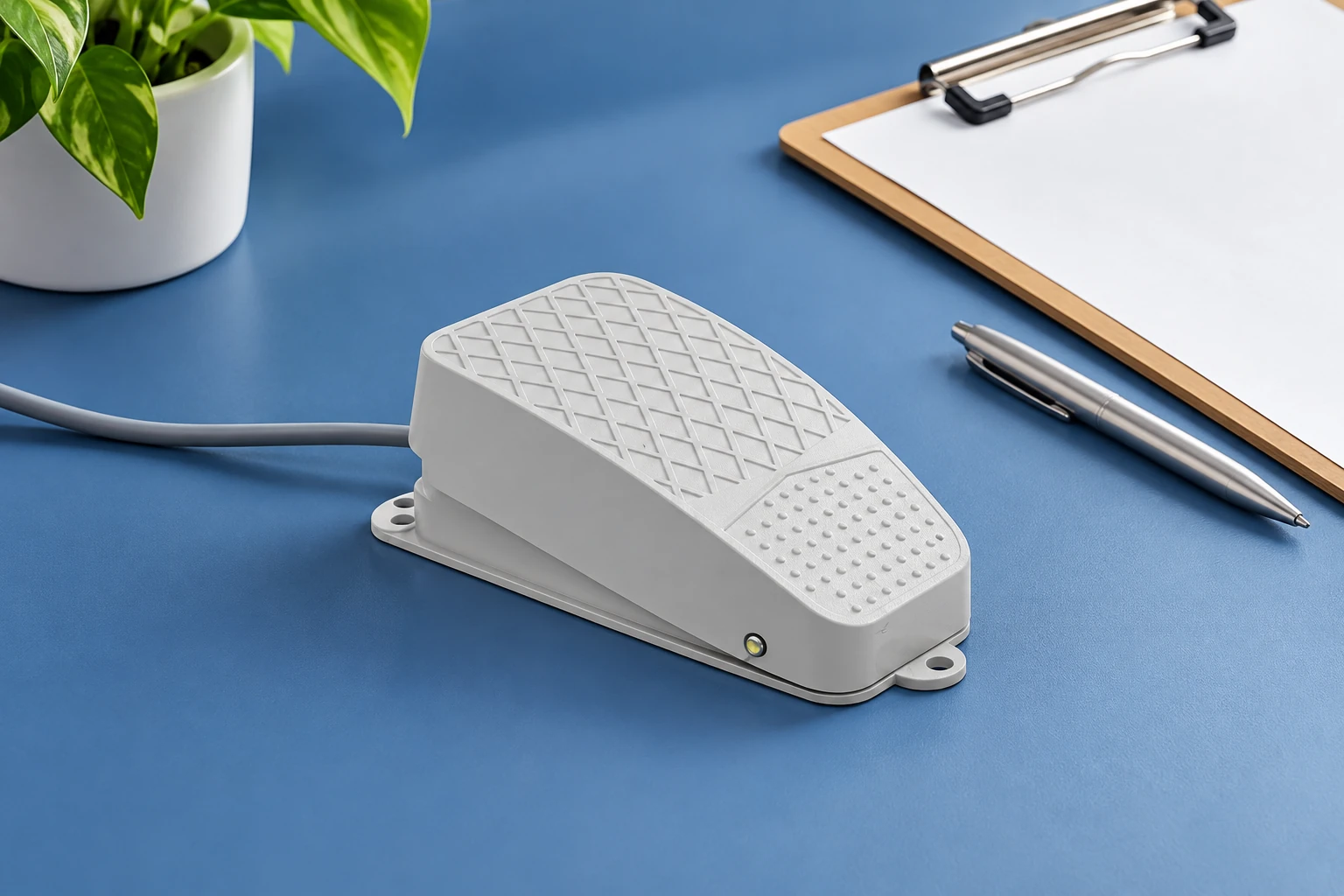
Check whether normal footwear, workstation position and task posture allow the incoming operator to use the pedal as intended. Moving a pedal for a different operator can change cable pull, access or the likelihood of accidental contact. Use the foot switch mounting-stability guide for that physical review. A new position should remain within the reviewed workstation arrangement instead of creating a convenient but unassessed route into the walking area.
Use a handover decision table
| Situation | Information to transfer | Before restart |
|---|---|---|
| Production operator change | Mode, cycle status and active control station | Incoming operator accepts the approved ready state |
| Unresolved fault | Observed response and review status | Authorized resolution and release are required |
| Cleaning or servicing | Work scope and energy-control status | Use the applicable isolation and release procedure |
| Several operators or stations | Control authority and affected people | Resolve conflicting command sources |
| Power or mode transition | Validated behavior after restoration or reset | Follow the approved deliberate restart sequence |
This table is a discussion framework for the equipment’s responsible designer and operating team. It is not a commissioning test script or permission to energize a machine. Record the actual acceptance criteria in the controlled procedure. A checklist becomes useful when each item identifies an observable condition and the person responsible for resolving an exception. A box marked complete without that definition can hide the uncertainty the handover is intended to remove.
Treat maintenance isolation as its own transfer
When the work involves servicing or entry into a hazardous area, the relevant procedure must address energy sources, stored energy, verification and responsibility for isolation. WorkSafe New Zealand’s machine-lockout guidance explains these issues and includes considerations for multiple workers. Follow the applicable local requirements and site procedure. This article does not provide a substitute isolation method or a complete legal compliance assessment.
Do not treat the control pedal, its off position or a software stop as automatic proof of energy isolation. A control device and an energy-isolating arrangement perform different functions. If a shift change occurs while equipment remains isolated, use the site’s authorized transfer process and preserve the protection of everyone involved. Resolve missing personnel information, unexplained locks or incomplete work through the responsible organization rather than improvising removal or restart steps.
Review restart after faults and power interruption
Ask what happens if power is lost before handover, restored during the transfer or interrupted while the pedal is pressed. Review fault reset, mode change and control-authority change separately. A reset that clears a message may not have the same meaning as a deliberate start command. The equipment specification should state the intended behavior and identify how it was validated. Do not assume that a contact rating or a maintained/momentary label answers these questions.
Validation should use a planned, controlled setup with competent people and the required safeguards. Define the initial state, the event being applied, the expected observable response and the action if the response differs. Include relevant transitions in the acceptance record rather than only a successful normal cycle. This is a request for evidence, not guidance for untrained operators to experiment with a live machine or a proposed safety-control architecture.
Check the delivered pedal and cable arrangement
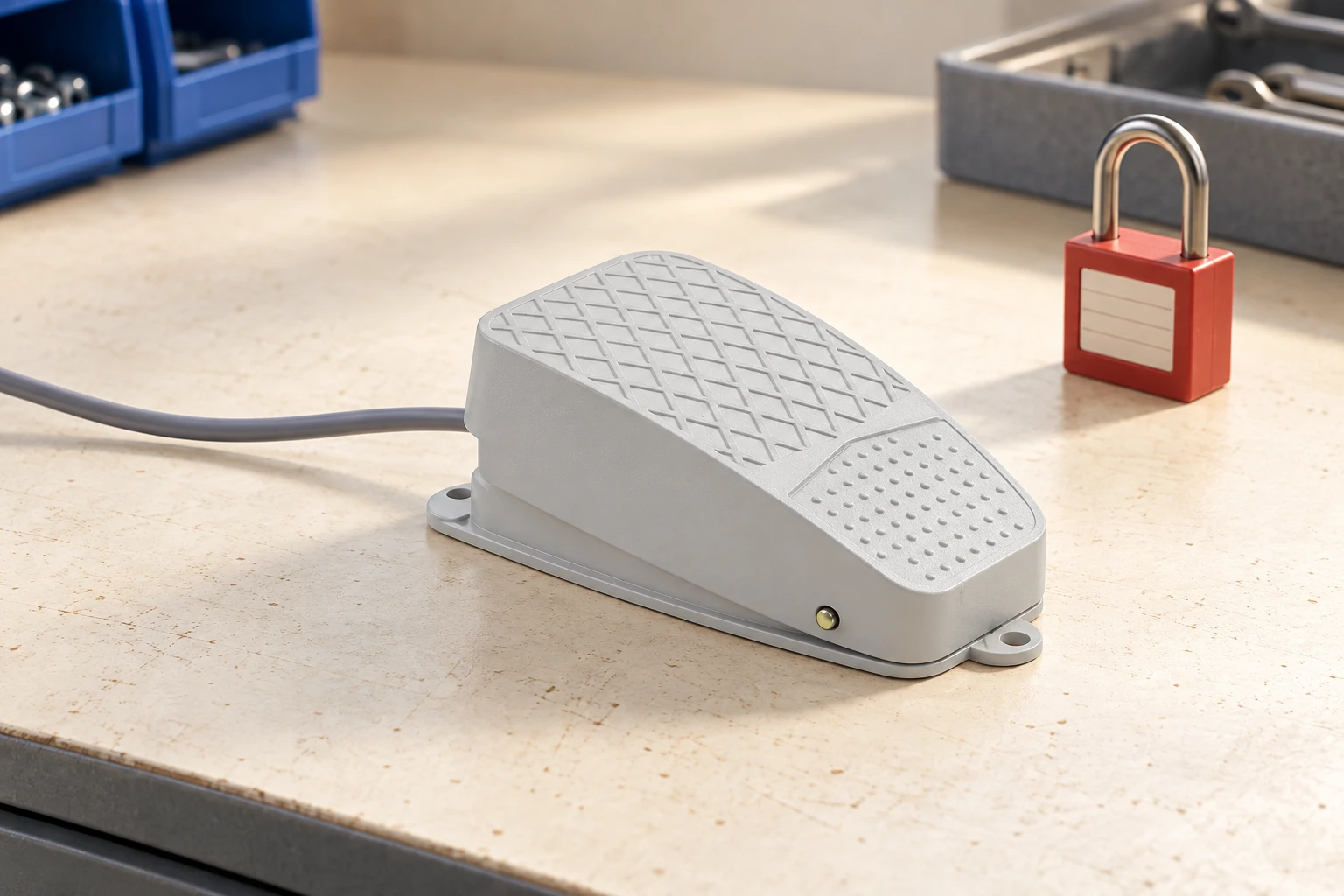
Das LEMA LF series foot switch is the product reference for identifying a pedal assembly and discussing variant-specific requirements. Request the exact contact arrangement, cable and termination details, mounting information and applicable supplied documentation. Family descriptions do not establish restart prevention, monitored contacts or any required safety performance. Those claims need evidence for the exact component and complete equipment design.
During handover planning, consider how a replacement pedal will be identified and accepted. Similar cases can contain different contacts, cables or interfaces. The industrial foot switch replacement guide helps organize component matching. After a change, verify the relevant equipment behavior through the authorized process. A replacement that operates the machine once has not necessarily been accepted for all the state transitions documented in the handover procedure.
Educational video: why a stationary machine can still start
Work Safe Queensland’s educational film describes an accidental foot-pedal activation while a worker was cleaning machinery. It helps explain why machine status and isolation must be communicated clearly. The example concerns maintenance and cleaning, rather than an ordinary production operator change, so use it in the isolation-boundary discussion. It does not certify a particular foot switch or determine the controls required for your equipment.
Work Safe Queensland: Isolating machinery when not in production
Watch Isolating machinery when not in production.
Prepare the supplier and commissioning questions
Send the equipment supplier a description of the operator-change task, all operating stations, the exact pedal variant, relevant modes and the maintenance boundary. Request the documented response to pedal actuation, release, reset and power restoration. Ask which acceptance checks establish the intended behavior and who is authorized to approve changes. Keep the electrical interface questions separate from the workplace procedure so responsibility does not disappear between suppliers.
The completed handover package should give the incoming operator a recognizable state, a responsible contact and an approved route to restart. It should also give the outgoing operator a clear method for leaving equipment unavailable when something is unresolved. Review the process after equipment, tooling, workstation or control changes. A short procedure supported by verified machine behavior is more useful than an elaborate form that operators cannot connect to the actual task.
Häufig gestellte Fragen
Does releasing the foot pedal prove the machine is safe to hand over?
No. Pedal release alone does not establish cycle status, stored commands, other control sources or isolation.
Is an ordinary production handover the same as a lockout transfer?
No. Servicing and isolation transfer require the applicable authorized procedure and protection of affected people.
Does a momentary pedal prevent automatic restart?
No such system behavior follows from the contact action alone. The complete equipment response must be specified and validated.
Is LF assigned a safety performance level here?
No. Request exact-variant data and the complete equipment assessment for any claimed safety function.