
Foot switch hygienic cleaning requires a process compatible with the exact pedal assembly and the hygiene needs of the workplace. Start with the equipment and switch manufacturer’s instructions, identify the permitted cleaning agent and application method, and define safe isolation and return-to-service checks. A pedal’s appearance, foot operation or ingress rating does not establish disinfectant compatibility, sterilizability or suitability for a medical or food-contact application. If the required cleaning process cannot be supported by documented component evidence, resolve that gap before approving the installation. Do not improvise soaking, spraying or chemical exposure on an electrically connected assembly.
Define whether the task is cleaning or disinfection
Cleaning addresses soil and residue; disinfection has a separate microbial-control purpose and process requirements. The distinction affects the agent, application method, contact time and verification needed. A workshop pedal with dry dust and a device in a controlled healthcare workflow should not inherit the same procedure simply because both are operated by foot. The equipment owner should identify the actual contamination and required hygiene outcome.
Das CDC facility-cleaning guidance distinguishes routine cleaning from situations where disinfection is needed. It is general environmental guidance, not approval for a particular industrial foot switch. Use it to clarify the process objective, then confirm whether the exact pedal, cable and connector tolerate the proposed procedure. Avoid transferring household or healthcare cleaning recipes directly into an industrial component specification.
Confirm the exact pedal and all exposed materials
Record the model, drawing revision, housing construction, tread, seam, fasteners, cable entry and connector. A family can contain several pedal forms and cable arrangements. The LEMA LF series foot switch is a relevant supplier reference, but a family page does not qualify every variant for every cleaner. Obtain the exact configuration and current maintenance instructions before approving a cleaning method.
Include the whole assembly. The housing surface may tolerate a proposed agent while the cable jacket, label, seal or connector does not. A removable floor mat or mounting pad can also retain residue. Ask for compatibility evidence for the actual exposed parts and concentration, application, temperature and frequency under consideration. An answer limited to the housing material leaves important interfaces unresolved.
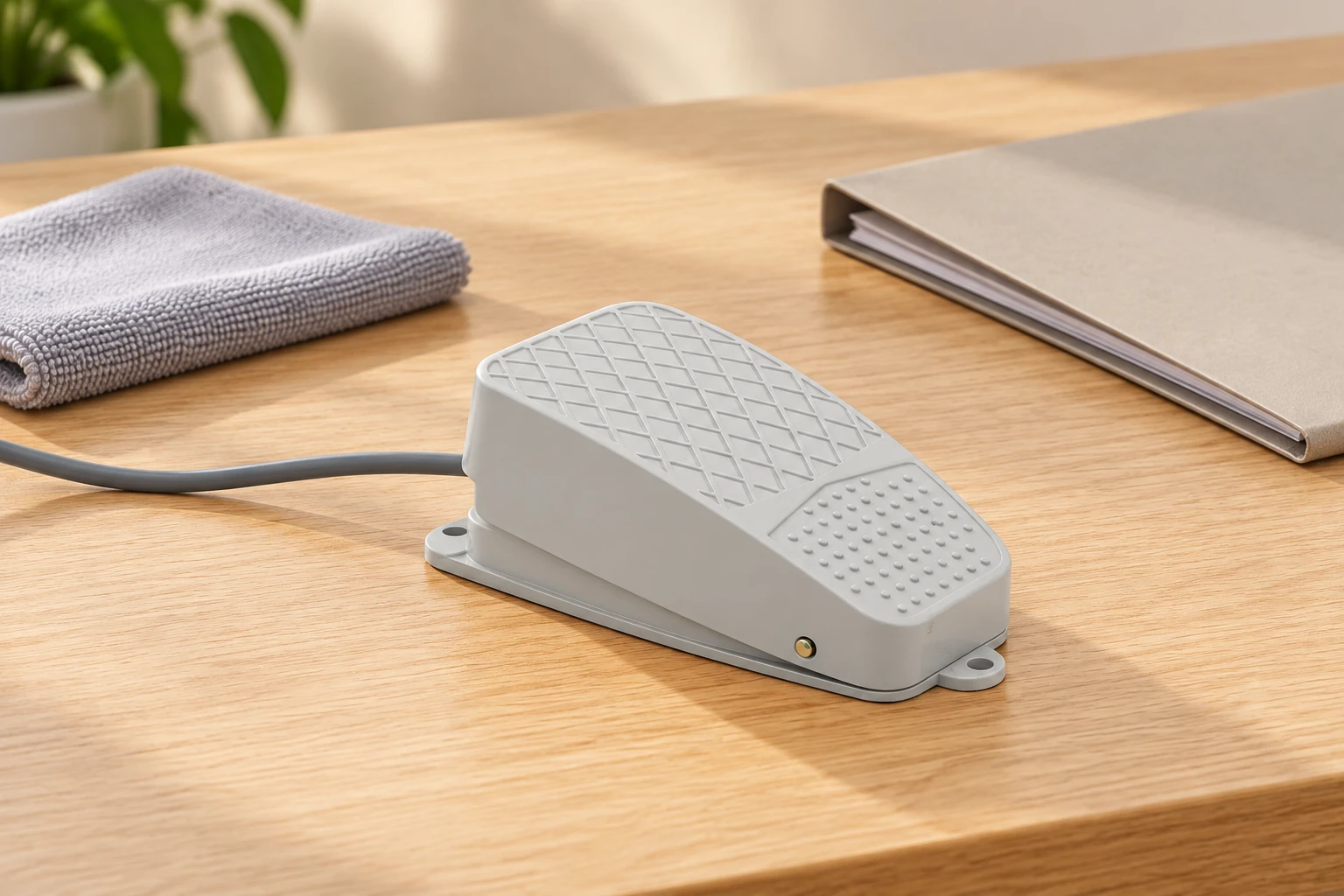
Plan access and isolation before the maintenance task
A foot-operated control may remain in a position where it can be pressed accidentally during cleaning. The responsible maintenance procedure must make the equipment safe, control stored energy where relevant and prevent unintended commands. Turning off one visible device is not automatically a complete isolation process. Follow the equipment-specific procedure and use authorized personnel for electrical work or disconnection.
Plan how the cleaner reaches the pedal without pulling the cable or changing the released mounting position. If the pedal must be removed, identify who is authorized to disconnect it and how its position will be restored. The foot switch mounting stability guide addresses sliding and rocking; the cleaning process should preserve that approved arrangement. A clean pedal that moves unpredictably is not a successful maintenance outcome.
Match the agent and application to approved instructions
The cleaning specification should name the actual product or controlled agent, permitted preparation and application method. A statement such as “wipe with disinfectant” is too vague for repeatable procurement or maintenance. The responsible team needs compatibility information and the cleaning product’s instructions. Do not change concentration, blend products or substitute a stronger chemical merely because residue remains difficult to remove.
Das CDC disinfection recommendations emphasize following manufacturers’ instructions and reviewing equipment surface integrity. Those principles help frame a compatibility review. They do not establish that an industrial LF pedal is a medical device or can undergo a healthcare reprocessing cycle. Where a regulated application requires specific validation, use the applicable equipment requirements and qualified review rather than treating general guidance as certification.
Review each exposed interface before choosing a method
Look for seams, recesses, tread grooves, fastener heads, mounting ears and cable transitions. Determine whether the approved method can reach the areas that matter without directing liquid into vulnerable interfaces. Access should be considered at the design stage, not discovered only after the first cleaning complaint. Keep the distinction between a design improvement and an authorized maintenance action clear.
| Schnittstelle | Question before approval | Record after the agreed process |
|---|---|---|
| Tread and recesses | Can the approved method reach the relevant soil? | Specified residue and surface condition |
| Housing seam and fasteners | What application method is permitted? | Condition of interfaces and any abnormal change |
| Cable jacket and entry | Does exact material evidence cover the agent? | Jacket condition and strain-relief arrangement |
| Connector | Who may disconnect it and how is it protected? | Authorized reconnection and equipment response |
| Identification | Is the label compatible with repeated cleaning? | Required identification remains readable |
The table organizes questions; it does not authorize spraying, rinsing, immersion or sterilization. An ingress rating describes a defined type of enclosure protection and cannot alone settle cleaner chemistry or repeated exposure. The separate Richtlinien für die IP-Bewertung von Fußschaltern can support the enclosure discussion, while compatibility and hygiene-process evidence remain specific to the actual materials and procedure.
Check residue removal without inventing a cleanliness claim
Define the observable result needed for routine maintenance, such as removal of specified visible soil or absence of an unacceptable residue under an agreed inspection. If microbial verification is required, the hygiene team should define the method and acceptance criteria. A visual inspection is useful but cannot prove a particular reduction in microorganisms. Likewise, a photograph of a clean pedal cannot support a sterile or hygienically certified claim.
Where the process includes disinfection, respect the agent’s stated requirements and the equipment’s compatibility limits. If those requirements conflict, the solution is an approved change of process or component. Shortening a required contact time to protect the pedal does not establish disinfection, while increasing liquid exposure beyond the component instructions can damage the assembly. Document the conflict so purchasing and engineering can resolve it together.
Understand environmental cleaning in its proper context
The CDC educational video below discusses environmental-surface cleaning and disinfection in a long-term-care context. It helps distinguish the purpose of the two activities and the importance of a defined workflow. It is not a cleaning instruction for an LF foot switch, a recommendation of a chemical for its housing or evidence of suitability for healthcare equipment.
Use the video as background for the hygiene conversation, then return to the exact equipment instructions. An industrial workshop may need a different process from the healthcare example. The useful connection is the discipline of identifying the surface, task and approved procedure. The video’s application setting must not be transferred into an unsupported product claim.
Centers for Disease Control and Prevention (CDC): LTC Mini Webinar: Sparkling Surfaces: Stop COVID-19’s Spread
Watch LTC Mini Webinar: Sparkling Surfaces: Stop COVID-19’s Spread.
Inspect condition before and after the agreed process
Record the initial condition of the housing, tread, cable jacket, entry and identification. Existing cracks or damaged surfaces can affect both cleanability and component integrity. Photograph relevant defects and refer them for authorized assessment. Do not use cleaning as a way to hide damage or postpone a necessary replacement. Preserve identification so the correct component can be traced if a concern emerges later.
After the process, inspect for the changes defined in the procedure, including residue, loosened labels, surface damage or signs of moisture where it should not be present. Drying requirements must come from the approved instructions rather than an arbitrary waiting period. If the assembly’s condition is uncertain, keep it out of service until the responsible team decides what additional inspection or replacement is required.
Restore the control and verify the equipment response
Return the pedal to its approved position, confirm its mounting or nonslip arrangement and route the cable without tension or a trip hazard. Check connector engagement through the authorized process. Any functional test must follow the equipment’s controlled return-to-service procedure. A pedal can appear to move normally while the machine interface, cable or action differs from the intended configuration.
Benutzen Sie isolated foot switch testing guide for the complementary component-check discussion. That does not replace the equipment-level verification needed after maintenance. Record the expected input response and release behavior using the approved test conditions. If a fault is intermittent, retain the sequence and observations rather than concluding that cleaning solved it after one successful operation.
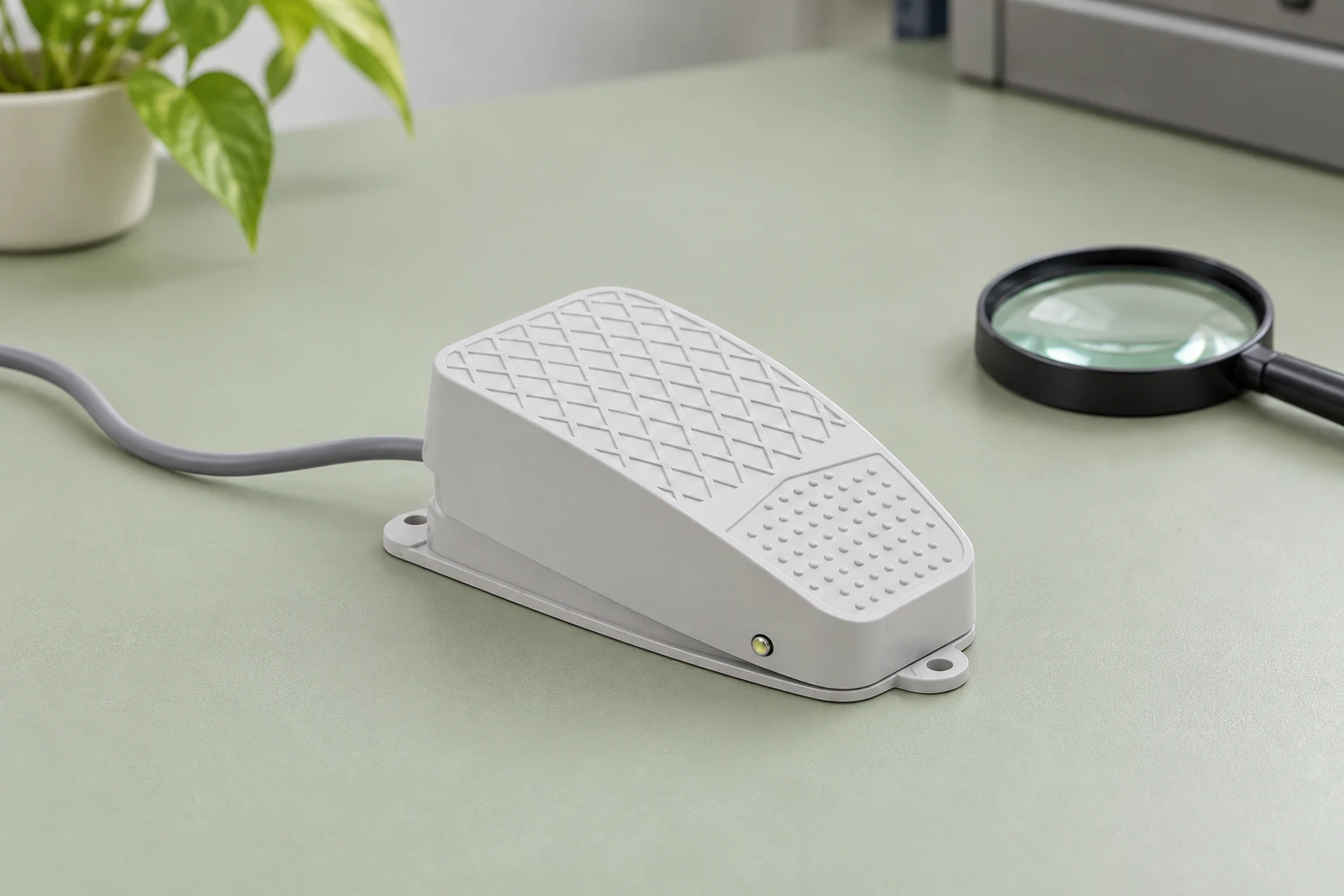
Validate repeated exposure before approving routine use
One successful wipe does not establish compatibility over a maintenance program. For a new application, agree a representative evaluation with the component supplier and equipment team. Define the exact agent, application, frequency representation, sample construction and properties to inspect. Avoid assigning a universal number of cycles without a requirement or supporting method. The purpose is to test the proposed process, not to produce an impressive but irrelevant endurance number.
Include interfaces that may age differently, such as cable flexibility, labels, tread and seals. Record appearance and functional criteria separately. If an alternative cleaner or pedal is proposed, determine whether previous evidence still applies. A purchasing substitution can change the maintenance boundary even when its basic electrical action is unchanged. Keep a controlled list of approved combinations rather than relying on informal familiarity with a brand name.
Send a cleaning-focused inquiry to the supplier
Provide the exact pedal code, assembly photographs, intended environment and proposed cleaning document. Ask for permitted methods, prohibited exposures, material compatibility evidence and replacement guidance for damaged surfaces. Explain whether the requirement is ordinary soil removal, disinfection or a regulated hygiene process. Request a direct statement where supporting evidence is unavailable, so the equipment decision can account for the gap.
Link the final process to training and change control. Maintenance staff need the approved method, inspection criteria and escalation route. Purchasing needs to preserve the specified pedal and cleaning-agent combination. Engineering needs to review substitutions and environmental changes. A usable outcome is a documented, compatible maintenance process with a clear return-to-service check, not a broad “hygienic” description that leaves each team to invent its own meaning.
Häufig gestellte Fragen
Does an IP rating prove disinfectant compatibility?
No. Ingress protection does not establish chemical compatibility, repeated cleaning durability, disinfection effectiveness or sterilizability.
Can a foot switch be immersed to remove dirt?
Only a method explicitly supported for the exact assembly and equipment procedure can be considered. Do not infer immersion permission from appearance or a generic family description.
Does a clean-looking pedal prove it is disinfected?
No. Visual soil removal and microbial-control verification are different outcomes. The responsible hygiene process must define any disinfection requirement and its acceptance method.
Is the LF series automatically suitable for healthcare cleaning?
No. Confirm the exact variant, materials, instructions and application requirements. The CDC educational material does not certify the pedal or authorize a cleaning chemical for it.