
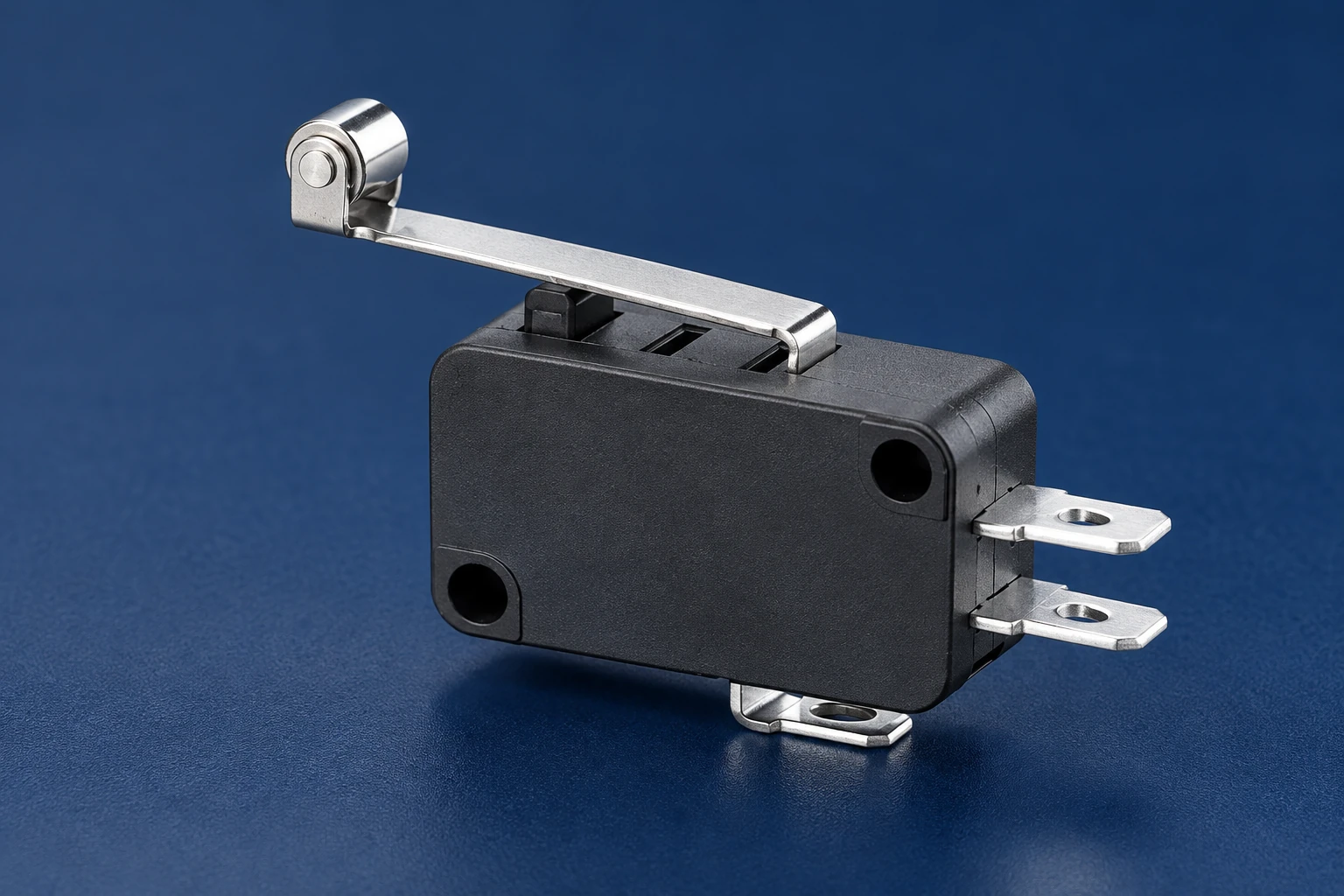
Micro switch sulfur corrosion should be investigated as a possible environmental mechanism, not diagnosed from contact intermittence alone. Establish the actual contact construction, identify plausible sulfur-bearing exposure and compare failed samples with controlled evidence before assigning a cause. For the LEMA KW7 family, obtain the exact variant’s material and environmental information. This article does not claim that every KW7 contact contains silver, that a particular unit is sulfur damaged or that an enclosure eliminates corrosive gases. The goal is an evidence-based investigation that separates exposure, material response and the observed electrical fault.
Start with a defined symptom and sample history
Intermittent operation can arise from several sources: motion, a connection, contact behavior, wiring or the measurement system. Record what the machine did, the contact state expected and how the event was observed. Preserve timestamps and operating conditions where practical. An environmental hypothesis becomes more useful when it can be compared against repeatable observations rather than a general report that the switch is unreliable.
Keep failed samples with their lot identity, location and handling history. Avoid cleaning, scraping or repeatedly cycling them before deciding what evidence is needed. Such actions can change the surface or the electrical behavior under investigation. Safe isolation and qualified handling remain necessary; preserving evidence does not mean leaving faulty equipment in operation.
Benutzen Sie micro switch failure investigation guide to organize alternative explanations. The present article focuses on sulfur-related exposure rather than replacing that wider diagnosis. A credible conclusion should explain why the observed evidence supports this mechanism and why the most plausible competing explanations have been considered.
Distinguish an element from its compounds and exposure routes
Das Royal Society of Chemistry sulfur page provides background on the element and its chemistry. In an equipment investigation, the important exposure may involve sulfur-containing compounds rather than visible elemental sulfur. A yellow material in a photograph is therefore not a necessary indicator, and its absence does not by itself exclude a sulfur-related environment.
Consider the operating process, air movement, storage materials and nearby substances as possible leads. Do not label every rubber, foam, adhesive or industrial process as a confirmed source. Ask suppliers for the information applicable to the exact material and investigate whether a relevant substance can reach the switch under the actual conditions. A plausible route still needs evidence.
Document when the exposure could occur. Storage, transport, assembly, idle periods and operation may present different conditions. If only one machine location shows a problem, compare it with a suitable control location while preserving differences in load and motion. Correlation can guide the next step, but it does not establish the chemical mechanism by itself.
Confirm the contact material before applying corrosion knowledge
A switch family can contain variants with different contact constructions. Obtain the complete code and current supplier information rather than inferring material from color or a broad catalog description. Plating, base material and the relevant contact surface may not be identifiable by a casual external inspection. Where information is unavailable, preserve that limitation in the investigation.
NASA’s corrosion protection standard discusses material-specific corrosion considerations, including sulfur-related susceptibility of silver plating. Its aerospace requirements are not LEMA product specifications. The source supports the reason to investigate a documented material and environment, not a claim that a KW7 unit has a particular plating or will behave identically.
Das gold and silver contact comparison is useful background for supplier questions. Do not treat a different contact material as a universal remedy. The intended electrical duty, contact construction and exact application still require review. Material choice should follow the confirmed failure mechanism and supplier evidence rather than an unsupported ranking of metals.
Create an evidence checklist for the investigation
| Evidence field | What to preserve | Frage zur Beantwortung |
|---|---|---|
| Symptom | Circuit state, timing and operating conditions | What functional event actually occurred? |
| Identity | Part code, lot and contact documentation | Which construction is under investigation? |
| Belichtung | Process, packaging and location history | Can a relevant substance reach the contact? |
| Analysis | Competent examination with recorded preparation | What does the result establish and leave unknown? |
| Correction | Cause-linked change and verification | Did the proposed change address the demonstrated mechanism? |
Use the checklist to organize observations and open questions. It is not a diagnostic score and contains no acceptable sulfur concentration. A numerical exposure limit would require an applicable source and product-specific basis. If a supplier cannot identify a relevant limit or test, the absence of a published value should remain visible instead of being converted into a generic resistance claim.
Assign sample analysis to a competent laboratory when the decision requires it. Agree what the examination can establish, what preparation is necessary and how results will be connected to the electrical symptoms. A detected element alone may not show when it arrived, which compound was present or whether it caused the functional failure. Preserve those distinctions in the report.
Separate films, resistance changes and mechanical faults
A contact surface observation and a circuit failure are related questions, but they are not the same measurement. Review the electrical detection method, the applied test conditions and the assembly connections. A change after cycling can be informative without uniquely identifying its cause. Do not repeatedly operate a sample until it works and then declare the exposure harmless.
Das contact resistance guide explains why measurement conditions matter. Keep the original test procedure and any later diagnostic procedure separately recorded. A higher diagnostic current can change the behavior being observed, making comparison with the machine’s low-level signal less straightforward.
Check the actuator and wiring at the same time. A motion fault can coexist with surface contamination, and a loose terminal can produce a similar intermittent symptom. If more than one mechanism is present, report that complexity. Forcing every observation into the first environmental hypothesis can lead to a corrective action that leaves the actual machine problem unresolved.

Investigate the exposure source without creating a new hazard
Review material records and process information through the responsible site personnel. Unknown gases and industrial chemicals require suitable controls; this guide provides no home exposure test or chemical mixing procedure. Do not reproduce suspected contamination on energized equipment. Any controlled environmental test should be planned by qualified personnel with defined conditions and disposal arrangements.
A useful comparison preserves the intended switch configuration and relevant duty while changing the specific factor under investigation. Record all other differences that could affect the outcome. Exposing one new sample and comparing it with one unrelated field return may provide a lead, but it is a limited basis for a broad production conclusion.
If storage or packaging is implicated, retain samples of the actual packaging lot and its documentation. An apparently identical replacement material may have a different formulation. Keep the material identity connected to the switch history so a later review can distinguish the original exposure from a change introduced during the investigation.
Select a correction tied to the demonstrated cause
Possible responses may include removing a confirmed source, changing the enclosure arrangement, improving a controlled storage process or selecting a differently documented switch variant. Each route needs its own verification. A sealed appearance is not proof of gas exclusion, and an ingress rating does not automatically establish resistance to a corrosive atmosphere.
Avoid adding an unqualified coating, contact cleaner or lubricant as an informal repair. Those substances can introduce new compatibility and electrical questions. If a cleaning process is proposed, review it using the solvent compatibility guide and the supplier’s exact instructions. A short-term restored signal is not evidence that the process preserves long-term performance.
Close the investigation with the observed mechanism, evidence, accepted correction and unresolved limits. Connect the result to purchasing and production records. If the analysis does not establish sulfur corrosion, say so and keep the next diagnostic action specific. A well-documented exclusion of one hypothesis is more useful than a confident but unsupported chemical explanation.
Sulfur chemistry background video
Periodic Videos: Sulfur – Periodic Table of Videos
Watch Sulfur – Periodic Table of Videos.
Periodic Videos introduces sulfur chemistry through university-based science education. It provides background for distinguishing the element from an equipment exposure question. It is not a switch corrosion test, a supplier qualification or an instruction to repeat chemical demonstrations. Product conclusions require the separate material and failure evidence described above.
Häufig gestellte Fragen
Does every KW7 switch have silver contacts?
No contact composition is established for every variant in this article. Obtain the exact ordered version and current supplier material information before applying a material-specific corrosion hypothesis.
Does an intermittent contact prove sulfur corrosion?
No. Motion, wiring, connections, contact condition and the measurement system can produce similar symptoms. Compare competing explanations and preserve physical and electrical evidence.
Does an IP rating prove resistance to sulfur-bearing gases?
No. An ingress rating has its own defined scope. Gas exposure and material compatibility require applicable documentation and assessment of the exact construction and installation.
Should a failed sample be cleaned before analysis?
Do not change the sample surface casually. Agree the investigation and safe handling with responsible personnel, because cleaning, scraping or repeated cycling may alter evidence needed to identify the mechanism.