
Micro switch cleaning solvents must be assessed for the exact switch, surrounding materials and cleaning process before exposure. A cleaner that removes visible contamination is not automatically compatible with the housing, actuator, seals, markings, lubricant or contact system. Nor does a water-protection description establish resistance to a chemical bath, spray or ultrasonic process. Obtain the manufacturer’s supported conditions and qualify the complete assembly instead of trying an unspecified solvent on production parts.
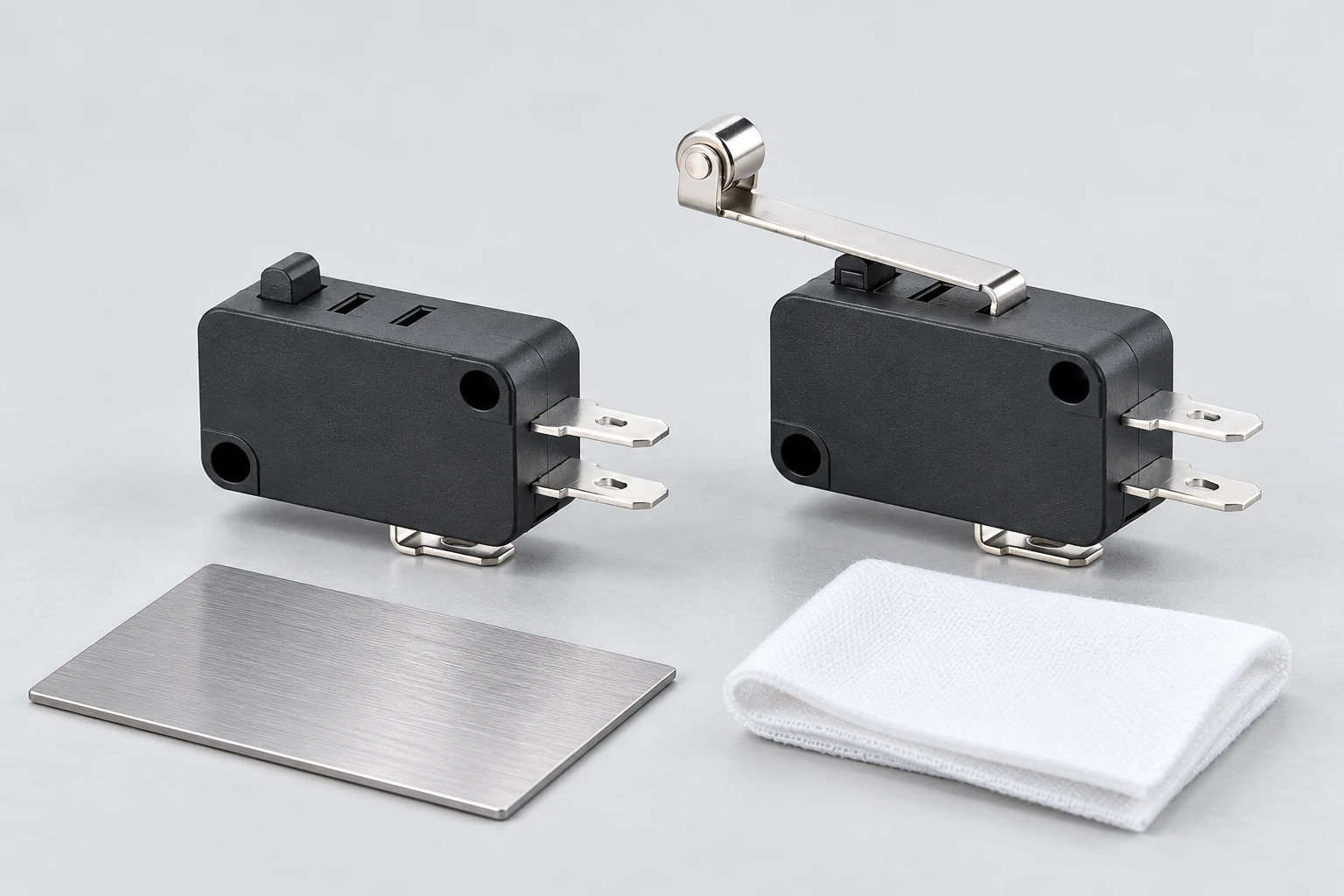
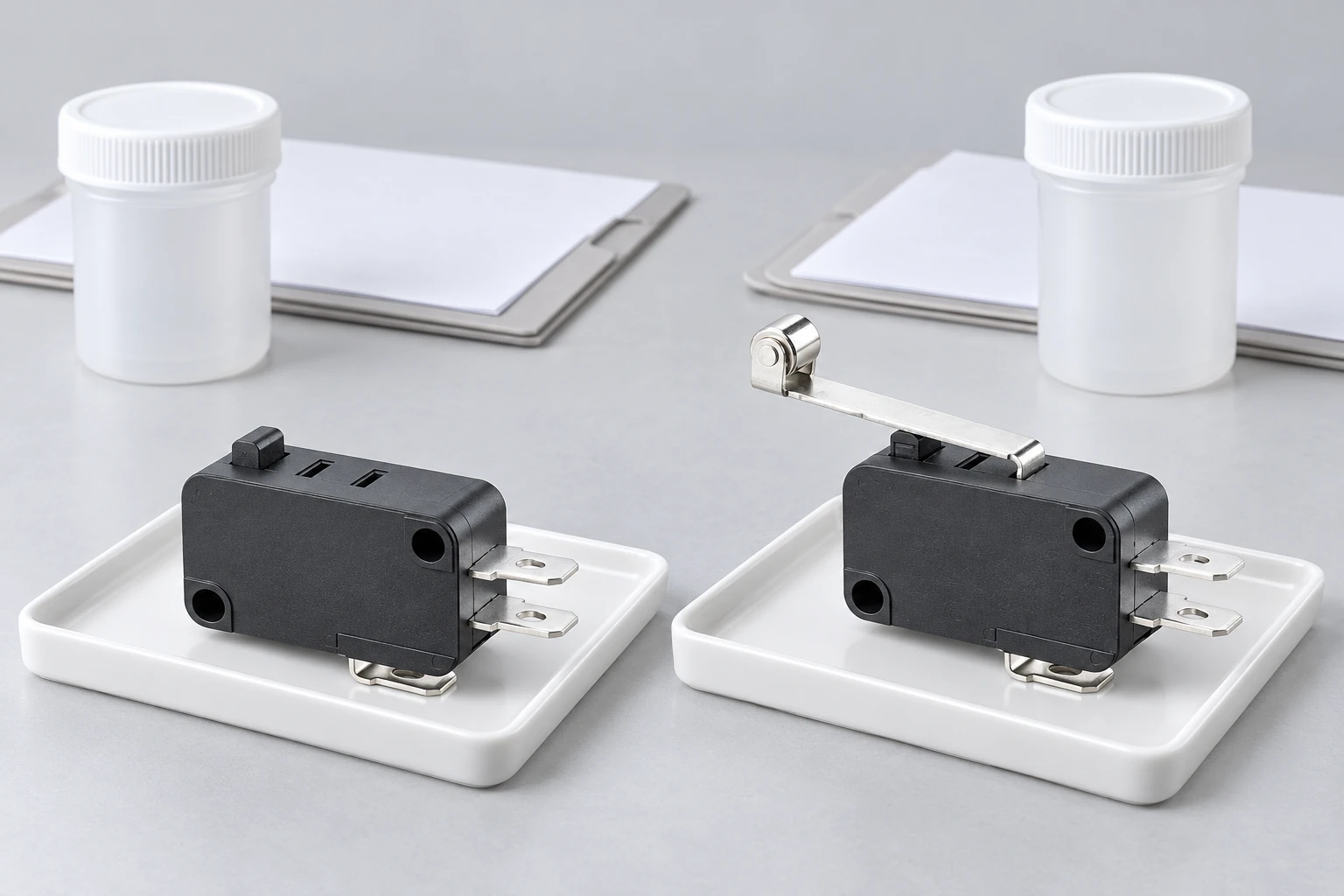
Das LEMA KW7 family is the visible product reference in this guide. The closed bottle and dry specimens in the figures illustrate process review only. They do not identify an approved cleaner, demonstrate a cleaning result or claim that the illustrated variant is sealed against chemical entry.
Define why cleaning is being proposed
Identify the contamination and the reason it must be removed. Flux residue, machining debris, oil, handling contamination and an external cosmetic mark are different problems. Record where the material is located and whether the proposed process can move it toward an opening or contact system.
Also ask whether cleaning can be avoided by controlling the earlier process. A protective cover during assembly, cleaner handling or a revised material application may prevent contamination more reliably than a later cleaning operation. Such a change still needs review, but it can remove an unnecessary exposure.
Do not clean a failure-analysis specimen before its condition is recorded. The failure-mode guide explains why preserving original evidence matters. A cleaned suspect part cannot reveal every feature of the original contamination event.
Identify every material and interface at risk
Review the housing, actuator, seals where present, terminal region, markings, adhesives and adjacent assembly parts. A chemical may affect one material while leaving another apparently unchanged. External appearance alone cannot prove that the complete component remains acceptable.
Request the exact product variant and its supported cleaning guidance. A general plastic-material compatibility chart can help identify questions, but it does not establish the behavior of a finished switch with multiple materials and interfaces. Avoid transferring approval from another model or manufacturer.
Include the surrounding assembly. Cable insulation, a panel overlay, a potting material or a protective boot may have different limits from the switch body. The process has to remain acceptable for the complete configuration that will actually be exposed.
Describe the process, not only the chemical name
Record the cleaner identity and concentration, application method, temperature, exposure time, mechanical action, rinsing, drying and the point in assembly at which cleaning occurs. A wipe, directed spray, immersion and ultrasonic process are not interchangeable exposures.
Specify the orientation and pathways by which liquid can reach the component. Capillary paths, terminal openings or a moving actuator can matter to the exposure. Do not assume that applying a small amount externally prevents entry into the assembly.
Where the process uses a mixture or a proprietary product, retain its technical and safety documents. Do not substitute a similarly named cleaner without review. A change in concentration, temperature or method can require a new compatibility assessment even when the product name remains unchanged.
Keep worker safety and component compatibility separate
A process must be assessed for the people performing it as well as for the component. The HSE COSHH assessment guidance explains the need to understand exposure and control measures for hazardous substances. It is not a declaration that a cleaner is safe for a switch.
Conversely, a supplier’s component-compatibility statement does not replace the workplace assessment. Follow the cleaner’s safety information and the facility’s approved procedure. Do not create an improvised mixture, apply an unknown aerosol to energized equipment or rely on odor as an exposure measure.
This article intentionally provides no solvent recipe or universal exposure limit. The useful output is a documented process boundary and evidence for the specific combination, not a list of liquids that readers might apply without qualification.
Do not confuse enclosure protection with chemical approval
Das IEC 60529 catalogue identifies the standard addressing degrees of protection provided by enclosures. An enclosure-protection designation does not, by itself, document compatibility with every cleaner, concentration, temperature or application method.
Read the exact product conditions and any installation requirements. A component can depend on a particular panel, seal or cable arrangement. A rating applying to one boundary may not cover liquid directed at another part of the assembly during manufacture or service.
Das dustproof micro-switch guide addresses the related distinction between an environmental description and the actual exposure. Keep chemical-process approval as its own requirement rather than treating a higher-looking protection label as a universal solution.
Plan a representative compatibility study
Agree the specimens, process parameters and acceptance criteria before exposing samples. Use the production-equivalent switch and surrounding materials. Identify the unexposed comparison specimens and preserve their traceable identity.
The study should examine the characteristics that the exposure could affect. Those may include external condition, actuator movement, markings, insulation behavior or contact performance, as appropriate to the product and application. Select the actual tests through the responsible engineering and supplier review rather than inventing a universal checklist of numerical limits.
Record the condition before exposure, immediately afterward and after any specified stabilization or aging interval. A part that appears satisfactory while still wet has not established its later behavior. Conversely, a short visual check cannot approve every long-term effect of an unqualified process.
| Process field | Informationen erforderlich | Unacceptable assumption |
|---|---|---|
| Chemical | Exact product concentration and documentation | A similarly named cleaner is equivalent |
| Anwendung | Wipe spray immersion or other method | Every exposure suits the same approval |
| Conditions | Temperature duration rinse and drying | A visually dry part is fully qualified |
| Materials | Switch and surrounding assembly identities | A housing-only chart approves the complete part |
| Beweis | Representative specimens and stated criteria | One cosmetic check proves long-term compatibility |
Treat residue and drying as controlled steps
Removal of visible contamination can leave another residue. Rinsing or drying may also introduce additional temperature, moisture or mechanical exposure. Include those steps in the qualification instead of evaluating only the initial cleaner application.
Gehen Sie nicht davon aus, dass das Erhitzen eines nassen Schalters ein genehmigter Wiederherstellungsprozess ist. Temperaturgrenzen, eingeschlossene Flüssigkeit und Materialkompatibilität benötigen weiterhin Nachweise. Trennen Sie fragliches Material und suchen Sie die unterstützte Entsorgung, anstatt es aufgrund des trockenen Aussehens in die Produktion zurückzuführen.
Das Lager- und Freigabeführer Behandelt die getrennte Handhabung von Material nach unsicherer Exposition. Reinigung sollte die Rückverfolgbarkeit nicht löschen oder untersuchte Proben wieder in unberührtes Inventar mischen.
Reinigung nach Lötarbeiten separat überprüfen
Eine gelötete Baugruppe kann Prozessanforderungen haben, die von der zulässigen Exposition des Schalters abweichen. Der Löten-Sicherheitsleitfaden erklärt, warum Hitze, Flussmittelanwendung und Nacharbeit eigene Kontrollen benötigen.
Schlussfolgern Sie nicht, dass ein Board-Reinigungsprozess für jeden montierten Schalter akzeptabel ist, nur weil er die Lötstelle passt. Identifizieren Sie die Einschränkungen des Bauteils und die Produktionssequenz. Wenn ein Lieferant einen Schutz- oder Prozessaufbau empfiehlt, dokumentieren Sie genau, was abgedeckt wird und wie die Installation kontrolliert wird.
Wenn der Schalter den vorgeschlagenen Prozess nicht verträgt, überprüfen Sie eine andere Montagefolge, Schutzmethode oder unterstützte Bauteilauswahl. Vermeiden Sie die Genehmigung einer zerstörerischen Umgehung nur, um ein bestehendes Reinigungsrezept zu erhalten.
Änderungen kontrollieren und Freigabeentscheidungen treffen
Dokumentieren Sie den genehmigten Reiniger, die Ausrüstung, Parameter, Bauteilrevision und Nachweis der Akzeptanz in der Fertigungsanweisung. Definieren Sie, wie Substitutionen, Wartungsänderungen und Bedieneranpassungen überprüft werden. Eine mündliche Aussage, dass ein Reiniger “immer verwendet wurde”, ist kein reproduzierbarer Freigabevermerk.
Bei einem fehlerhaften oder unklaren Ergebnis bewahren Sie die exponierten Proben auf und vergleichen Sie sie mit den unexponierten Kontrollen. Dokumentieren Sie Abweichungen und die tatsächliche Exposition. Reinigen Sie die Proben nicht wiederholt, bis das Ergebnis leichter akzeptiert werden kann.
Senden Sie die vollständige Prozessbeschreibung und Modellidentität durch die LEMA contact page. Die richtige Frage ist, ob die spezifische Exposition unterstützt wird und welche Nachweise erforderlich sind, nicht ob ein allgemeines Lösungsmittel für Mikroschalter geeignet ist.
Weiterführendes Lernen: Materialverhalten unter Exposition
nptelhrd: Mod-01 Lec-16 Dielektrische (Isolierende) Feststoffe. NPTEL erklärt die dielektrischen Isoliermaterialien. Es ist Hintergrund für die Betrachtung der Isolierung unter den nach der Exposition überprüften Eigenschaften; es genehmigt kein Lösungsmittel, keine Reinigungsmethode oder Schaltermodell.

Mod-01 Lec-16 Dielektrische (Isolierende) Feststoffe ansehen.
Häufig gestellte Fragen
Ermöglicht eine IP-Schutzart die Reinigung mit Lösungsmitteln?
Nein. Eine Schutzart des Gehäuses gewährleistet nicht die Kompatibilität mit sämtlichen Chemikalien oder Prozessbedingungen. Prüfen Sie das genaue Modell, die Grenzen der Baugruppe und die zulässigen Reinigungsbedingungen. Bewerten Sie anschließend die tatsächliche Konzentration, Temperatur, Einwirkdauer und Anwendungsmethode.
Kann ich einen unbekannten Reiniger an Produktionsschaltern ausprobieren?
Verwenden Sie kein Produktionsmaterial als unkontrolliertes Kompatibilitätsexperiment. Identifizieren Sie den Prozess und die Lieferantenanweisungen, definieren Sie repräsentative Proben und Annahmekriterien und trennen Sie exponiertes Material, bis die erforderliche Überprüfung seine Verwendung festgelegt hat.
Ist eine Kompatibilitätstabelle für Kunststoff ausreichend?
Es kann helfen, Fragen zu identifizieren, aber es genehmigt keinen fertigen Schalter mit mehreren Materialien, Schnittstellen und internen Merkmalen. Die vollständige Variante, die umgebende Montage und die tatsächliche Belastung benötigen eine eigene unterstützte Kompatibilitätsbewertung.
Zeigt ein sauber aussehender Schalter, dass der Vorgang sicher funktioniert hat?
Keine Erscheinung stellt einen Aktuator, Kontakt, Isolierung, Kennzeichnung oder das langfristige Verhalten fest. Verwenden Sie die genehmigten Bewertungs- und Trocknungsbedingungen, bewahren Sie Vergleichsmuster auf und dokumentieren Sie die genaue Exposition sowie etwaige Abweichungen vor der Freigabe.