
Power inlet polymer hydrolysis is a material-specific question: water can participate in chemical degradation of susceptible polymers, but a black plastic housing does not reveal its composition or resistance. Before approving an inlet for a warm, damp application, obtain the exact material and construction information, define the exposure and request evidence relevant to the assembled part. Moisture absorption, surface condensation and chemical degradation are different questions. This guide helps buyers organize a useful review without assuming that an IPZ inlet uses a particular resin or has a hydrolysis qualification that the published information does not establish.
Establish what material information is actually available
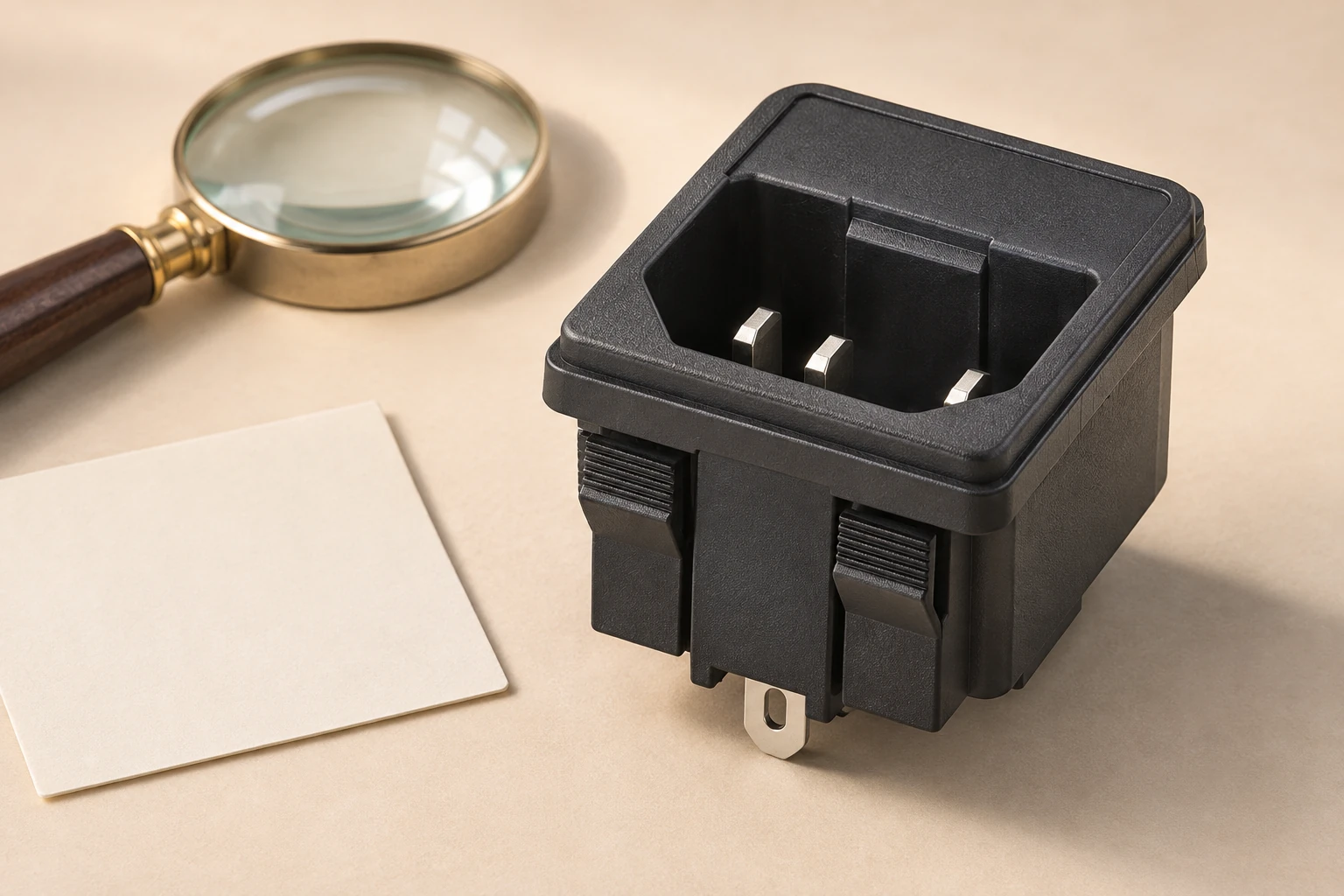
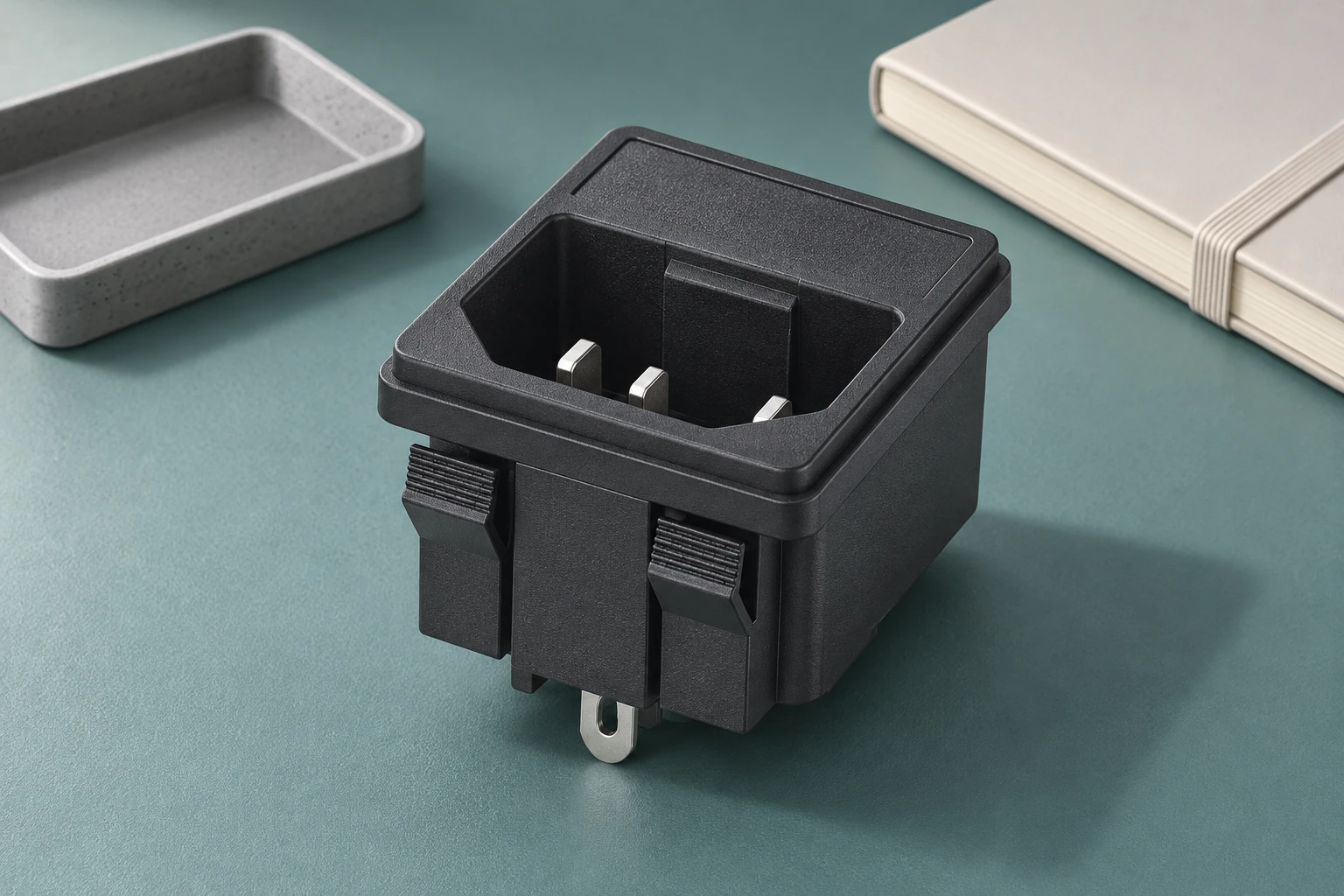
Begin with the exact inlet variant and drawing revision. The IPZ-Serie AC-Steckdose is the product reference for this discussion. Its family page identifies electrical and general operating characteristics, but those entries should not be treated as a complete resin specification or damp-service qualification. Record the selected construction, mounting arrangement, terminals and mating component in the inquiry.
Ask the supplier what housing material information can be provided for that variant. A useful response identifies the relevant material specification and the scope of any available declaration or report. Different parts of an assembly may use different materials. Do not let a statement about the outer housing silently become a statement about every internal insulating component, accessory or connected cable.
Appearance cannot resolve that gap. Color, gloss and apparent stiffness are not a reliable basis for assigning a polymer grade. A generic material abbreviation may also leave important formulation and processing questions unanswered. Keep the known facts separate from the information still being requested. If the exact composition is confidential, ask what applicable performance evidence or controlled material reference can support the equipment review.
Separate hydrolysis from other moisture questions
Hydrolysis concerns chemical reaction involving water. Moisture absorption can affect a material without proving the same chemical degradation mechanism, while condensation describes liquid formation under particular environmental conditions. A field report that says “wet plastic” has not identified which issue is present. Begin with observations and exposure history rather than naming a mechanism from appearance alone.
Das Canadian Conservation Institute guide to plastics and rubbers explains that plastics differ in their susceptibility to degradation and that identifying the material matters. This is conservation guidance, not an electrical-component approval method. Its relevant lesson is to avoid transferring one polymer’s behavior to another unidentified material. Do not copy museum storage recommendations into an operating equipment specification.
For an inlet assembly, several review tracks may be necessary. Electrical behavior in moisture, physical retention and long-term material condition do not become the same requirement simply because water appears in each discussion. The responsible team should decide what evidence is needed for each track. A single favorable measurement cannot establish every aspect of the inlet’s suitability for the proposed environment.
Describe the exposure before requesting a report
“High humidity” is too vague to select evidence. Describe the operating location, temperature pattern, moisture sources, expected time in service, shutdown periods and storage before installation. Explain whether the concern is humid air, occasional condensation, cleaning exposure or sustained wetting. The supplier needs to understand the intended conditions, including reasonably foreseeable changes over the equipment’s use.
Identify nearby heat sources and the inlet’s actual location in the enclosure. An ambient description from elsewhere in the machine may not represent the housing under review. Record cleaning agents or contaminants as separate information where relevant. Do not assume that a moisture-only assessment also establishes resistance to every chemical used during cleaning or maintenance.
Agree how exposure information will be obtained when it is incomplete. An equipment team may need observations or measurements before a supplier can assess applicability. Keep the source of each value and the operating state in the record. A design estimate, a chamber setting and an installed measurement describe different things; they should not be merged into one unexplained “test temperature.”
Use a material and evidence checklist
The table below organizes an inquiry without supplying invented service-life numbers. It is a qualitative decision aid. The final methods and acceptance criteria must come from the applicable equipment requirements and competent review.
| Review field | Request this information | Keep this boundary |
|---|---|---|
| Material | Exact housing and relevant insulating material reference | Black appearance does not identify a resin |
| Belichtung | Moisture source, temperature history and duration | Humid air and liquid wetting are different conditions |
| Specimen | Variant, lot, revision and assembly details | A coupon result is not a complete inlet result |
| Funktion | Required retained properties and measurement stages | One favorable check does not cover every function |
| Freigabe | Applicable evidence, limitations and change triggers | A generic declaration is not a lifetime prediction |
Ask for the test specimen description, material identity, conditioning and exposure history, measured properties and report limitations. A material coupon report can inform a decision while leaving assembly questions open. A completed inlet includes geometry, interfaces and mechanical constraints that a simple sample may not represent. Record which claims the report supports and which still require component or equipment evidence.
A second technical source, the NIST publication on hydrolysis-controlled water transport in polymeric coatings, provides a material-specific research context. Coating research must not be turned into an IPZ housing qualification or a universal rate of degradation. Use a source only for the mechanism and material scope it actually studies, and assess transferability before relying on its findings.
Choose acceptance criteria before the assessment
Start from the function the inlet must retain. The equipment team may need evidence concerning housing integrity, retention, electrical performance or another defined requirement. State the relevant examination and measurement stages in advance. A clear plan prevents a team from choosing an easy pass criterion only after it sees the results.
Keep the installed configuration traceable. Panel mounting, mating parts and connected components can matter to the assembly question even when a material report is available. Identify whether specimens are complete assemblies, housing samples or raw material coupons. Record why each specimen type was selected and what it can reasonably demonstrate. Do not describe a resin-only result as an assembled-equipment result.
Avoid unvalidated lifetime extrapolation. A short accelerated exposure does not automatically establish a specific number of service years. Any model needs appropriate evidence and boundaries. For purchasing purposes, a clear statement that an intended condition remains unqualified is more useful than a precise-looking lifetime number unsupported by the report. Retain assumptions and deviations with the acceptance decision.
Investigate suspect parts without destroying the evidence
If a returned inlet shows cracking, distortion, surface changes or retention problems, preserve its identity and history. Record the original installation, observed condition, time in use and any cleaning or storage events. Similar appearances can have different causes. Do not label the part “hydrolyzed” before a suitable investigation establishes the mechanism.
Keep suspect parts separate from new comparison specimens and prevent unnecessary cleaning, scraping or dismantling before the investigation plan is agreed. Such actions can remove information or make it difficult to reconstruct the original condition. The investigating team should decide whether material identification, microscopy, mechanical examination or another method is appropriate. This guide does not prescribe a laboratory diagnosis from a photograph.
Compare evidence with the actual variant. A replacement that looks identical may belong to a different material revision or production history. The equipment power inlet replacement guide covers the broader matching process. Preserve the affected lot and replacement reference so the inquiry can distinguish a material question from an assembly or substitution issue.
Keep related qualifications distinct
A general material declaration serves a different purpose from environmental performance evidence. The switch material declaration guide explains how to request usable substance information. A declaration can help document composition-related requirements without establishing hydrolysis resistance, retention after damp exposure or a service-life prediction.
Similarly, a report about repeated temperature transitions answers a different question from moisture-driven chemistry. The power inlet thermal cycling guide helps define that separate assessment. Where an application involves both temperature variation and moisture, the responsible team should review their combined relevance rather than treating one report title as complete environmental coverage.
The educational video below explains polymer degradation, including hydrolysis, in a biomaterials course. It provides chemistry background for understanding why material identity and degradation mechanism belong in the evidence request. Biomedical specimens and exposure conditions differ from an electrical inlet assembly, so the lecture cannot establish housing durability or an IPZ qualification. Use it to clarify the mechanism, then request application-specific evidence.
NPTEL-NOC IITM: Lec 26: Degradation of Polymeric Biomaterials | Polymeric Biomaterials

Watch Lec 26: Degradation of Polymeric Biomaterials | Polymeric Biomaterials.
Turn the review into a controlled purchasing decision
Send an inquiry containing the exact part reference, material information already known, exposure description, required functions and the evidence requested. Ask the supplier to identify applicable reports and their limits. If the intended environment lies outside available evidence, document the next assessment required or reconsider the application conditions through the equipment team’s normal design process.
Keep the final decision with the approved drawing, supplier reference and report version. Record which changes require renewed review, including material substitutions and changes to the relevant use conditions. Do not reduce the entire decision to “plastic approved,” because that phrase hides both configuration and scope. A useful approval explains the condition assessed and the function demonstrated.
No polymer identity, hydrolysis resistance class or damp-service lifetime for the IPZ series is established by this guide. The purchasing objective is to close the evidence gap for an exact assembly. When the information remains insufficient, retain that requirement as unresolved and obtain an appropriate assessment before release. This preserves an honest distinction between a product reference and a qualified application.
Häufig gestellte Fragen
Hydrolysiert jeder Kunststoff auf die gleiche Weise?
Nein. Die Anfälligkeit hängt vom Material und der Exposition ab. Erhalten Sie Informationen zur tatsächlichen Konstruktion anstelle der Übertragung einer allgemeinen Aussage.
Bestimmt eine Umgebungstemperaturbewertung die Hydrolysebeständigkeit?
Nur eine Temperaturbewertung allein bestimmt nicht das Verhalten bei einer definierten Feuchtigkeitsbelastung oder langfristiger chemischer Zersetzung.
Can housing color identify the polymer?
No. Obtain a controlled material reference or applicable evidence; appearance is insufficient.
Is an IPZ hydrolysis lifetime stated here?
No. This guide does not establish an IPZ resin identity, hydrolysis qualification or damp-service lifetime.