
Foot switch cable jacket marking identification starts with a readable record of the actual cable and a match to the ordered assembly. Photograph the full available legend, preserve package or reel labels, and compare the supplier cable designation with the approved drawing. Do not identify a cable from black jacket color, overall diameter or a familiar certification symbol alone. For an LF foot switch order, request the exact cable option and supporting documentation rather than assuming that every supplied lead has the same construction. This guide provides a receiving and purchasing workflow for resolving missing, abbreviated or conflicting markings.
Define the cable identification question
Begin with the assembly you are buying: switch model, cable option, length requirement, termination and destination equipment. The Lemaele LF series page describes customizable wiring, so the order needs a configuration record. A photograph of one example does not establish the cable specification for another order or shipment.
Separate identification from suitability. Identification asks what cable was supplied and whether it matches the approved order. Suitability asks whether that construction works in the equipment, environment and applicable compliance scheme. A clear marking can help answer the first question while leaving the second unresolved. Neither a print legend nor an assembly photograph proves the completed machine is approved for use.
Capture the original evidence before cleaning or cutting
Place the disconnected assembly on a clean bench and photograph the overall switch, cable entry and available cable length. Rotate the loose cable gently to locate printing without twisting the entry or opening the housing. Use diffuse light and a close focus that keeps similar-looking characters distinguishable. Retain the original photographs as well as any enlarged copies used for review.
Record missing or unreadable characters as unknown. Do not reconstruct a voltage, style number or manufacturer identity from what a different reel usually carries. Avoid solvents, abrasion or heat merely to improve a photograph: those actions can damage the jacket or remove the evidence. If the delivered lead is too short to show the full repeating legend, request the associated reel or packaging record from the supplier.

| Evidence item | Que vérifier | Decision supported |
|---|---|---|
| Actual assembly | Overall photograph and cable-entry view | Connects a loose cable image to the received foot switch |
| Legend capture | Original close-ups and literal transcription | Preserves uncertain characters without guessing |
| Packaging evidence | Source reel or smallest-container identity where applicable | Supports traceability and claimed certification review |
| Controlled documents | Supplier cable code, construction reference and revision | Allows comparison with the approved purchase order |
| Review result | Matched, held for clarification or approved substitution | Prevents an undocumented change entering production |
Read a legend as separate information fields
Create a transcription with separate fields for maker identification, cable designation, conductor information, ratings, additional use markings and production references where present. Keep the original character sequence beside the interpreted fields. This prevents an internal stock code from being mistaken for a cable type or a manufacturing reference from being treated as a certification file.
Le UL Wire and Cable Application Guide explains that markings and supporting tags or packaging must be considered together, and that surface printing is supplemental certification evidence. Use that distinction when reviewing a supplier claim. This article does not assign a UL listing, AWM style, jacket compound or conductor size to the LF family.
Confirm the scope before applying a marking rule
Requirements differ between cable categories, component wiring and installation uses. A building-wire example is useful for learning how to separate fields, but its permitted applications do not transfer to a foot-operated control lead. Ask which category and destination requirements apply to the ordered assembly before treating any marking pattern as mandatory or sufficient.
For example, IAEI cable-identification overview illustrates how markings convey cable identity and application information. Its examples do not mean every small component lead must carry the same legend. Have the responsible equipment or compliance reviewer determine applicability; do not replace that decision with a universal rule copied from a different cable application.
Match photographs, supplier records and the purchase order
Compare three things side by side: the delivered cable, the supplier configuration record and the approved purchase requirement. Where a supplier uses an internal cable code, ask for a controlled cross-reference to the relevant construction document. Preserve the revision used for the shipment. An undocumented verbal statement that two codes mean the same cable is difficult to rely on during a later investigation.
Check whether the record covers the cable alone, the switch assembly or a finished item incorporating both. Those scopes should not be merged. A cable document does not establish switch contact arrangement or completed-machine protection, while a switch family datasheet may say little about a customized lead. Ask the supplier to identify which document supports each claimed property and which details remain to be agreed.
Handle absent or conflicting print deliberately
No visible legend on a short lead is an information gap, not an automatic material identification. Ask whether the supplied cable category uses package marking, whether the legend lies outside the delivered length and how the assembly is linked to the source reel. A controlled assembly record may help connect those facts, but should be reviewed against the actual purchasing requirement.
A direct conflict needs stronger action. If the delivered cable identifies a different type or maker from the approved record, hold the affected stock and request a documented explanation. Do not obscure the original printing with a buyer label or accept a replacement datasheet without checking the physical cable. If substitution is proposed, evaluate it as a change rather than quietly renaming it in the receiving log.
Keep identity separate from wiring decisions
Jacket information does not establish which internal conductor connects to each switch terminal. Use the approved assembly diagram and qualified verification process for circuit identity. Do not energize an unidentified assembly to discover its function. The foot switch customization request guide helps put contact function, lead details and termination into the order before production.
Likewise, a readable legend does not prove bend life, strain-relief retention or jacket chemical compatibility. Use the cable strain relief guide for that separate mechanical interface. If the purchasing concern is the conductor construction, review conductor strand verification without treating a jacket photograph as a substitute for the necessary construction evidence.
Build a useful receiving record
A practical receiving record identifies the purchase line, switch configuration, shipment reference, photograph set, transcribed legend and reviewed supplier document. Add the reviewer, date and result. State exactly which mismatch or unknown prevents release so the supplier can answer a focused question. A row marked only “cable OK” gives the next reviewer little to work with.
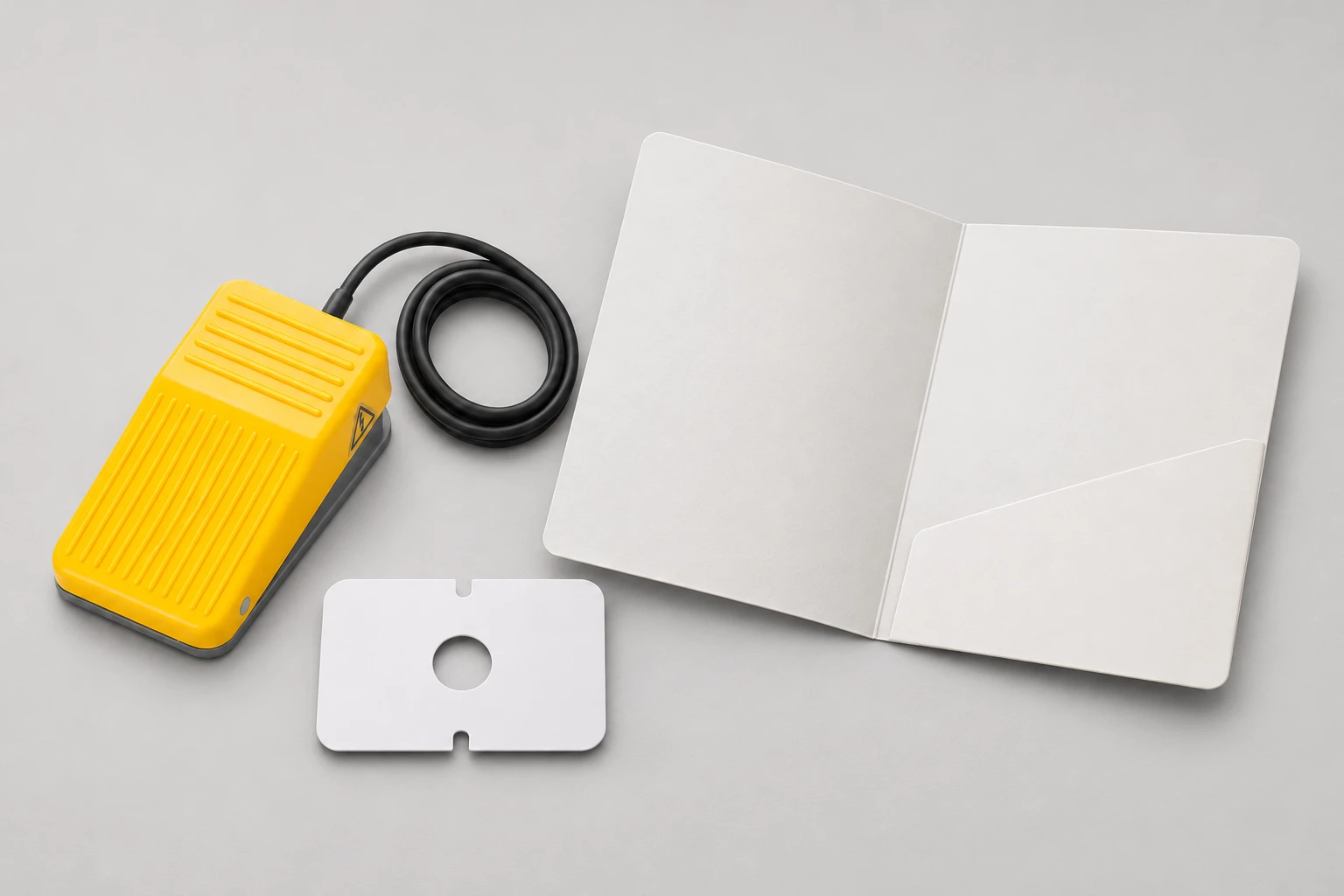
Keep identification photographs attached to the corresponding sample, not in an anonymous folder containing several similar yellow pedals. Where more than one cable option is supplied, record them separately. If a shipment includes a mixture of packaging labels or cable legends, preserve that observation before parts are combined in storage. Your quality procedure should define whether the mixture is permitted, requires segregation or needs supplier investigation.
Write the next order so the same question does not recur
Specify the supplier cable code and revision, required construction evidence, approved alternatives and any required identification photographs or labels. State who must approve a cable substitution. If destination documentation requires particular traceability, agree how reel information will remain connected to completed foot switch assemblies after the reel has been consumed. These are purchasing controls to agree, not capabilities inferred from a product-family page.
Request an approval sample with the intended production cable and retain its evidence package. Before reordering, check whether the supplier has changed the cable, marking process or document revision. A previous accepted assembly can be a useful comparator, but it should not turn into a permanent assumption that any visually similar black lead is interchangeable. Release the order when the defined identification question is answered and suitability evidence is separately complete.
Escalate uncertainty with the evidence intact
When a character remains ambiguous, send the supplier a clear close-up plus the full assembly and packaging photographs. Ask one precise question at a time: what is the cable designation, how does it map to the ordered configuration, and which document establishes that mapping? This is more effective than asking whether an unclear picture “looks compliant.”
If a cable fails identification after reasonable document checks, retain the sample and the unresolved record under your hold process. Let the authorized engineering or quality reviewer determine whether further inspection, return or an agreed replacement is appropriate. Do not invent a missing rating, add a certification symbol or present a local relabeling action as original manufacturer evidence. The goal is an auditable link from the delivered lead to the approved configuration.
Further learning
IAEI’s short training video demonstrates how cable markings convey different pieces of information. Its NM building-cable example illustrates the reading method; it does not specify the cable fitted to an LF foot switch or transfer that cable’s permitted uses to this assembly.

Foire aux questions
Puis-je identifier le câble par la couleur de la gaine ?
Aucune couleur et diamètre ne suffisent à établir la construction, les classifications ou l'identité. Faites correspondre la légende réelle et les dossiers de fournisseur de soutien à la commande approuvée.
Un symbole UL sur la veste prouve-t-il que l'ensemble de l'interrupteur à pied est certifié ?
Non. Examinez les preuves de certification des câbles applicables et leur portée. Un marquage de câble n'établit pas la certification de l'ensemble de commutation ou de l'équipement complet.
Que faire si le fil court n'a pas d'impression lisible ?
Preserve photographs and request the linked source-reel, packaging and assembly records. Determine the applicable identification requirement before deciding whether the missing print is acceptable or requires a hold.
May I replace missing manufacturer markings with my own label?
A buyer identification label may support an internal tracking process, but it does not create manufacturer ratings or certification evidence. Keep original evidence and resolve the unknown with the supplier.