
Push button operation with gloves should be validated with the actual glove, operator task and assembled panel. A larger button alone does not prove reliable use. Check whether the operator can identify the control, reach it without strain, press it deliberately, recognize the response and release it without touching a neighboring control. Keep the protective glove required by the workplace assessment throughout the evaluation. This guide provides a practical purchasing and trial checklist; it does not assign a glove-use rating to a switch or prescribe a universal button diameter, spacing or operating force.
Define the task before selecting the button
Begin with a short description of what the operator does. A brief reset once per shift differs from repeated hold-to-run actions, a setup jog and an occasional selection change. Record the normal starting position, the intended response and the consequence of a missed or unintended operation. Include whether the operator watches the button, the workpiece or another display during the action. These details determine what the trial must observe, rather than simply whether a volunteer can press a sample once.
Treat the button, label, indicator and receiving control as an interface. A press that closes contacts may still be unsuccessful if the person cannot tell whether the command was accepted. Conversely, a visible indicator may confirm a command without proving the machine reached the requested state. Write down what each cue means. The equipment designer should determine the required protective functions separately; an ordinary push button and a favorable usability trial do not establish a safety-related control function.
Keep the exact protective glove in the trial
Specify the glove manufacturer, model, size, material, lining and condition. Include any underglove normally worn. A thin disposable glove cannot represent a thick lined glove just because both fit the same hand. If several approved gloves are used across shifts, make a trial matrix rather than selecting the most convenient example. Record replacement and laundering practices where these change the glove’s shape or flexibility.
Das HSE guide to choosing protective gloves explains why glove selection depends on the hazards, work and wearer. Select the protection through the workplace assessment, then test the control with that protection. Do not solve a difficult button action by cutting a fingertip, removing a glove or choosing a thinner glove without the responsible assessment. This article evaluates the interface; it does not recommend a chemical-protection or electrical-protection glove.
Examine access from the real working position
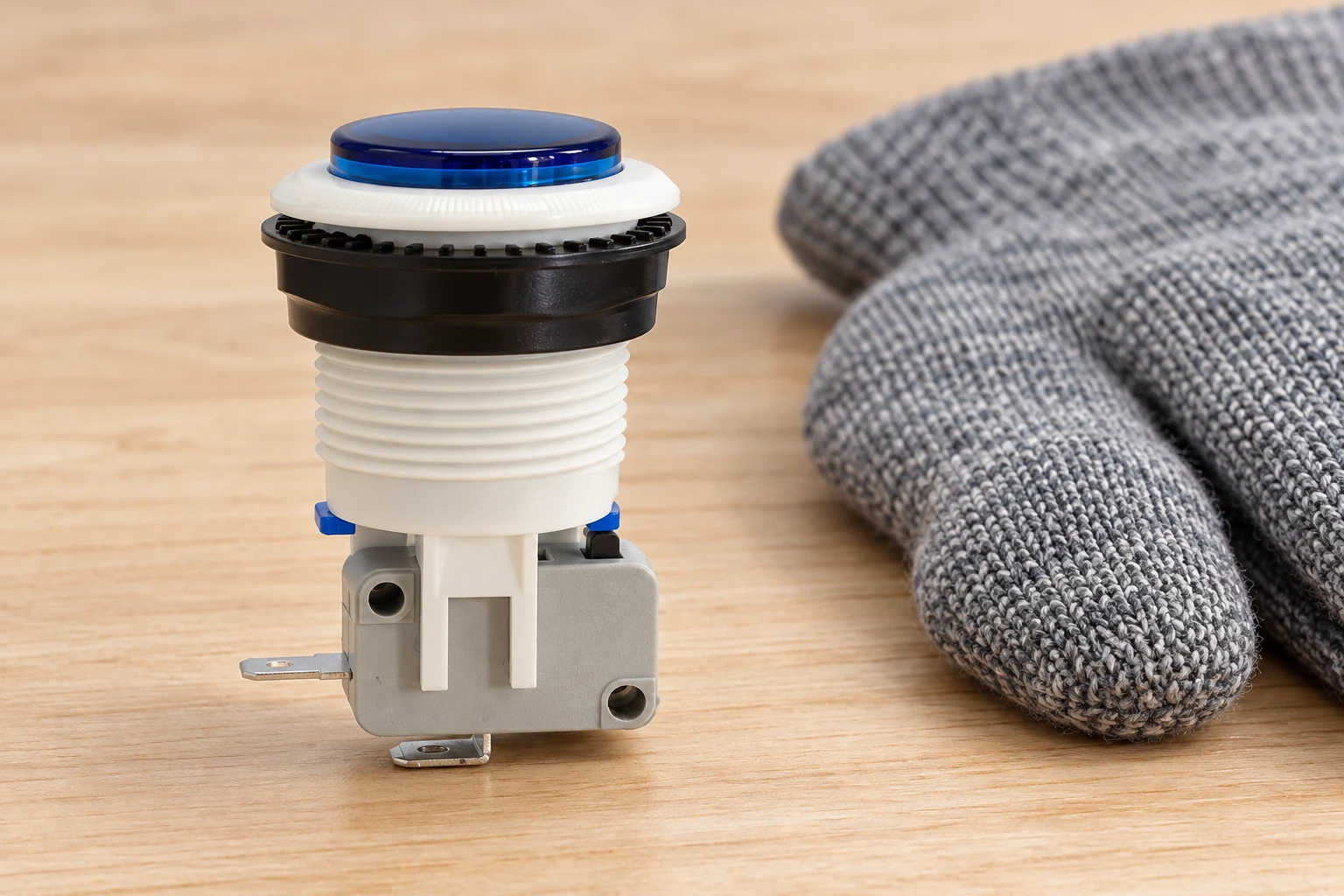
Build a representative panel mockup with the intended mounting height, angle, surrounding enclosure and adjacent devices. A loose button held in the hand hides reach and obstruction problems. Try the approach used during work, including the hand position after handling a tool or part. Observe whether the wrist remains comfortable or whether the operator has to twist, extend a finger awkwardly or lean against the panel to complete the action.
Include the intended operator population and appropriate workplace supervision. A single designer’s hand is not a population. Ask participants to explain where the control feels uncertain, then record the observed behavior rather than only a comfort score. Keep the trial safe and disconnected from hazardous movement. The HSE ergonomics guide supports evaluating the fit between people, tasks and equipment; the trial procedure below is a proposed project method, not an HSE certification test.
Check the approach, press, hold and release separately
First observe identification and approach. The hand should reach the intended control without accidentally brushing another active device. Next observe initial contact: does the glove contact the cap positively or slide toward the surrounding bezel? For a maintained or hold action, check whether the person can sustain the intended input without bracing against adjacent controls. Finally observe release and withdrawal, including whether loose glove material catches on surrounding hardware.
Separate a usability problem from an electrical fault. If the cap moves but the receiving input does not respond, inspect the wiring and contact sequence through the appropriate qualified procedure. If the circuit responds correctly but the person repeatedly misses the cap, the interface still needs work. Use the Handbuch zur Auswahl von Industriebeschlagtastern for the wider selection questions and retain a distinct record for glove operation rather than hiding both issues in a generic pass box.
Use an observation matrix with explicit decisions
| Trial element | Was aufnehmen | Decision to make |
|---|---|---|
| Glove | Approved model, size, lining and condition | Does the trial represent the actual protection? |
| Ansatz | Working position and neighboring controls | Can the intended button be reached deliberately? |
| Press and hold | Cap contact, slips and sustained input | Can the complete task be performed as intended? |
| Freigabe | Withdrawal and unintended adjacent input | Does the action end without interference? |
| Feedback | Observed command acceptance and machine state cues | Can the operator recognize the relevant response? |
Agree the project acceptance criteria before collecting results. They should address unintended neighboring operations, incomplete intended actions, unsafe posture, ambiguous feedback and operator workarounds. Where a measurable threshold is needed, the responsible designer should justify it against the task and equipment requirements. This article supplies no universal success percentage, maximum force or minimum separation. A short trial can reveal problems, but a small number of successful presses cannot prove lifetime reliability.
Record both the intended command and the actual event for each trial condition. Keep the order of trials and any coaching visible in the notes. A participant who has just been shown exactly where to press is in a different condition from a person identifying the control from the normal work instruction. If an error appears, preserve the configuration and investigate it before repeating until an apparently favorable result is obtained.
Decide which physical changes deserve a new trial
Possible design responses include changing cap projection, rearranging adjacent controls, improving the legend location or altering panel access. Evaluate each proposal on the actual assembly. A projected cap may improve access but also become easier to strike unintentionally. A guard may reduce accidental contact while making the intended press harder with a bulky glove. There is no useful choice without considering both sides of the task.
Das flush push button panel guide covers head projection and panel geometry. Keep this glove trial focused on the operator’s complete action rather than repeating that mounting guide. If a change affects the cutout, rear clearance or contact arrangement, reopen those checks independently. A successful ergonomic correction should not quietly introduce a wiring conflict or prevent service access behind the panel.
Separate color, illumination and tactile recognition
A blue cap is a visible feature, not proof that every operator can identify the intended function in every environment. Evaluate the actual label, lighting, viewing angle and task instructions. If the glove hides the cap during the press, determine how the operator recognizes acceptance of the command. If color carries meaning in the equipment, use additional identification appropriate to the design rather than relying on color alone.
NASA’s crew-interface guidance provides examples of considering control spacing, coding and operating conditions together. It is aerospace guidance, not a direct industrial spacing specification for LEMA products. Its useful lesson here is to assess the human interface as a system. Do not transfer dimensions or space-glove requirements into an ordinary control panel without the applicable equipment assessment.
Apply the review to a PBS product inquiry
Das LEMA PBS series provides a real product starting point for the review. The family information describes color choices, optional LED versions and some configurations using KW7 microswitches. Those options do not establish suitability for a particular glove, operator population or duty. Identify the exact configuration and obtain its dimensional, mechanical and electrical documentation before treating the panel mockup as representative.
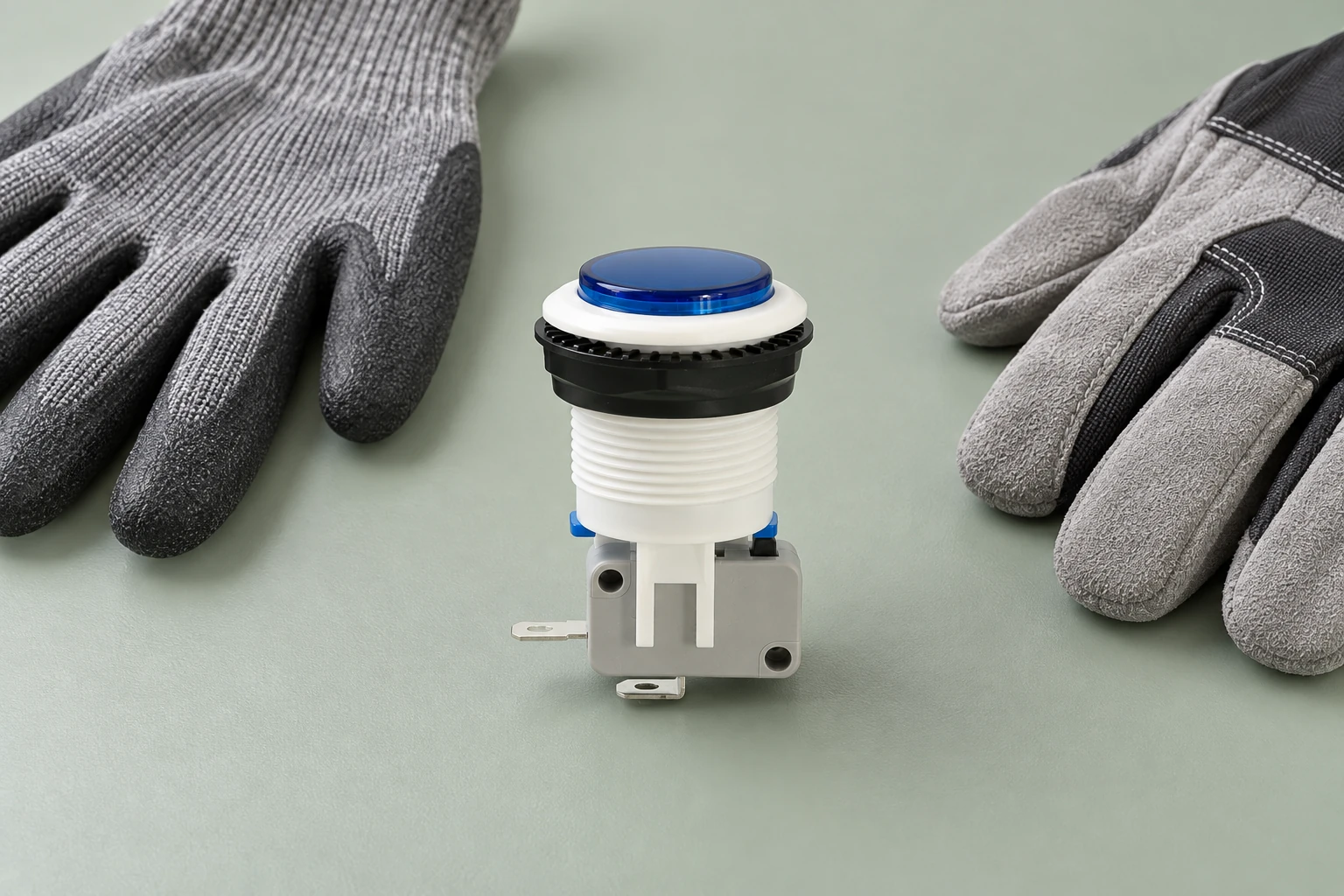
Send the supplier the intended cap style, mounting arrangement, contact function, lamp requirement where applicable and trial conditions. Ask which details distinguish the sample from the intended production variant. Keep the sample identifier with the observation record so that a later cosmetic or construction change can be evaluated. Photographs in this article are product-reference illustrations, not records of a completed glove trial or an approved machine installation.
Document a repeatable release package
A useful release package contains the approved glove list, panel drawing revision, exact button order code, task description, trial participants and observations. Keep the changes made after the first trial and the reason for accepting them. State which operating conditions were represented and which remain outside the trial. This makes the result useful when the machine is copied, the control panel is redesigned or the glove supplier changes.
Revisit the interface after relevant workplace feedback, a glove change, a moved guard or a replacement button. An apparently similar replacement can change cap feel or travel. Use the push button replacement guide to manage that separate substitution decision. During routine review, ask whether operators remove gloves, press with tools or use unusual hand positions; these are observations to investigate, not shortcuts to normalize.
Further learning: why gloves change dexterity
The European Space Agency’s demonstration below uses a simple gloved activity to illustrate dexterity and coordination. It is an educational comparison, not an industrial glove test or a basis for selecting PPE. Use it to explain why bare-hand impressions are insufficient, then return to the representative panel, approved protective glove and actual operator task for your project decision.
European Space Agency, ESA: Challenge 3: Astro Art | #TrainLikeAnAstronaut
Watch Challenge 3: Astro Art | #TrainLikeAnAstronaut.
Häufig gestellte Fragen
Does a larger button guarantee reliable operation with gloves?
No. The actual glove, reach, cap geometry, adjacent controls and feedback all affect the task. Evaluate the complete representative panel rather than choosing solely by nominal diameter.
Can operators remove their gloves when a button is difficult to use?
Do not use glove removal as an informal workaround. Retain the protection required by the workplace assessment and have the responsible team resolve the interface or reassess the work through its approved process.
Does PBS family information prove suitability for a particular glove?
No. Confirm the exact order code and product documentation, then evaluate the intended assembly with the approved glove and representative operator task. No glove-use rating is assigned here.
When should the glove-operation trial be repeated?
Review relevant changes to gloves, cap style, panel layout, guards and replacement components. Use the original trial record to identify which operating assumptions need to be checked again.