
Micro switch ozone exposure requires an application-specific review of the atmosphere, exposed materials and operating duty before a component is approved. Neither a general enclosure rating nor a published ambient-temperature range establishes ozone compatibility. Identify where ozone can originate, characterize the conditions at the installed switch and ask the supplier which evidence applies to the exact variant. If the available product record does not establish resistance, keep that question open. This guide helps equipment builders prepare a clear exposure specification and evaluation request without assuming the KW7 family has been ozone-tested or treating air-quality guidance as a component qualification standard.
Define the question at the component location
Begin with the reason for the review. A new equipment design near an ozone-producing process needs a compatibility decision; a returned switch with a fault needs an investigation. These are related but different tasks. Record whether ozone is confirmed, suspected from the process or merely included in a broad environmental questionnaire. A named process is a useful lead, but it does not describe what reaches a component inside a particular enclosure.
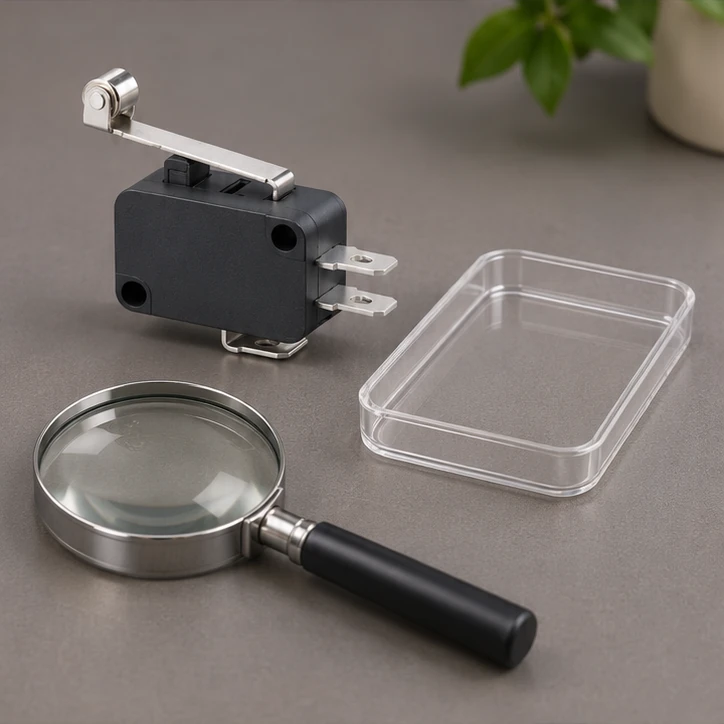
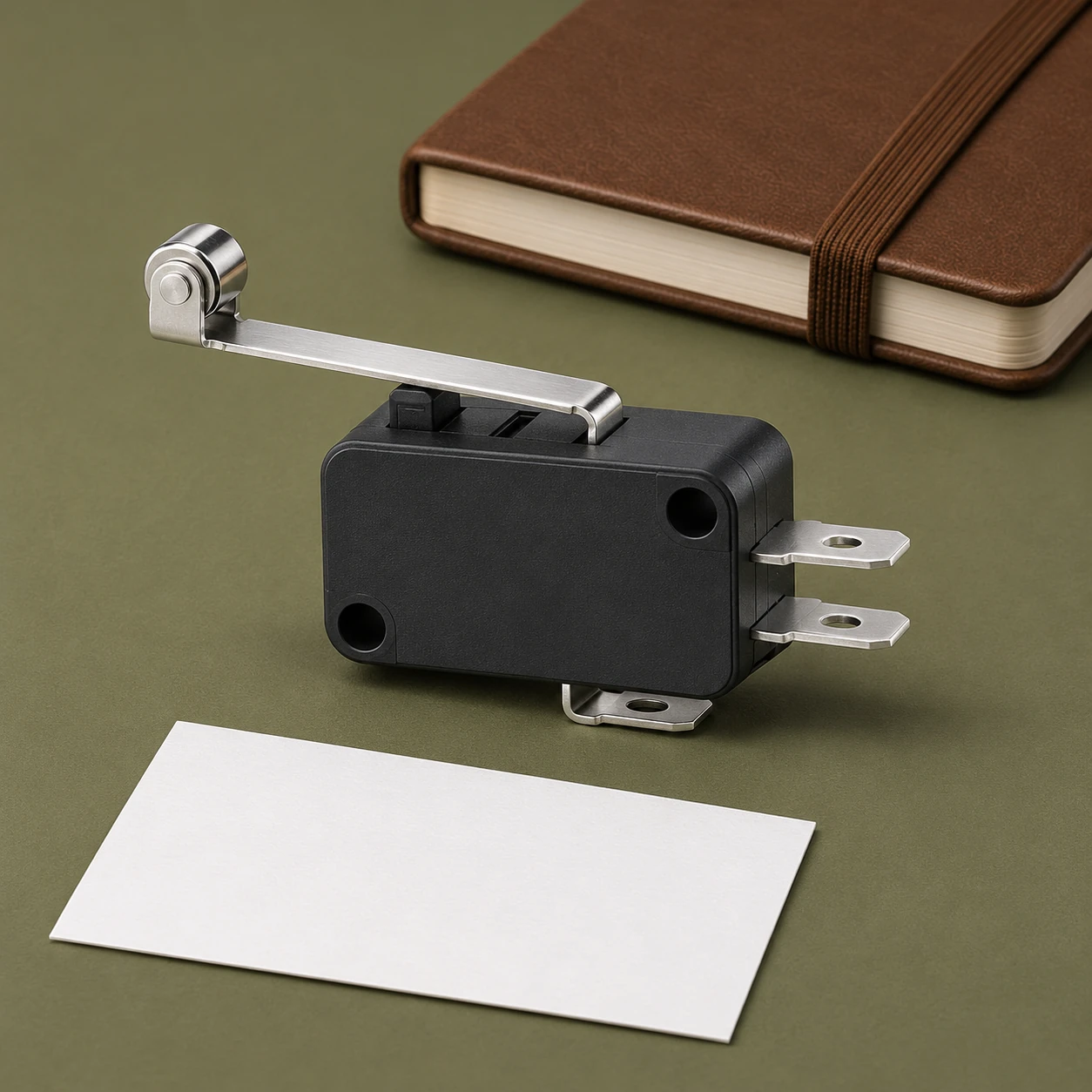
Pour le Micro-interrupteur de la série KW7, confirm the ordered construction and installed location before asking for a resistant alternative. Include photographs or drawings showing the switch, enclosure, openings and nearby process equipment. Do not infer the composition of the housing, actuator components or internal contacts from the family image. Request material and environmental information for the exact variant within the supplier’s available documentation.
Understand why a general material warning is not a product verdict
Le US EPA discussion of ozone generators identifies potential damage to susceptible materials, including rubber and electrical wire coatings. That warning explains why an exposure question deserves attention. It does not establish that every polymer, every wire insulation or every assembled switch behaves alike. Nor does it show that ozone caused the particular electrical symptom in a returned component.
Le California Air Resources Board ozone effects page also describes material effects in general terms. Use such sources to frame the need for review, then obtain component-specific evidence. No ozone concentration, service life, safe distance or acceptable exposure duration for KW7 is established by these public pages or by this article. A product approval needs a defined application and evidence that addresses it.
Describe concentration, duration and operating conditions
An exposure description should identify the ozone information available, how it was obtained and where it applies. Include concentration units, measurement location, the instrument or data source, timing and any known limitations. Explain whether the process is continuous, intermittent, enclosed or associated with maintenance. Keep a distinction between a measured value near the component and a process setting, room reading or equipment brochure value that may not represent it.
Also describe temperature, humidity, airflow and relevant co-exposures where they are known. These details help the supplier or test specialist decide whether existing evidence is relevant and what further evaluation may be needed. Mark gaps explicitly. Do not create a numerical exposure estimate by multiplying unrelated catalog figures or assuming that an enclosure reduces a room concentration by an arbitrary amount. Arrange measurements through qualified personnel under the site’s safety procedures when additional data are required.
Keep electrical duty and mechanical operation in the record
The same environmental question can arise in different switching duties. Document the actual load or signal interface, switching frequency, actuator movement and expected service conditions. These inputs establish what performance must be maintained in the intended assembly. They are not evidence of ozone resistance on their own. A component that operates on a bench under a different load has not automatically demonstrated suitability for the installed circuit and atmosphere.
Include the distinction between electrical malfunction, mechanical return difficulty, visible surface changes and cable or connector issues. For baseline fault localization, use the micro switch replacement guide alongside the exact equipment procedure. Do not replace the environmental review with a simple continuity check. Conversely, do not attribute an intermittent harness connection to ozone solely because an ozone process exists elsewhere in the facility.
Use a supplier evidence checklist
The following table proposes information for a compatibility inquiry. It is not an ozone qualification method or an acceptance specification. Agree the relevant requirement, method, specimens and decision criteria with the supplier and the responsible equipment team. Where the information is unavailable, record the limitation rather than converting a general assurance into a test result.
| Evidence area | Information to supply | Avoid assuming |
|---|---|---|
| Exposition | Location, units, timing and measurement basis | A process setting equals component exposure |
| Construction | Exact order and available material records | A family image identifies every material |
| Fonctionnement | Load, actuation and required function | A bench click proves installed suitability |
| Report scope | Specimens, conditions and evaluated outcomes | A material statement qualifies an assembled switch |
| Investigation | Untreated parts and traceable history | A nearby ozone source proves causation |
| Approval | Defined configuration and decision owner | A general rating establishes ozone resistance |
An existing report may be useful if its construction, exposure and evaluated characteristics match the intended question. Ask what was tested, what was observed and what conclusions the report actually supports. Separate a raw-material statement from a test of an assembled switch, and separate an exposure-only examination from a test that included operation. These distinctions prevent a narrow result from being expanded into a much broader service claim.
Do not treat ingress protection as gas qualification
A familiar enclosure designation can be useful within its intended scope, but it does not answer every environmental compatibility question. Ask specifically whether the available evidence addresses ozone and the actual installed assembly. A boot, cover or external enclosure introduces additional materials and interfaces that may also need review. Do not assume that adding one unspecified barrier establishes a known concentration at the switch or an unlimited service life.
Describe how any proposed enclosure interacts with ventilation, access, actuation and maintenance. The equipment designer should review these functions together rather than approving a cover only because it appears to isolate the component. A barrier proposal may be reasonable to investigate, but its effectiveness needs evidence under the defined conditions. This article does not prescribe an enclosure modification or authorize sealing a switch with an unreviewed compound.
Preserve returned parts before intervention
If the concern follows a failure, retain the received condition and traceability of the affected assembly. Record the symptom, service history, lot, installation and exposure information before opening, cleaning or replacing parts. Photographs should show the whole assembly and relevant surfaces without implying a diagnosis. Agree specimen handling with the supplier or investigator so that useful evidence is not destroyed by well-intended repair work.
Keep comparison specimens and their histories identifiable. An unused spare, a working unit from a different location and a failed unit from the process area provide different comparisons. None is automatically a perfect control. Record differences in duty, storage and handling, then let the investigation assess their significance. For broader preservation of unused material, the switch storage guide covers a separate part of the lifecycle.
Separate competing contamination mechanisms
An enclosure may contain several materials and process residues. A change on a contact surface or housing does not identify its cause without supporting evidence. Describe suspected exposures separately and retain the basis for each. The investigator may need to consider the assembly history, contact duty, nearby materials and observed condition together. Ask for a method suited to the question instead of specifying an analysis simply because it was used in another failure report.
Le silicone vapor contamination guide addresses a different source investigation and should not be treated as an ozone mechanism. Similarly, a successful replacement demonstrates that the system operates with that replacement at the observed time; it does not isolate why the original component failed. Controlled comparisons and traceable findings are more useful than assigning the latest known environmental concern to every returned switch.
Evaluate a proposed change against the defined requirement
A supplier may propose a different variant, external protection, relocation or a revised maintenance arrangement. Treat each as a proposal requiring review, rather than proof that the original problem is solved. Compare the proposal with the exposure description and required switching function. Identify any new material, geometry or maintenance dependency, and agree how its effect will be evaluated before it becomes part of a production build.
Keep changes controlled so that the result can be interpreted. If the switch, enclosure, wiring and process settings all change together, a successful trial may support that combined configuration while providing little evidence about any single change. State the approval scope honestly. Define the configuration identity, observed duration, evaluated characteristics and remaining limitations. No accelerated exposure factor or field-life conversion is supplied here; any such relationship needs its own justified basis.
Prepare an inquiry that can produce a useful answer
Send the exact KW7 order code, component location, circuit duty, exposure record and the decision you need to make. Ask whether existing documentation addresses those conditions, what additional information is required and what evaluation can be proposed. Include your required service function and the approval owner. A request for “ozone-proof micro switches” without a defined environment is difficult to answer responsibly and invites an unsupported yes-or-no response.
Retain the supplier’s answer with the evidence and the final equipment decision. Review it when the process, enclosure, cleaning practice or component construction changes. This gives purchasing a repeatable way to distinguish an approved configuration from a similar-looking replacement. It also keeps the technical uncertainty visible until it is resolved, rather than allowing a broad material label to become a permanent and untraceable product claim.
Background video: environmental degradation of polymers
This university lecture introduces polymer degradation concepts relevant to understanding why exposed materials need a defined evaluation. It is educational background, not a KW7 material declaration, ozone test report or recipe for an exposure test. Use it to understand questions raised during the supplier review while relying on the agreed application evidence for approval.
nptelhrd: Mod-01 Lec-30 lecture-30-Environmental Degradation of Polymers

Watch Mod-01 Lec-30 lecture-30-Environmental Degradation of Polymers.
Foire aux questions
La résistance à l'ozone de KW7 est-elle établie ici ?
Numéro. Demandez des preuves pour la variante exacte et l'exposition définie ; ce guide ne fait aucune déclaration concernant la résistance à l'ozone.
Une classification d'entrée établit-elle la compatibilité avec l'ozone ?
Aucune qualification de ce type n'est établie par la classification disponible. Vérifiez spécifiquement l'ozone et l'ensemble installé réel.
Une lecture de pièce peut-elle représenter l'emplacement de l'interrupteur ?
Seulement si sa pertinence est justifiée. Enregistrer le lieu de mesure, le moment, la méthode et les limitations.
La réussite du remplacement identifie-t-elle l'ozone comme la cause ?
No. A working replacement alone does not isolate the original failure mechanism.