
Electromechanical switch storage shelf life cannot be inferred from mechanical life, the shipping date alone or a universal expiry rule. Follow the exact supplier storage instructions and assess package condition, exposure history and the intended assembly process. Older unused stock may need a documented review, but elapsed time by itself neither approves nor rejects a lot.
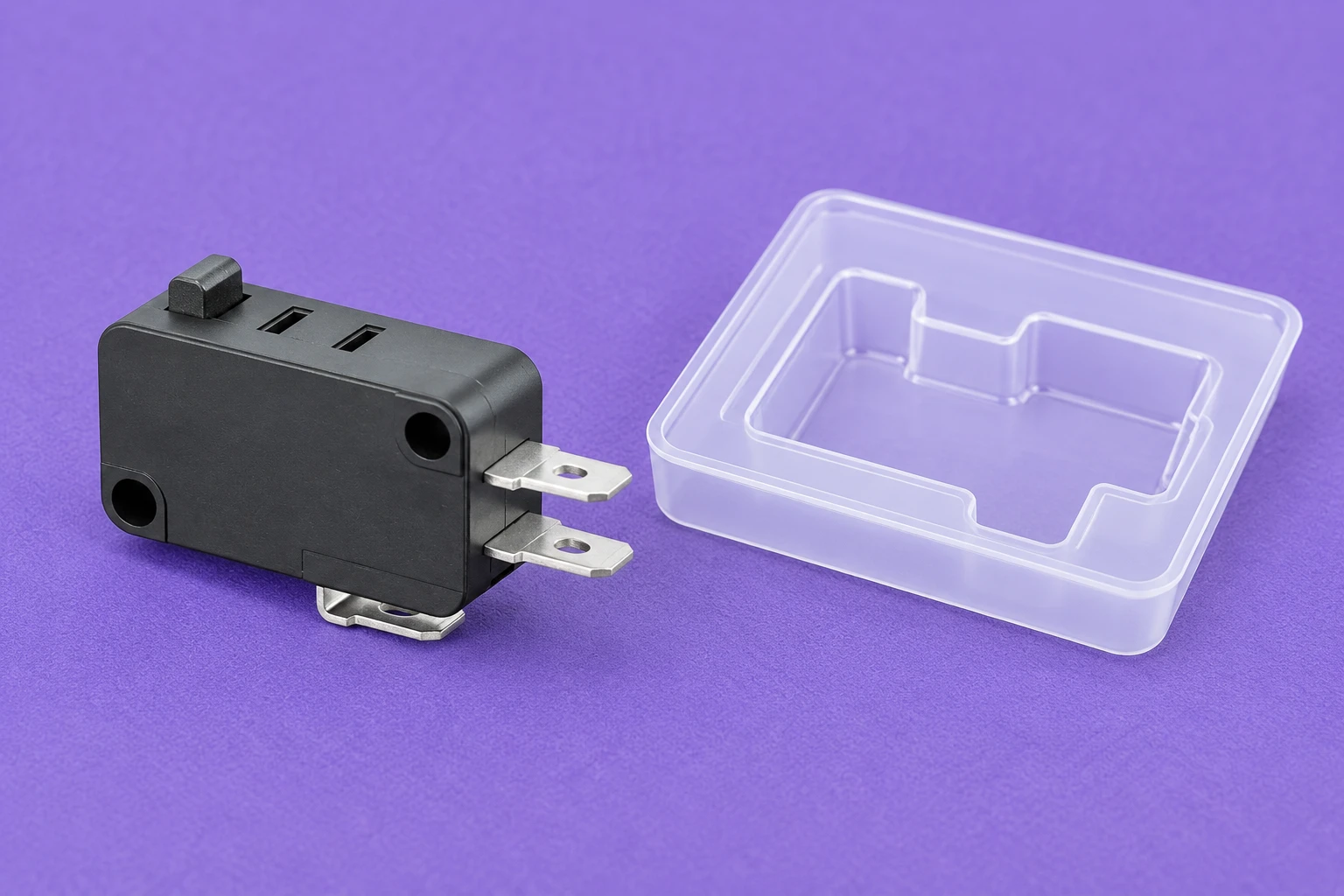
O Micro Interruptor da Série KW7 is the LEMA product reference illustrated here. Its photograph identifies the external product, not an unlisted rating, accessory compatibility or test result. Obtain the current specification for the full order code before approving an assembly.
Storage Shelf Life Is Different From Operating Life
Operating life concerns performance during use. It may involve mechanical cycling, contact wear, electrical loading, arcing, actuator fatigue, or changes in switching characteristics. Storage shelf life concerns whether an unused component remains suitable after time in inventory. These are related reliability considerations, but they are not interchangeable specifications.
An unused switch has not consumed its rated operating endurance simply by sitting in a warehouse. Nevertheless, storage can affect terminal surfaces, exposed contacts, seals, lubricants, plastics, and packaging. A satisfactory cycling result does not automatically establish solderability, and acceptable solderability does not establish endurance under the intended electrical load.
Keep these distinctions explicit in purchasing requirements and inspection plans. Avoid converting an operating-life statement into a storage approval or assuming that a switch with no visible wear must be ready for production. Acceptance should address the mechanisms relevant to storage and the demands of the manufacturing process.
Read Lot Age Alongside Condition and History
A date code can help identify manufacturing history, but its meaning depends on the supplier’s coding system. It may not identify packaging, shipment, receipt, or the most recent inspection. Record these events separately where available. Treat uncertain or mixed date codes as traceability issues rather than guessing what they represent.
Older stock with intact protective packaging and documented storage may present a different risk from newer stock returned from an uncontrolled production area. Conversely, an apparently clean package does not prove that the material avoided earlier exposure. Review condition and history together, acknowledging gaps instead of treating missing records as evidence of acceptable storage.
For inventory decisions, distinguish routine stock, stock awaiting review, and material approved under a specific disposition. This prevents an engineering investigation from becoming an informal release. Approval should identify the lots and quantities covered, the intended use, and any conditions attached to assembly or further storage.
Packaging Is Part of the Storage System
Original packaging helps preserve more than identification. Depending on its design, it can protect terminals from abrasion, keep actuators from unintended loading, separate components, and reduce exposure to environmental contaminants. Replacing it with a convenient container may remove protections that are not obvious during a visual check.
Inspect bags, trays, tubes, reels, separators, and outer cartons for damage relevant to the product. Torn wrapping, crushed pockets, loose components, contaminated cushioning, or missing closures can justify further assessment. A damaged shipping carton does not necessarily mean damaged switches, but the condition of the internal protection needs verification.
When partial packages must be opened, use a documented resealing and identification method. Preserve the lot identity and relevant handling information. Do not assume that an ordinary replacement bag reproduces the protective properties of the original package, particularly where the supplier specifies moisture control, cleanliness, or special handling.
Control Moisture Without Assuming Every Switch Is Alike
Moisture can contribute to corrosion, surface changes, and contamination-related electrical problems. Temperature changes can also create condensation when cold material enters warmer, humid air. Storage procedures should address environmental transitions as well as warehouse conditions, using the supplier’s instructions and the packaging system as the starting point.
Do not automatically apply moisture-sensitive semiconductor practices to every electromechanical switch. Switch construction, housing materials, seals, terminal arrangements, and assembly methods vary. Some products have specific drying or packaging requirements; others require different controls. Product-specific documentation should determine whether moisture conditioning is needed and what procedure is acceptable.
Unapproved drying is not a neutral recovery action. Heating can affect plastics, lubricants, adhesives, seals, and packaging materials. Before attempting it, obtain an approved method that addresses the actual switch construction. If no supported recovery process exists, quarantine the affected material while engineering and the supplier assess the options.
Prevent Contamination Before It Becomes a Contact Problem
Warehouse cleanliness matters because contamination can reach solderable surfaces, moving interfaces, or accessible contact regions. Dust, oily residues, corrosive vapors, and handling deposits may create concerns that are not captured by inventory age. Store switches away from incompatible chemicals and processes that generate airborne residue.
Handling controls should protect both terminals and actuators. Avoid touching solderable surfaces, placing loose switches on dirty workbenches, or using unapproved tapes and packing materials. Keep opened stock covered when it is not being used. Return unused material through a controlled process rather than mixing it directly with untouched inventory.
Cleaning requires the same caution as drying. A solvent that removes visible dirt may enter a switch, redistribute contamination, or disturb internal lubrication. A sealed appearance does not establish compatibility with immersion or washing. Use only a supported cleaning method, and investigate the source of contamination before attempting recovery.
Use First-In-First-Out With Condition-Based Exceptions
First-in-first-out rotation reduces avoidable aging and makes inventory easier to manage. It works best when lot identity survives receiving, storage, kitting, production returns, and repacking. If operators cannot distinguish lots after a package is opened, the rotation policy exists on paper but cannot reliably guide material selection.
Rotation should not override a quality hold. An older lot awaiting solderability review should not be issued merely because it arrived earlier. Likewise, newly received material with damaged protection should not bypass review because it is recent. Release status must take precedence, followed by the applicable stock-rotation rule.
Review slow-moving inventory before it becomes an urgent production requirement. This creates time to retrieve supplier information, inspect representative material, and arrange testing where justified. Include surplus purchases, service stock, returned kits, and material transferred between sites, since these routes can obscure storage history.
Assess Storage Concerns by Their Possible Effects
A practical review connects each concern to a plausible failure mechanism and an appropriate check. The table below supports that discussion; it is not a substitute for product specifications or an acceptance standard. Several concerns may apply to the same lot, requiring a combined assessment rather than a single inspection.
| Storage observation | Possible concern | Useful review direction |
|---|---|---|
| Older lot with intact packaging | Uncertain surface condition despite good protection | Review supplier guidance, history, and assembly suitability |
| Opened or damaged packaging | Exposure, contamination, or mechanical damage | Inspect protection, components, and handling records |
| Evidence of condensation | Corrosion or moisture-related deterioration | Quarantine and obtain product-specific assessment |
| Discolored terminals | Surface change affecting solderability | Investigate finish condition and perform appropriate testing |
| Unknown storage history | Unresolved environmental and handling exposure | Expand evidence gathering and document uncertainty |
Verify Solderability Separately From Electrical Function
Solderability is a central storage concern for switches intended for soldered assembly. Terminal finishes can change through environmental exposure or handling, affecting wetting during production. A switch can operate electrically on the bench while its terminals remain unsuitable for the planned soldering process.
Visual inspection can identify corrosion, residues, damaged plating, or unusual discoloration, but appearance alone cannot establish solderability. Equally, discoloration should be investigated rather than automatically classified as failure. Use an applicable, documented test method and acceptance criteria agreed by the responsible quality and manufacturing functions.
Where appropriate, supplement component testing with a controlled assembly evaluation using the intended board finish, flux, soldering method, and cleaning process. This helps distinguish a component surface problem from a process mismatch. Record the conditions carefully; a successful trial under unrelated conditions offers limited support for production release.
Do not use aggressive preparation to make a questionable sample pass unless that preparation is itself an approved production operation. Scraping terminals, applying unusual flux, or repeated solder exposure can obscure the original condition. Requalification should evaluate material as it will actually enter the authorized assembly process.
Release stored lots against documented evidence
Requalification should end with an explicit disposition for the identified stock. Record the packaging history that is known, the unresolved exposure, sample selection, test method and intended assembly process. Define whether the result releases the whole identified lot, only a segregated quantity or a specific application. Preserve any restrictions so the same stock is not later issued to a different process under a broader assumption.
If the evidence is insufficient, retain a controlled hold while the supplier and responsible engineering function resolve the missing information. Avoid changing date labels, mixing lots or using a successful specially prepared sample to erase uncertainty. A useful supplier inquiry includes the full order code, lot markings, actual storage history, packaging photographs and proposed manufacturing process. Ask for the applicable storage guidance rather than demanding a universal expiry date.
Technical references and the scope of this review
Met Office humidity and dew point: Humidity and temperature interact when stock moves between environments. Keep that physical background separate from a manufacturer-specific shelf-life requirement.
NPL solderability assessment note: NPL describes a defined method for assessing solderability. A suitable assessment of stored solder terminals needs an agreed process, not a visual assumption that their age guarantees good or bad wetting.
For the wider component decision, see Selecionar um Microinterruptor Industrial para Paineis OEM. Complementary checks are covered in Vida Elétrica vs Vida Mecânica de um Micro Switch: O que Significam as Classificações e Micro Switch Soldering Precautions: Control Heat and Rework. These pages address separate questions and do not replace the acceptance evidence defined here.
Further learning
The Met Office explains humidity and its physical meaning. This supports the moisture discussion; it does not set a storage period or environmental approval for the illustrated switch.

Watch What is humidity? — Met Office – Learn About Weather
Perguntas frequentes
Do all electromechanical switches have the same expiry date?
No. Apply the supplier-specific storage guidance and assess the identified lot and intended process.
Is storage age the same as used operating life?
No. Unused-stock condition and operating endurance address different mechanisms.
Can a continuity check establish solderability?
No. Solderability needs its applicable assessment separately from electrical contact function.
Can I dry or clean old stock without instructions?
Use only a supported process for the exact construction. Unapproved recovery can alter the component and obscure the original condition.