
Understanding Core Socket Standards and Raw Material Selection
To determine the correct ac power socket, you must understand what the standard and materials will be used for to achieve an acceptable level of performance over a long term basis. Globally, the following types of sockets are most commonly specified for OEM equipment:
- North America: NEMA 5-15R, 125V AC / 15A, governed by UL 498.
- Europe: Schuko CEE 7/3, 250V AC / 16A, under VDE 0620, plus the Europlug‑compatible socket.
- United Kingdom: BS 1363 Type G, 250V AC / 13A, with integrated shutters and fuse.
- Global IT/Medical: IEC 60320 C13 and C19 inlets, up to 250V AC / 10A–16A.
| Socket Type | Reference Standard | Rated Voltage / Current | Primary Markets | Typical Contact Material |
|---|---|---|---|---|
| NEMA 5-15R | UL 498 | 125V AC / 15A | North America, Japan | Phosphor bronze, nickel plated |
| Schuko CEE 7/3 | VDE 0620 | 250V AC / 16A | EU, Middle East, parts of Asia | Phosphor bronze, silver plated |
| BS 1363 Type G | BS 1363 | 250V AC / 13A | UK, Ireland, Gulf states | Phosphor bronze, silver/nickel plated |
| IEC 60320 C13 | IEC 60320 | 250V AC / 10A | Global (IT equipment) | Tin‑phosphor bronze |
Material engineering underpins every specification. Critical decisions include:
- Contact alloy: In an AC power socket, the use of phosphor bronze (C5191)—rather than brass—allows both live and neutral contacts to achieve spring force for more than 10,000 insertions. Beryllium copper is often used by some manufacturers as a substitute for applications requiring maximum insertion life (e.g., medical connectors that are powered up daily), but the increased cost must be balanced against lifecycle requirements.
- Plating: We will use selective silver (for low, stable resistance) or nickel plating on the wear zones, controlled thickness to prevent flaking. In large quantities, we routinely verify uniformity of each individual layer through cross-sectional sampling done under a microscope in minutes; this prevents future corrosion complaints from occurring at an installation site.
- Insulation: Housings in PBT+30%GF or PC/ABS, UL 94 V‑0, passing the 125°C ball pressure test per IEC 60884‑1.
- Incoming inspection: Verification of alloy composition by spectrometer. Melt flow and DSC verification of polymers for batch consistency. Quarantine any resin with a melt flow shift greater than 10%. Experience has taught us that these shifts generally indicate a higher likelihood of molding porosity and dielectric failure.
Tracing all raw material sources from heat or batch numbers establishes first layer of product genealogy.
Precision Injection Molding and Contact Assembly for Multi‑Country Socket Types
The precision of tooling governs safety and fit. The cavity inserts for shutters and housings are wire-cut EDM machined to a tolerance of ±0.02 mm, thus directly controlling the insertion and withdrawal forces required by BS 1363 and VDE 0620.
Inside our toolroom, we check cavity wear after every 50,000 shots using CMM inspection. If dimension drift exceeds 0.01 mm, we will rework or replace the insert. This proactivity helps us ensure that the insertion force curves fall within the narrow band identified by the Standards, and we have gained this experience through producing more than two million pieces each year.
Injection machines that are coming from other companies, such as Engel and Arburg, are completely electric and will create molded parts from a special flame resistant resin, with little or no internal stress in the part. In addition, contact terminals will be riveted or torque screw terminals will be positively torqued to 0.5-0.8 N·m with immediate feedback. Vision systems will be used to inspect for earth straps and/or shutter springs prior to final welding and/or snap fitting.
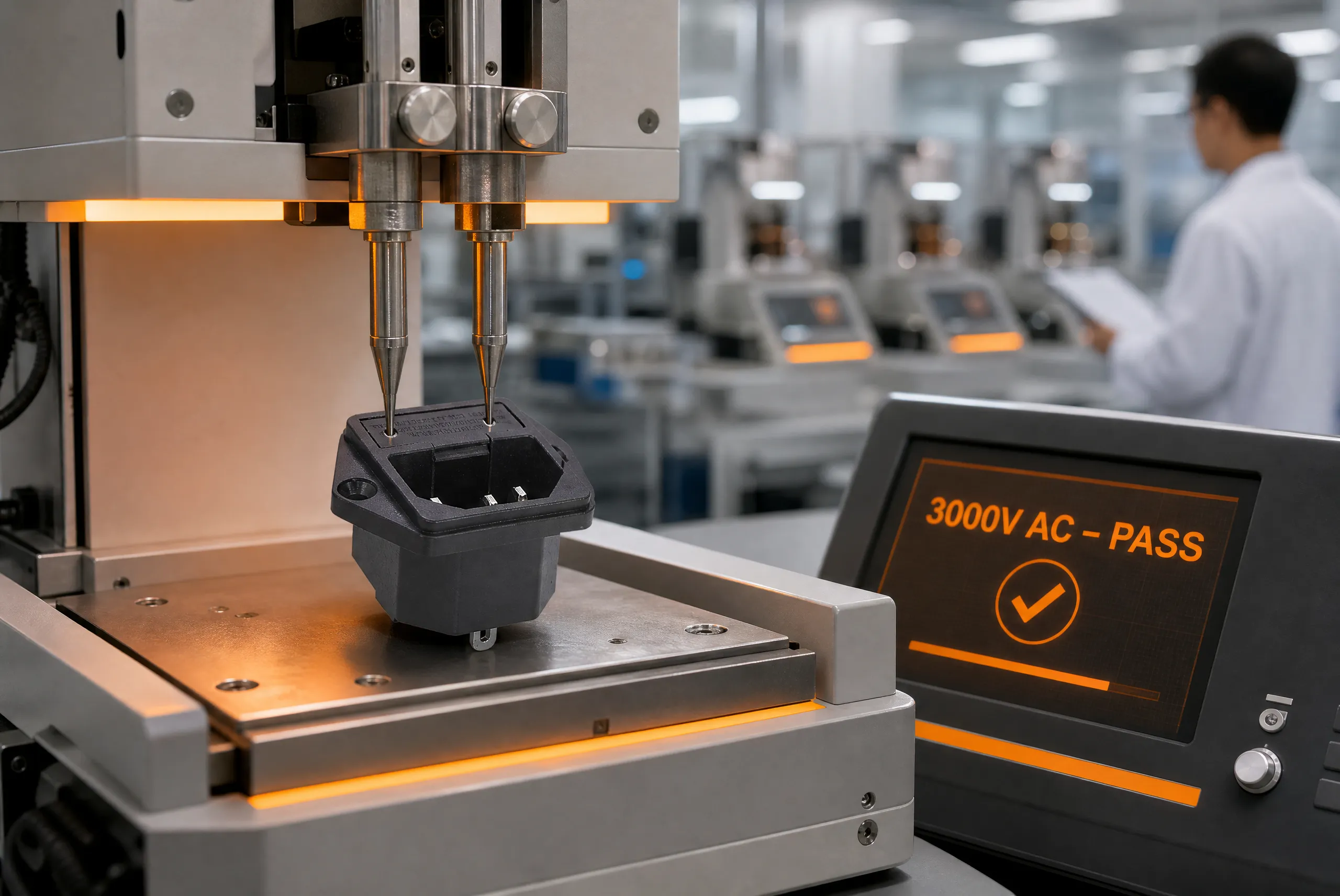
Inline Quality Control and End‑of‑Line Safety Testing per IEC, UL, and VDE Requirements
Safety testing is embedded in every production cell. Each socket undergoes mandatory inline checks:
- Earth continuity: Resistance ≤50 mΩ to ensure instantaneous breaker operation.
- Dielectric withstand: 1500 V AC (basic) or 3000 V AC (reinforced), 1 second, verifying creepage and clearance.
- Polarity verification: Automated detection of wiring errors.
Limits follow IEC 60884‑1:2022 Clause 17 and VDE 0620‑1:2020 Clause 18.
When testing thermal rise sampling loads from sockets, all temperatures are taken at the maximum specified value (15 Amperes on the NEMA side and 13 Amperes on the British side). The final temperatures taken at the terminals must all be ≤ 45 K from ambient temperature for safety purposes to prevent PV C insulation on the wires which connect into the receptacle to become deformed by heat in excess of 45 K; deformation of insulation will cause decreased creepage distance between energized components over time bringing with it an increased risk of fire. Additionally, all UL listed variants are tested to the U L glow-wire standard 850°C in an ISO/IEC 17025 accredited laboratory as per U L 498.
Here, a supplier’s manufacturing credentials are solidified. With nearly three decades of experience, Zhejiang Lema Electrics Co., Ltd. has an 11,000 m² plant in Wenzhou (China) and holds certifications like UL, VDE, CE, and ENEC. Buyers can validate specific certification numbers via UL Product iQ, therefore any time a supplier offers verifiable certification numbers and welcomes on-site performance testing record audits, it establishes the supplier’s compliance as a manufactured attribute instead of a simple paper claim.
OEM Customization: From Front Plate Design to Modular Multi‑Standard Integration
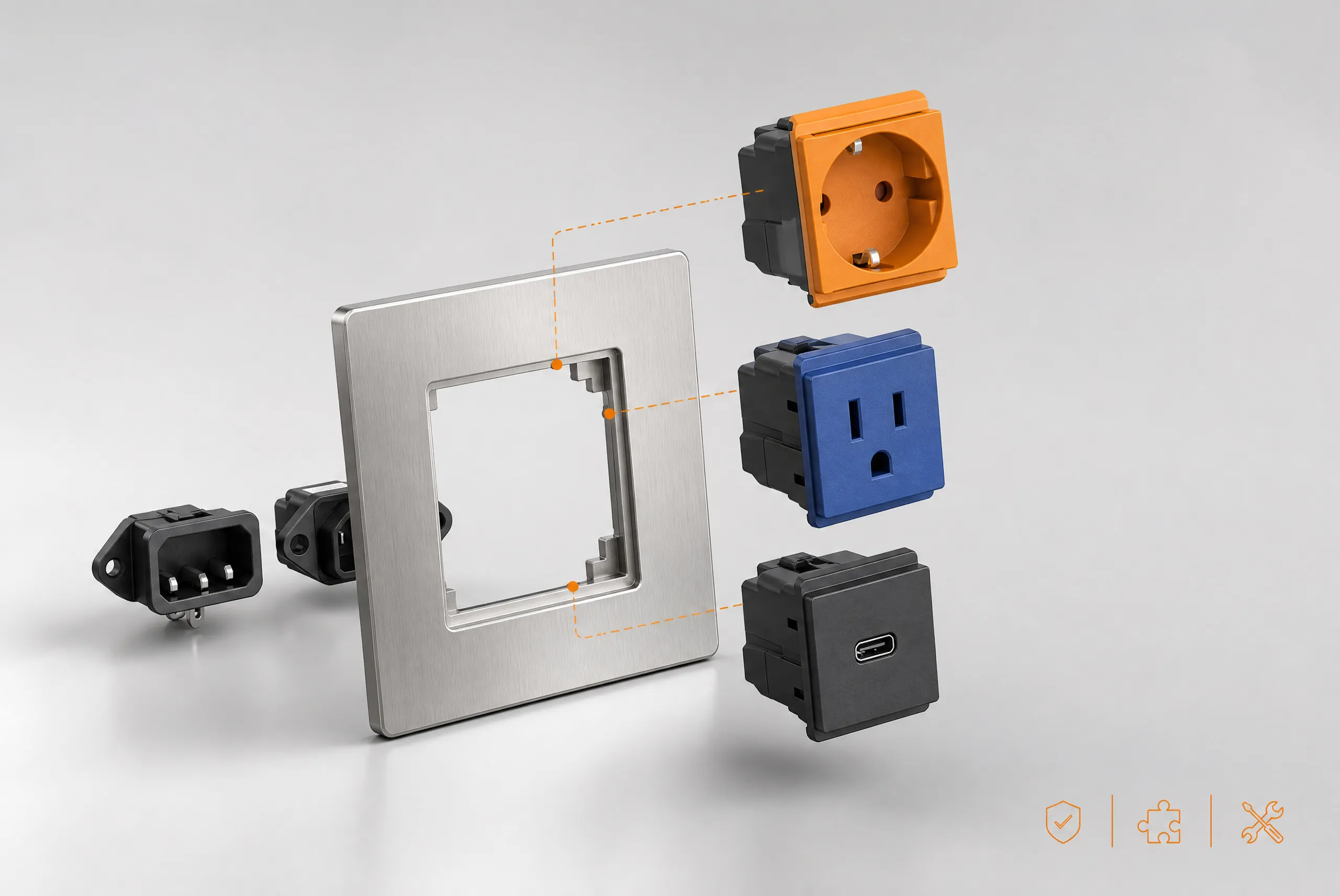
The OEM ability is not limited to logos. It begins with creating front plates that suit a customer’s aesthetic requirements such as: thickness, color (by RAL/Pantone), and finish (matte, brushed, polished). Then, a strategic implementation tool that incorporates modularity to create a standardized back-frame for the various interchangeable and certified inserts for the different applicable standards.
A device platform may come equipped equipped with NEMA 5-15R duplex, while another could feature Schuko as well as USB‑C 20W PD; a third option might have BS 1363 installed—for every configuration having the same base tooling. All inserts used in these configurations will have their own independent certifications, allowing OEMs to maintain one frame (SKU) and several certified variations for their final product offering.
| Customization Category | Options | Remarks |
|---|---|---|
| Panel Surface Finish | Matte, gloss, brushed, soft‑touch | Must pass abrasion and adhesion tests |
| Modular Combination | 1×NEMA + 1×Schuko; 2×BS + USB‑C 20W | Interchangeable inserts, common frame |
| Marking & Branding | Laser, pad print, hot stamp | Permanent markings, wear‑test compliant |
| Integrated Sub‑assemblies | EMI filter, overload protector, LED | Pre‑assembled for reduced downstream work |
While designing, manufacturers also can provide DFM (Design for Manufacture) reports, 3D STEP models, and pre-compliance samples. Integrated facilities will speed customization and enable mixed certifying pallets to be assigned to a single part number.
Full Traceability and Final Batch Verification Before Global Shipment
Each socket has a Data Matrix Code (laser-marked) which connects it to the ID of a copper coil, the batch of resin used, plating parameters, and all inline test results through the MES (Manufacturing Execution System). Also, this is in compliance with IPC-1782 traceability principles.
A digital dossier is generated during the final inspection process and includes AQL sampling (cosmetic) and safety level measurements:
- High‑resolution sample images and defect classification.
- Pin gauge and CMM dimensional reports.
- Insertion‑force curves from calibrated gauges.
- For BS 1363 sockets, fuse compliance with BS 1362 time‑current characteristics.
- Signed certificate of conformance and traceability matrix.
The whole idea behind providing this document to you before shipment is to take all of the uncertainty out of supplier evaluation and turn sample-based trust into data-driven confidence that they are providing a quality product. We provide this documentation to you regularly; no purchase order is required and the factory’s quality system is the best sales tool that they have.
Technical Resources for Buyers
We compiled two engineering tools from our daily quality assurance (QA) workflows to back-up your supplier audits. The tools are not sales pitches; the tools are data:
- Global Socket IEC Cross‑Reference Chart: A standard for specifying the type of socket, its governing standard, rated current, and typical certification mark.
- Supplier Audit Checklist: 25 individually itemised verification points that include: Material certificates, CPK data, Mould maintenance logs and Traceability system Walk through inspection.
Our technical department will handle your request. Your inquiry will only be directed to one of our engineering personnel, not to our sales department.
Frequently Asked Questions
1. Which AC power socket types are most common for global OEMs?
There has been a dramatic increase in the availability of modular multi-standard options such as the NEMA 5‑15R (North America), CEE 7/3 Schuko (Europe), BS 1363 Type G (UK), IEC 60320 C13/C19 (IT/medical) connector types over the past few years.
2. What datasheet specifications should buyers verify?
For each clause of the standard, you have specifications of rated voltage/current, contact resistance (<30 mΩ), dielectric voltage, insulation resistance, terminal torque, and maximum operating temperature.
3. How is molding consistency and insertion force validated across batches?
Using calibrated gauges, CPK data (≥1.33) and dimensional reports of cavities to determine insertion force curve characteristics from batch sample.
4. Can OEM modules combine multiple national standards?
The modular frame provides snap-in insertion capability for the NEMA, Schuko and BS certified inserts which will make the design of the enclosure much easier with regards to inventory.
5. What routine quality tests run per production lot?
At full load, inline dielectric, earth continuity, polarity, and thermal rise are sampled. The results are logged for each range by their serial number and compiled into batches.
6. How is end‑to‑end traceability maintained?
With an MES you can link raw material batches to every socket using a unique data matrix code for fast retrieval of complete production and testing history.
7. Are pre‑compliance samples and technical files available?
Already-established manufacturers supply buyer certification pre-assessment (UL, TÜV, …) to FDA-accredited laboratories with an engineering sample, a 3-dimensional model and construction file.
8. What are typical MOQs and lead times for custom sockets?
Tooling for custom colors and marking typically takes about 4 to 6 weeks while 8 to 10 weeks is necessary for the actual production, depending on complexity and other factors. This can result in total MOQs as low as 1,000 units.
References
- IEC 60884‑1:2022, General Requirements for plugs and sockets for residential and common use.
- UL 498:2024, Standard for Attachment Plugs and Receptacles.
- VDE 0620‑1:2020, Stecker und Steckdosen für den Hausgebrauch und ähnliche Anwendungen.
- IPC‑1782, Standard for Manufacturing and Supply Chain Traceability of Electronic Products.
- Grand View Research (2025), Electrical Sockets & Switches Market Size, Share & Trends Analysis Report.