
A 24V control circuit flips the usual switch worry upside down. Arcing nearly disappears, and with it the self-cleaning that keeps contacts fresh at mains voltage. The engineering questions become minimum load, surface films, and what the controller input really draws at the instant of closure.
Part 1. What changes for a micro switch at 24V?
Control-voltage duty removes most arc erosion but also removes arc cleaning. A contact that only ever sees milliamps must conduct through whatever film forms during storage and standby.
| Property | Mains-level duty | 24V control duty |
|---|---|---|
| Arc at opening | Significant, self-cleaning | Minimal or absent |
| Dominant failure | Erosion and welding | Film resistance and intermittency |
| Selection focus | Rating and derating | Minimum load and material |
Families and options are indexed in the LEMA Micro Switch product line; the fields to read change, not the catalog.
Part 2. Why does minimum applicable load matter most?
Minimum applicable load states the smallest voltage and current at which the maker expects stable switching. Below it, resistance can wander enough to flip a logic input unpredictably.
Voltage-specific habits from the 12V micro switch overview carry over; the 24V case simply tightens the same minimum-load discipline.
Part 3. How do controller inputs create hidden inrush?
Controller inputs are not resistors. Filter capacitors behind an input pin charge at contact closure, drawing a brief current spike that dwarfs the steady signal.
- Identify the input circuit type and its capacitance.
- Estimate closure inrush against the contact’s documented capability.
- Add series resistance where the spike exceeds the documented range.
- Debounce in firmware so bounce does not multiply the spikes.
Part 4. Which wiring run effects need checking?
Long runs between switch and controller add resistance, capacitance, and noise pickup. Each subtracts margin from a signal that started at only 24 volts.
| Run effect | Symptom | Check |
|---|---|---|
| Conductor resistance | Input voltage below threshold | Drop calculation at signal current |
| Cable capacitance | Slowed edges and repeat inrush | Cable data times the run length |
| Noise coupling | Phantom transitions | Routing distance from power wiring |
Compact switch envelopes for dense control assemblies are covered in the miniature switch packaging guide.
Part 5. How should a 24V switch point be validated?
Validate the signal chain, not the switch alone. Exercise the production harness with the production controller, then read the input state through firmware while cycling the mechanism.
Include environmental standby in the plan: weeks of non-operation in a humid enclosure test film behavior in a way bench cycling never does.
Part 6. What belongs in the RFQ and Fit Boundary?
RFQ input checklist
- Control voltage, signal current, and input circuit type
- Cable length, routing, and shielding plan
- Switching rate, standby periods, and environment
- Actuator, mounting, and expected operations
- Volume and sample timing
Fit Boundary
This guide plans 24V signal switching. It does not guarantee contact resistance stability or a life figure for any model, and it does not cover switching real power at 24V.
Part 7. How can LEMA support a low voltage inquiry?
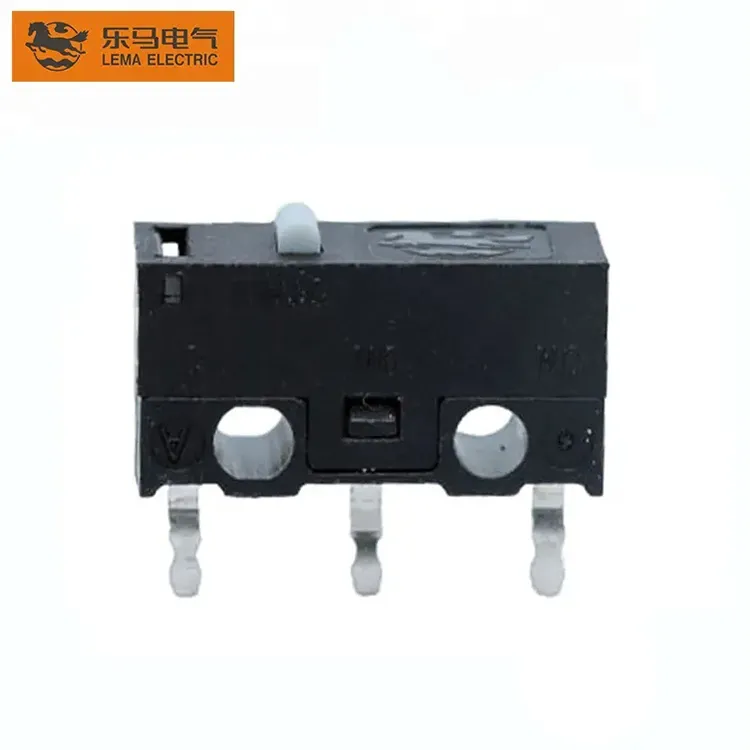
Compact signal-class families are the natural shortlist here. The KW10 series micro switch page is a public LEMA route for reviewing low-energy options against a signal plan.
Product recommendation: state the signal current and input type in the inquiry so minimum-load compliance is checked first. A power-class contact dropped into a milliamp circuit is the classic 24V mistake.
Send an OEM switch RFQ with the signal plan attached.
FAQs
Can any micro switch handle a 24V control circuit?
Not reliably. The contact must be suitable for low-energy switching, which the model’s minimum applicable load defines.
What is minimum applicable load?
It is the smallest voltage and current combination at which the maker expects stable contact behavior; circuits below it risk intermittent readings.
Why would a switch work at mains voltage but fail at 24V?
Mains arcing cleans contact films; a 24V milliamp signal cannot, so surface films accumulate and raise resistance.
Do controller inputs really create inrush?
Yes. Input filter capacitance charges at closure, producing a brief spike well above the steady signal current.
How long can the cable run be at 24V?
Long enough that voltage drop, capacitance, and noise stay inside the controller input’s thresholds; calculate against the specific cable and route.
What should a 24V switch RFQ include?
Include voltage, signal current, input type, cable route, switching rate, standby conditions, environment, volume, and sample timing.