
Micro switch terminal solderability after storage should be reviewed against the exact terminal variant, its storage history and an agreed wetting test, rather than the date code alone. Confirm that the termination is intended for soldering, preserve representative parts before cleaning, and compare results under one controlled method. A switch can still actuate normally while its external termination needs further solderability evaluation. Conversely, an old date code does not by itself prove that the lot is unusable. This guide explains how an equipment buyer can request useful evidence and make a documented disposition without inventing a universal shelf life or applying another supplier’s process limits.
Separate solderability from soldering heat resistance
Solderability asks whether a termination can be wetted under defined conditions. Heat resistance asks whether the component withstands the thermal exposure involved in a specified test or assembly process. These questions interact during production, but they are not interchangeable. Increasing heat until a reluctant joint finally forms does not establish that the original terminal met the intended wetting requirement, and it may introduce another failure mechanism.
The public scope of IEC 60068-2-20 distinguishes solderability and resistance to soldering heat for devices with leads. Its existence does not establish that a particular KW7 variant has passed either test. Request the applicable specification and report for your ordered construction. Keep the detailed micro switch soldering precautions as a separate assembly review, especially when rework is being considered.
Identify the terminal before choosing a test
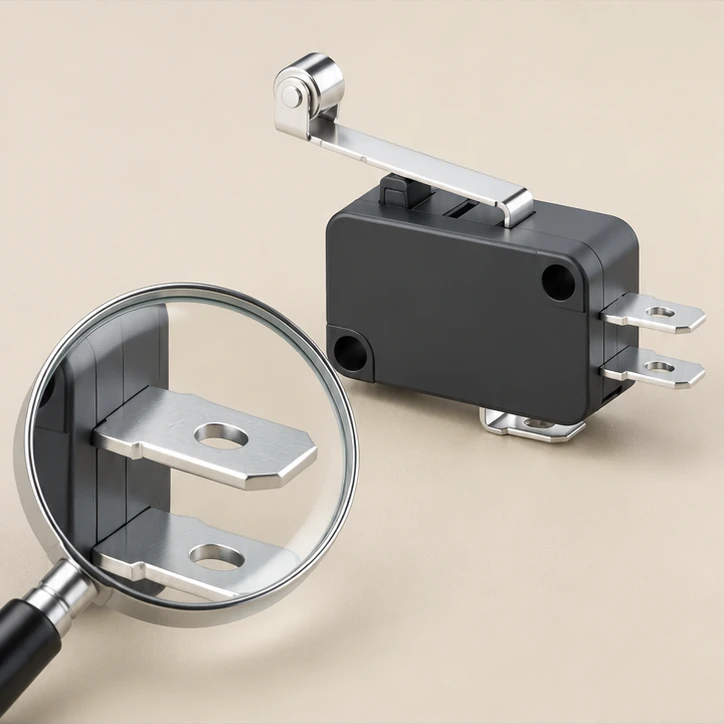
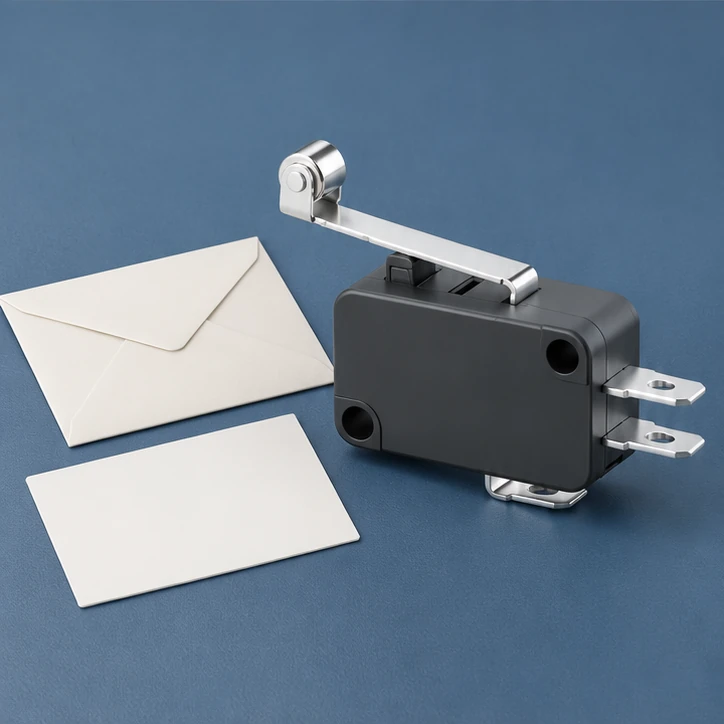
The KW7 Series Micro Switch family offers different configurations. A family photograph is useful for identifying a product category, but it does not establish terminal finish, solderability treatment, permitted immersion depth or an assembly profile. Send the supplier the order code, drawing revision and clear photographs of the actual termination. Ask explicitly whether it is intended for direct soldering, a printed board connection or a mating connector.
The distinction matters when a purchasing team receives similar-looking parts from different orders. A test coupon or report is relevant only if its construction represents the lot under review. Start with the micro switch terminal types guide to separate connection interfaces. Do not assume that a hole in a metal tab automatically makes every finish and variant suitable for the same soldering process.
Reconstruct the storage history without guessing the cause
Collect the manufacture or lot identification, receipt date, packaging condition, opening history and any recorded environmental excursion. Note whether the affected parts came from an unopened package, a partial reel, a loose bin or a returned production tray. Record where the suspect units were located and whether handling, nearby processes or repackaging differed from the accepted stock. Keep unknown items marked unknown rather than completing the history from memory.
This record helps define comparisons; it does not diagnose a surface film. Two lots with different ages may also differ in finish, handling and production history. Likewise, similar appearance is not proof of identical surface chemistry. Use the switch storage and lot-release guide for broader inventory controls, while keeping this investigation focused on the wetting evidence needed before assembly.
Preserve samples before cleaning or re-tinning
Separate the suspect material from production stock and label the retained specimens so that each can be traced to its package and location. Photograph the received condition before performing any intervention. Record who selected the samples and whether their terminals were touched, wiped, heated or otherwise altered. Include a comparison group where available, but describe its history rather than simply calling it a good sample.
Cleaning, abrasion and re-tinning can change the characteristic being investigated. They may form part of an approved corrective process, but results after treatment answer a different question from the condition as received. Ask the supplier or laboratory how specimens should be packed and handled before dispatch. Do not scrape a terminal to make it look cleaner and then submit it as untouched evidence of the original lot.
Agree the evaluation record before testing
The following checklist is a proposed purchasing review structure, not a replacement for a standard or a prescribed KW7 test method. Each item should be completed using the exact component specification and the laboratory’s agreed procedure. Numerical temperatures, times, acceptance areas and sample quantities must come from that agreed basis; this guide supplies none.
| Review item | Request or record | Decision boundary |
|---|---|---|
| Variant | Order code, drawing and terminal purpose | A similar tab does not establish soldering suitability |
| History | Lot, package opening and exposure records | Age alone is not a release or rejection rule |
| Specimens | Identity, selection and untreated condition | Cleaned specimens answer a different question |
| Method | Applicable procedure, preparation and inspection | Do not transfer another supplier test limits |
| Comparison | Controlled setup and group histories | A different lot may differ in more than age |
| Disposition | Scope, approval owner and restrictions | One trial does not release unrepresented stock |
A report that says only “solderability passed” leaves several important questions unanswered. Ask which specimen surfaces were evaluated, how the samples were conditioned, which method was used and how the observed result was compared with the requirement. If the report contains an image, establish whether it is one illustrative specimen or the complete inspection record. Keep the test setup and acceptance statement together so that later reviewers can understand the decision.
Compare results under a controlled method
A useful comparison keeps the chosen test conditions consistent across the suspect and comparison groups. If the operator, solder, flux, preparation or inspection method changes at the same time as the lot, the result becomes harder to interpret. Agree which variables are held constant and document any necessary deviations. A laboratory can help select an appropriate method and explain what its result can support.
The NPTEL lecture notes on joining and wetting provide background on contact between molten filler and a surface. They are educational context, not a production recipe for this switch. In practical review, distinguish the observation from its explanation: uneven coverage may be recorded directly, while attribution to oxidation, contamination or another cause may need additional investigation.
Read the result within its limits
Check that the tested lot, specimen identification and method revision match the question raised by production. Review individual outcomes where the report provides them, including exceptions and excluded specimens. A result applies to the evaluated material and conditions; it does not automatically release every remaining package, prove long-term electrical reliability or validate a different assembly line. Define the scope of the intended release before asking whether the report is sufficient.
Appearance also needs careful handling. A discolored terminal can trigger investigation, but color alone should not become a substitute for the agreed acceptance method. An apparently bright surface is not a universal assurance either. Where a failure mechanism must be established, request suitable analysis and explain the original symptom, rather than asking a laboratory to confirm a cause that the purchasing team has already assumed.
Make a lot disposition that production can follow
Possible outcomes include release under the agreed requirement, further evaluation, a supplier-approved recovery process or rejection of the affected material. The responsible quality and engineering teams should choose the disposition using the evidence and application requirements. Mark the exact scope: package numbers, lot identifiers, quantities and any restrictions. Keep replacement material distinct from material undergoing review so that an urgent shipment does not silently close the original investigation.
If recovery is approved, document its process, verification and effect on traceability. A successful trial on a few treated parts does not establish that uncontrolled hand rework is acceptable for the entire stock. Agree whether treated components require further functional checks and how their identity will be retained. This avoids mixing original, tested and recovered specimens into a single unlabeled container.
Use a short supplier request with a clear decision question
A focused inquiry can state: “We need to decide whether the identified stored lot is suitable for the intended soldered assembly. Please confirm the terminal construction and permitted evaluation method, review the attached history, and propose evidence and a disposition.” Attach the drawing, lot record, received-condition photographs and a description of the assembly symptom. Ask for missing information explicitly, including any restriction on cleaning, preparation or further heat exposure.
Keep procurement and engineering responsibilities clear. Purchasing can obtain traceable records and manage stock status; engineering defines the intended connection and process; quality assesses whether evidence meets the release requirement. The supplier confirms the component-specific information within its scope. Naming the owner of each unanswered question is more useful than circulating a vague request for a certificate and assuming any returned document closes the issue.
Learn the wetting concepts behind the review
The following university lecture explains solders, wetting and flux as background for understanding terminology in an evaluation report. It does not establish the finish of the ordered KW7 terminal or authorize a soldering profile. Use it to frame questions about the report, then return to the agreed specification and the supplier’s instructions for production decisions.
nptelhrd: Mod-07 Lec-34 Solders; Wetting of solders; Flux and its properties; Defects in wave soldering
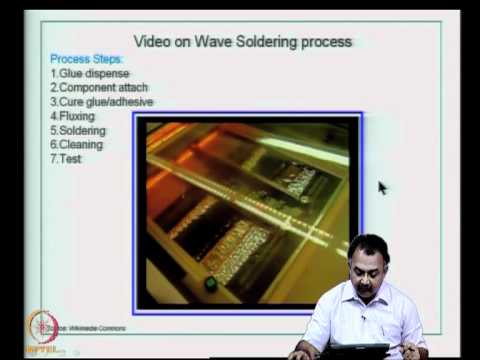
Watch Mod-07 Lec-34 Solders; Wetting of solders; Flux and its properties; Defects in wave soldering.
Frequently asked questions
Does an old date code prove poor solderability?
No. Review the exact termination, history and agreed evaluation; no universal shelf life is established here.
Can I clean samples before sending them for analysis?
Agree handling first and preserve received-condition specimens; cleaning can change the evidence.
Does a solderability pass validate the assembly heat profile?
No. Wetting performance and resistance to soldering heat are different questions.
Is the KW7 terminal finish established by the product image?
No. Confirm the ordered variant and terminal construction with the supplier.