
Micro switch humidity and condensation are different exposure questions. Relative humidity describes the air at a particular temperature; condensation depends on whether a surface reaches conditions where water can form. An ingress rating alone does not establish that an installed mechanism will remain free of internal or external condensation. Review temperature transitions and the complete installation.
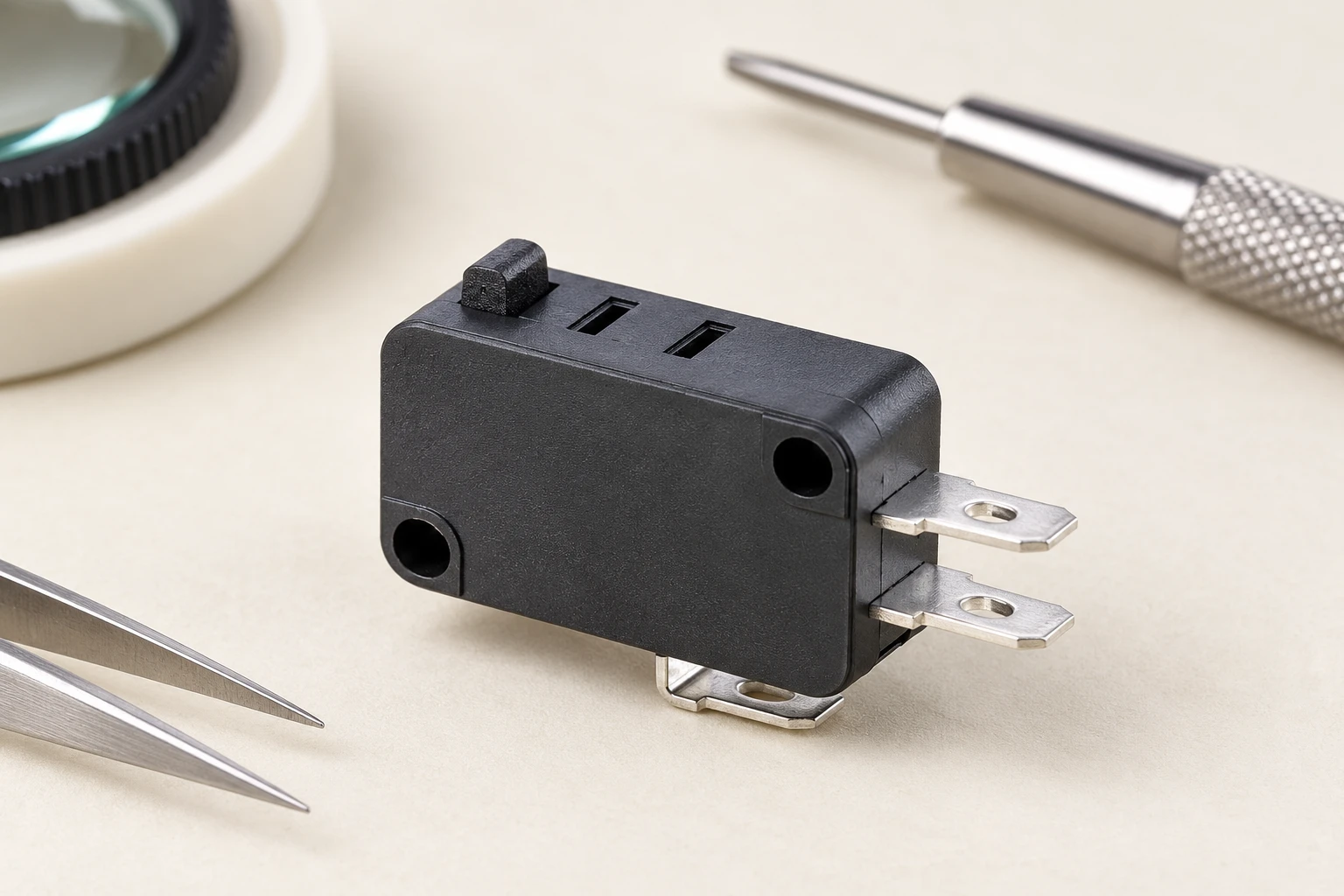
The KW7 Series Micro Switch is the LEMA product reference illustrated here. Its photograph identifies the external product, not an unlisted rating, accessory compatibility or test result. Obtain the current specification for the full order code before approving an assembly.
Relative Humidity Versus Dew Point
Relative humidity describes how close air is to saturation at its current temperature. It changes when air warms or cools, even if the amount of water vapor remains unchanged. This makes a humidity reading useful but incomplete. Air sampled near a warm controller may appear relatively dry while a nearby metal bracket, door panel, or switch terminal is cold enough to collect moisture.
Dew point is the temperature at which the sampled air becomes saturated. Condensation becomes possible when a surface reaches or falls below the dew point of the air contacting it. The important comparison is therefore between local dew point and local surface temperature, not simply between a cabinet humidity reading and a general environmental specification. Temperature differences inside an assembly can matter more than the average cabinet condition.
For troubleshooting, record air temperature and humidity near the switch while also observing the temperature of representative surfaces. Pay particular attention to parts connected thermally to the outside environment. A mounting screw, shaft, or metal support can create a cold location that a centrally placed sensor misses. Measurement uncertainty, sensor response, and placement should be considered before concluding that condensation was impossible.
Cold Starts and Environmental Transitions
A cold start can expose a switch to moisture before normal operation establishes a warmer internal environment. Equipment stored in a cool warehouse may be moved into warm, humid production air. Its exterior warms unevenly, while internal metalwork remains cold. Opening the enclosure introduces fresh vapor directly to those surfaces. Starting the machine immediately can then place electrical stress on terminals or contacts while surface moisture is present.
Shutdown can be equally important. Heat generated during operation may keep local surfaces above the dew point. After power removal, the assembly cools, pressure changes encourage air exchange, and previously warm surfaces can become condensation sites. A product that performs well during continuous operation may therefore behave differently during intermittent service, overnight shutdown, seasonal storage, or transport between climates.
Design reviews should describe these transitions explicitly rather than labeling the environment simply “indoor” or “humid.” Consider whether the cabinet is opened while cold, whether cleaning precedes startup, and whether a door-mounted switch cools faster than internal controls. If warmup or moisture-control measures are required, define how operation is managed when those measures are unavailable, interrupted, or not yet effective.
Surface Films and Switching Reliability
Condensation does not need to form visible droplets to affect electrical behavior. Thin moisture films can interact with residues left by handling, manufacturing, cleaning, or airborne contamination. Dissolved material can make these films conductive or chemically active. The resulting symptoms may include leakage paths, corrosion, unstable contact resistance, or intermittent signals. Appearance alone is therefore an unreliable basis for judging whether a switch area is dry and clean.
Contact behavior also depends on the electrical application. A circuit carrying a small sensing signal may respond differently to contamination than a circuit with a more substantial switching duty. Contact material, contact action, circuit characteristics, and the manufacturer’s application guidance should be considered together. Changing to a different contact arrangement without examining the moisture source can leave the underlying problem unresolved.
Moisture outside the switch can be just as consequential as moisture near its internal mechanism. Water films across terminals, connectors, circuit boards, or wiring insulation can produce symptoms that resemble contact failure. During diagnosis, separate internal switching performance from external leakage and connection problems. Otherwise, replacing the switch may temporarily disturb or dry the affected area without correcting the actual failure path.
IP Protection Is Not Condensation Control
An IP classification describes protection against specified external ingress under defined test conditions. It should not be interpreted as a guarantee against internal condensation. Water vapor may be present from assembly, service access, material moisture, or air exchange through the complete enclosure system. If that vapor encounters a sufficiently cold surface, liquid water may form even when no external liquid has crossed the switch housing.
Sealing can help control particular ingress paths, but its suitability must be evaluated alongside temperature cycling, pressure changes, interfaces, and installation quality. Actuator openings, terminal exits, cable entries, and adjacent components deserve separate attention. A switch’s protection classification also does not automatically apply to the cabinet, connector, or installed assembly. Each boundary has its own construction and environmental exposure.
OEM documentation should distinguish between resistance to external water exposure and management of internal moisture. Avoid language implying that a sealed switch prevents condensation. Instead, describe the verified protection features, mounting requirements, permitted environmental conditions, and any system measures needed to manage humidity. This distinction supports better purchasing decisions and prevents service teams from overlooking condensation merely because a protected component was specified.
Cabinet Design for Moisture Management
Cabinet design should begin with moisture sources and thermal paths. Examine process vapor, wet cleaning, outdoor air, damp incoming cables, and moisture introduced during assembly. Then identify cold walls, exposed fasteners, and structural members connected to cooler surroundings. Locate the switch and its terminals away from likely drip paths and cold collection surfaces wherever practical. A protected position is usually more dependable than relying on component protection alone.
Route cables so that water is not guided directly toward terminals or actuator interfaces. Consider drip paths, cable entry orientation, connector placement, and the behavior of water when a door opens. Shields may redirect falling droplets, but poorly arranged shields can also trap moisture or obstruct drying. Evaluate the installed geometry rather than assuming that an added cover always improves environmental performance.
Heating, ventilation, drainage, and humidity-control components each address different mechanisms. Heating can help maintain surface temperature; ventilation can exchange air; drainage can remove collected liquid. None should be selected without considering the surrounding climate and operating cycle. Ventilation may introduce humid air, drainage may create another exposure path, and a heater may leave remote surfaces cold. Assess their combined effect under realistic conditions.
Pressure-equalizing features and moisture-absorbing materials also require application-specific review. Their effectiveness depends on placement, exposure, maintenance, and the moisture burden over service life. They are not substitutes for controlling direct water entry or resolving cold surfaces. Provide access for inspection and replacement where needed, and make maintenance responsibilities clear so that moisture management does not depend on an unrecognized consumable or hidden component.
Qualitative Review of Common Moisture Conditions
| Condition | Likely concern | Practical OEM response |
|---|---|---|
| Warm humid air reaches cold equipment | Condensation on slow-warming parts | Assess transition exposure and startup readiness |
| Cabinet cools after shutdown | Moisture formation during idle periods | Review cooling paths and standby moisture control |
| Residues remain near terminals | Conductive or corrosive surface films | Improve cleanliness and verify material compatibility |
| Protected switch sits below a drip path | Water exposure at installed interfaces | Change placement, routing, or shielding |
| Humidity sensor is near warm electronics | Local cold conditions remain undetected | Measure near vulnerable surfaces |
| Cabinet is opened during service | Humid air contacts cold internal parts | Include service access in environmental assessment |
Inspection and Failure Investigation
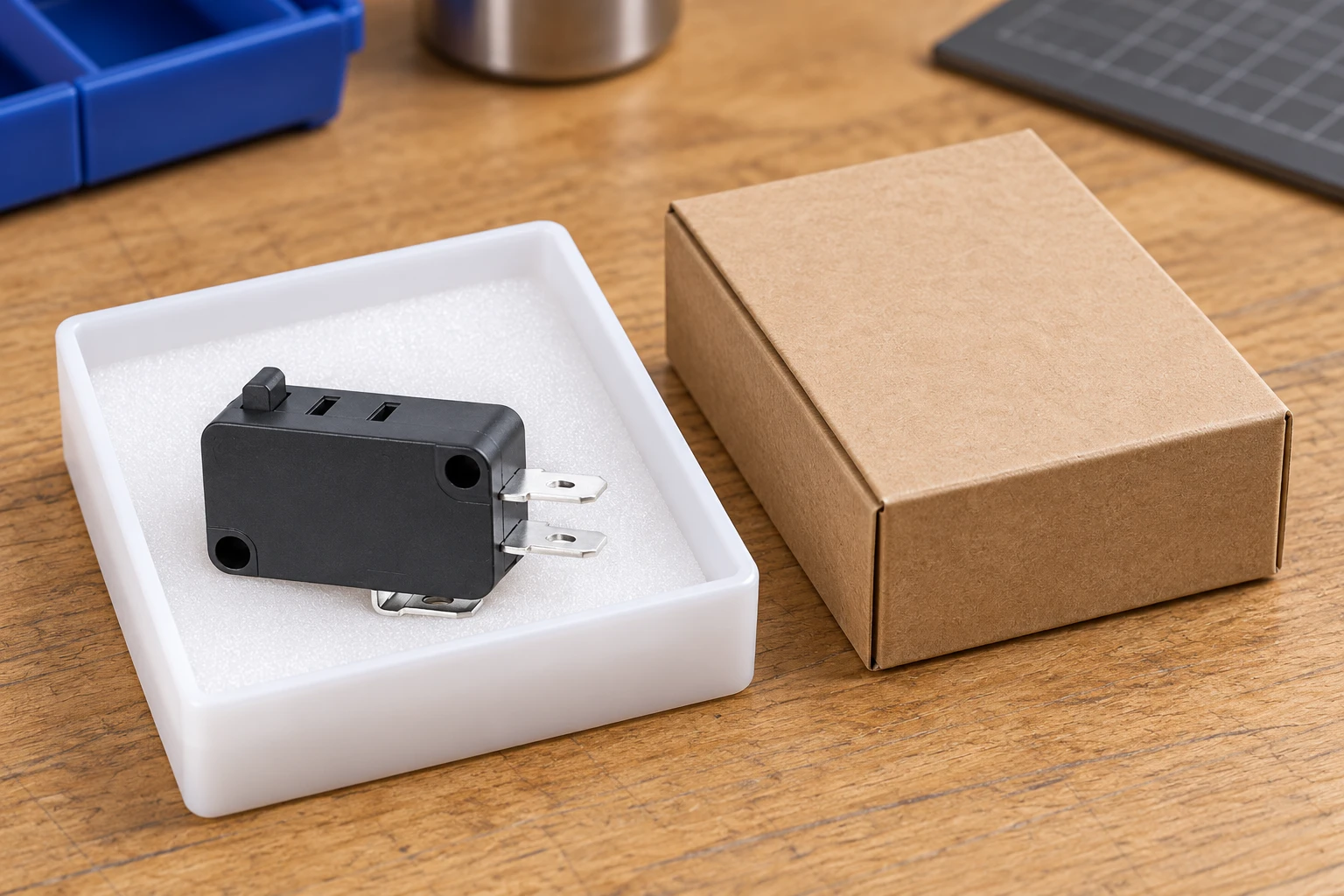
Inspect suspect equipment before unnecessary handling, cleaning, or prolonged operation changes the evidence. Photograph water marks, residue trails, corrosion, terminal discoloration, and the surrounding cable arrangement. Record whether the equipment was running, cooling, recently cleaned, or opened before the symptom appeared. A dry switch on the workbench does not establish that it was dry when the fault occurred.
Examine the complete switching circuit, including connectors, terminal insulation, nearby boards, and grounding arrangements. Use appropriate electrical isolation and safe inspection procedures. Where testing is justified, distinguish contact resistance changes from insulation leakage and mechanical actuation problems. Avoid introducing unapproved cleaners or lubricants, since these can alter materials, leave residues, and complicate interpretation of the original condition.
Validate transitions as well as steady conditions
Build an environmental assessment around the actual sequence: storage, movement into the work area, startup, running, shutdown and service access. Locate measurements near vulnerable surfaces and record both the switch state and the surrounding conditions. Define the observation and acceptance methods before exposure. An isolated continuity result after a sample dries cannot describe every contact or insulation effect during moisture exposure. Controlled electrical testing must follow the approved method.
Keep the failed configuration and exposure history when investigating intermittent behavior. Separate evidence of external wetting, surface contamination and actuator interference from assumptions about the internal contacts. If an environmental measure such as heating or ventilation is necessary, assess its availability and maintenance as part of the equipment. Obtain the exact component conditions from the supplier; do not convert a generic humidity entry into approval for condensation.
Technical references and the scope of this review
Met Office explanation of humidity: The Met Office distinguishes relative humidity and dew point. Surface temperature therefore matters when evaluating whether moisture can condense near a component.
HSE electrical testing guidance: Any electrical assessment after moisture exposure needs a controlled procedure and competent personnel. A dry-looking housing is not a complete safety assessment.
For the wider component decision, see Selecting an Industrial Micro Switch for OEM Panels. Complementary checks are covered in Micro Switch Failure Modes: Evidence and Root-Cause Checks and Micro Switch Insulation Resistance vs Dielectric Strength. These pages address separate questions and do not replace the acceptance evidence defined here.
Further learning
The Met Office explains humidity and its physical meaning. This supports the moisture discussion; it does not set a storage period or environmental approval for the illustrated switch.

Watch What is humidity? — Met Office – Learn About Weather
Frequently asked questions
Is high relative humidity the same as condensation?
No. Condensation also depends on the temperature of the surface relative to the surrounding air conditions.
Does an ingress rating prevent condensation?
It does not establish that the complete installed system is free of condensation.
Can a dry bench inspection exclude a moisture fault?
No. Preserve the history and evidence from the time and conditions of the symptom.
What environment should a validation represent?
Include the relevant steady conditions and transitions such as startup, shutdown, transport and service access.